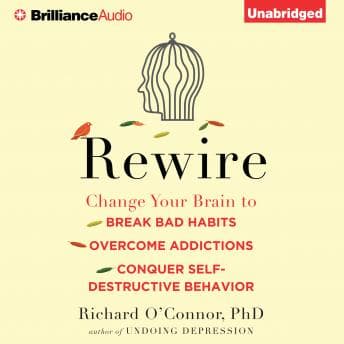

Why do we keep doing the thing we swore we'd stop doing — the doom-scrolling, the 2 AM snacking, the going back to the ex who texts "u up?" with zero punctuation and even less self-awareness? This is the question Richard O'Connor's Rewire tries to answer, and I spent ten hours jogging through Cambridge with it in my ears, trying to decide if it actually does.
Here's what I found.
Two Brains Walk Into a Therapy Session
O'Connor's central framework is the dual-brain model: the conscious, deliberative self (he calls it the "thoughtful" brain) versus the automatic self that runs most of our behavior without asking permission. If you've read Kahneman's Thinking, Fast and Slow, you'll recognize this territory — System 1 and System 2 wearing different clothes. And honestly? That comparison haunted me through the whole listen. O'Connor is a practicing psychotherapist, not a behavioral economist, so he brings a clinical warmth that Kahneman doesn't. But Kahneman brings the research receipts. O'Connor's references to studies felt, at times, frustratingly anecdotal — he'd mention a finding without giving you enough detail to actually evaluate it. As someone who reads methodology sections for fun (I know, I know), this drove me a little nuts.
But here's where O'Connor earns his keep: the specificity of the behaviors he covers. This isn't a book about one bad habit. He moves through procrastination, overeating, chronic disorganization, passive aggression, self-medication, excessive worrying — and for each, he maps out how the automatic brain hijacks the thoughtful brain's good intentions. The chapter on staying in bad situations hit particularly hard. The protagonist of our own lives exhibits classic approach-avoidance conflict, and O'Connor describes this with the kind of precision that tells me he's sat across from hundreds of people trapped in exactly this loop. The research actually shows that we develop neural pathways that make the familiar feel safe even when it's destroying us. O'Connor gets this on a gut level, not just an intellectual one.
What I found myself asking: why does O'Connor really organize the book this way — casting such a wide net across so many behaviors? It's ambitious. Maybe too ambitious. By trying to address everything from addiction to passive aggression in ten hours, some topics get surface treatment when they deserve deep dives. The section on self-medication, for instance, felt rushed compared to the more developed work on procrastination.
Fred Stella and the Consonant Problem
Let's talk about Fred Stella's narration, because it's genuinely polarizing and I understand both sides. His diction is immaculate. Clinical-grade clarity. Every word lands exactly where it should, which is what you want for a book packed with psychological concepts and brain science terminology. I never had to rewind because I missed something.
But — and this is a real but — the delivery is dry. Not "academic lecture" dry. More like "your very competent but emotionally unavailable professor reading from prepared notes" dry. There's a slightly overpronounced quality to his ending consonants that starts to feel almost percussive after a few hours. Words like "thought" and "conflict" get these crisp little stops that pull you out of the content and into awareness of the performance itself. Psychologically, this doesn't track with how we naturally absorb information over long periods — our brains want some variation in affect, some warmth in the delivery, especially when the material is about deeply personal struggles like addiction and self-destructive behavior.
I will say: at 1.25x speed, some of that stiffness smoothed out. The pacing felt more conversational, less like a reading and more like a person actually talking to you. Worth trying if the standard speed feels too measured.
Who This Is Really For (And Who Should Run)
If you're someone who's read a dozen self-help books and found them all too fluffy — too much "believe in yourself!" and not enough "here's why your brain is literally working against you" — O'Connor's approach will feel like relief. He respects the listener's intelligence. He doesn't promise miracles. He's honest that change is slow, neurologically difficult, and requires sustained effort. My therapist would have thoughts about this book, mostly approving ones. It's grounded in actual clinical practice, not Instagram wellness culture.
But if you want cutting-edge neuroscience with robust citations, or if a dry narrator is a dealbreaker for you, this might not be your listen. And if you've already read Kahneman or Charles Duhigg's The Power of Habit, you'll recognize significant conceptual overlap — O'Connor synthesizes rather than breaks new ground. Atul Gawande does something similar in Being Mortal — synthesizing what clinicians already know into something a general reader can actually use, and somehow making it land harder than the primary literature ever did.
This is a fascinating case study in a book that's smarter than its delivery system. The ideas deserve a narrator who can make you feel the weight of what it means to be at war with your own automatic self. Instead, you get precision without passion. Still — the content got under my skin during those morning runs. I caught myself noticing my own automatic responses for days afterward. That counts for something.
The Prescription
Worth your time if you approach it as a workbook for understanding your own worst patterns, not as entertainment. Borrow it, listen at 1.25x, and keep a notes app open. The insights are real, even if the audiobook experience is a B-minus at best.