
"The majority of millionaires never spent more than $41,000 on a car."
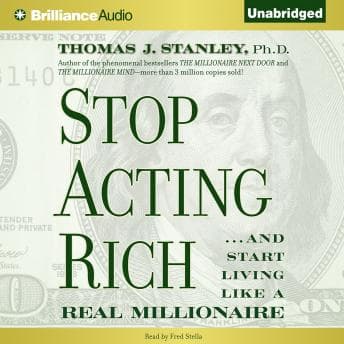
I was doing client invoicing at my kitchen table around 10 PM when that stat hit me through my AirPods, and I literally stopped typing. Not because it shocked me - I grew up watching my parents drive a 1994 Camry until the odometer quit - but because Stanley spent roughly 8 hours building an entire book around a principle my mom and dad understood without ever reading a single page of business literature.
This is what my parents did instinctively. Now it has a TED talk.
Your Neighbor's BMW Is Financing His Poverty
Bottom line: If you read The Millionaire Next Door, you've already absorbed about 70% of this book's core argument. Stanley's thesis hasn't evolved much - real millionaires are frugal, status-chasing is a wealth destroyer, and the guy in the $800 suit is probably broker than the plumber in Carhartt. The data points shift slightly - there's more focus here on vodka brands, wine consumption, and neighborhood choice as predictors of wealth accumulation (or destruction). The same tension between projected image and actual substance shows up in Walter Isaacson's Steve Jobs - Jobs being one of the rare cases where the reality actually exceeded the mythology, which made that book's 4.5-star data point feel earned rather than aspirational. Stanley goes deep on what he calls "Big Hat No Cattle" types, people living in $500K homes earning $80K, driving leased luxury vehicles, and drinking Grey Goose because their aspirational peer group does.
The vodka thing actually landed for me. Stanley's research shows that most millionaires drink cheap vodka or no vodka at all, while high-income-but-low-net-worth households are disproportionately loyal to premium brands. It's a weirdly specific data point, but it crystallizes his argument better than another paragraph about cars ever could. Your liquor cabinet is a balance sheet in miniature.
But here's the problem: chapter after chapter, he essentially restates the same thesis with different consumer categories. Cars. Houses. Watches. Suits. Wine. It's like sitting in a McKinsey presentation where someone has 47 slides that all support one recommendation. By hour five, I was thinking: I got it at hour two. Move on.
The Data Is Right. The Delivery Is Brutal.
I've seen this pattern wreck plenty of business books. Strong research, weak editorial discipline. Stanley clearly had mountains of survey data - the guy was a legitimate academic who spent decades studying affluent populations. But an 8-hour audiobook built on survey results needs a narrative backbone, and this one doesn't have it. There are no real stories here. No extended case studies of families who changed their behavior. No before-and-after arcs. Just data point, conclusion, repeat.
Fred Stella's narration is... fine. Workmanlike. He reads it like a news anchor covering economic policy - even-keeled, professional, but there's no energy shift when Stanley drops a genuinely surprising finding versus when he's padding with another table of statistics. At 2.0x speed the monotone actually helped me push through the repetitive sections, but I shouldn't have to rely on playback speed as an editorial tool.
My 2.0x speed couldn't save this one from feeling like it loops.
What My Parents' Dry Cleaning Shop Already Knew
Here's what gets me about this book, and it's personal. My parents never made more than maybe $90K combined in their best year. They owned their house outright by their late 50s. They never leased a car. My dad wore the same three suits to church for a decade. They weren't following Stanley's framework - they were immigrants who understood that visible wealth and actual wealth have almost nothing to do with each other.
So when Stanley spends entire chapters proving with regression analysis what Korean dry cleaners in Koreatown already knew in 1989, I feel two things simultaneously: validated, and impatient. Validated because someone with a PhD finally put numbers behind the common sense my parents lived. Impatient because - and Jenny would say I'm being harsh, Jenny is right - this could've been a killer 3-hour audiobook instead of an 8-hour endurance test.
Skip to chapter 5. Thank me later. That's where Stanley gets into the neighborhood trap - how buying a house in a wealthy zip code forces lifestyle inflation that devours your ability to accumulate wealth. It's the most actionable section, and it's the one I'd actually recommend to any startup founder who just closed a Series A and is eyeing a place in Palo Alto.
Who Gets ROI and Who Doesn't
If you've never read The Millionaire Next Door, skip that and read this instead - the data's more current and the examples are more relatable. If you already absorbed the earlier book, you're going to feel like you're paying for the director's cut of a movie you already own. The key takeaway is worth the listen. The other 7 hours? Not so much.
Perfect background listen while doing expense reports or meal prepping. Not worth dedicated attention for all 8 hours. Grab the core chapters, internalize the principle that spending like the rich keeps you from becoming rich, and move on. My parents could've told you that for free.