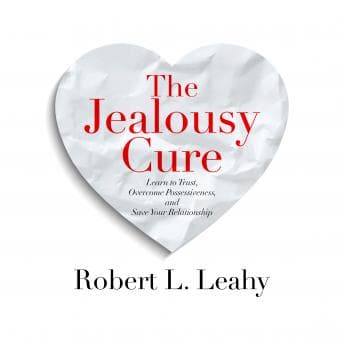

Robert Leahy gets it. He actually gets it.
I was chopping onions for a biryani that would take three hours and feed one person (me, obviously) when Leahy started explaining the evolutionary psychology of jealousy, and I had to put down my knife. Not because I was crying—though the onions weren't helping—but because here was a clinician who understood that jealousy isn't just neurotic noise. It's data. The protagonist of your own relationship exhibits classic attachment behaviors, and Leahy treats that with the respect it deserves.
When Your Therapist Writes a Book (And It's Actually Good)
Look, I've read approximately seven hundred self-help books for research purposes. Most of them make me want to throw things. The genre has this tendency to either pathologize every human emotion or wrap toxic positivity in a bow and call it healing. Leahy does neither. His argument—that jealousy signals investment, that it served evolutionary purposes, that it's not inherently shameful—is the kind of reframe that actually changes how you think.
The research shows that jealousy activates the same neural pathways as physical pain. Leahy knows this. He builds his interventions around it. The CBT and ACT techniques aren't just listed; they're scaffolded in a way that makes psychological sense. Brainstorm does something similar with adolescent neuroscience—taking complex brain development research and making it actually usable for parents and teens. He walks you through emotional schema theory (my academic heart did a little flutter) and then immediately grounds it in practical application. A fascinating case study in how to write accessible psychology without dumbing it down.
What makes this book compelling is that Leahy doesn't pretend jealousy can be "cured" like a disease. The title is slightly misleading, honestly. It's more like... jealousy management? Jealousy integration? This acceptance-based approach reminded me of Prince, where Machiavelli doesn't pretend power dynamics can be eliminated—just understood and navigated. He's asking you to make room for the feeling while not letting it drive the car. My therapist would have thoughts about this character—meaning me, the jealous person I've definitely never been.
Fred Stella: Competent Professor Energy
Stella reads this like a professor delivering a lecture you actually want to attend. Clear, measured, informative. He's not trying to be your friend or your guru. He's delivering content, and the content is good enough to carry itself.
That said—why does self-help narration always sound like this?—there's a certain... flatness. Not bad flatness. Functional flatness. The kind that works for focus listening but might lose you during a long drive. I listened over several cooking sessions and one very early morning jog through Cambridge (4 AM, couldn't sleep, brain wouldn't stop analyzing my own attachment patterns, thanks Robert). The pacing held up, but I wouldn't call it dynamic.
No audio issues. No weird production choices. Just clean, straightforward delivery of genuinely useful psychological content.
Where the Framework Gets Narrow
I have one significant complaint, and it's not about the audio. Some listeners have noted—and I noticed too—that Leahy's examples skew heavily toward heterosexual, monogamous relationships. The framework is solid enough to adapt, but the book doesn't do that work for you. If you're in a non-traditional relationship structure, you'll be doing mental translation throughout.
Also, seven hours is a lot of time to spend on jealousy. The book could be tighter. There's some repetition that feels like padding, and a few tangents that tested my patience. I found myself speeding up during certain sections—not because the content was bad, but because Leahy sometimes takes the scenic route when the highway is right there.
Who Should Listen (And Who Should Skip)
This is for people who want to understand their jealousy, not just suppress it. If you're looking for quick tips and affirmations, you'll be frustrated. If you want someone to validate that jealousy is always wrong and you should feel bad, wrong book. Leahy is interested in complexity, in the why behind the feeling.
Perfect for: anyone who's ever spiraled at 2 AM over a text that took too long to arrive, and wanted to understand what the hell their brain was doing. Skip if: you need representation beyond straight couples, or you're not in the headspace for genuine self-examination.
Case Closed (For Now)
I finished this book with a better understanding of jealousy as a psychological phenomenon—both clinically and personally. (Not that I have jealousy issues. I'm a researcher. I was taking notes.) Leahy writes like someone who has sat across from hundreds of jealous people and actually listened to them. That matters. That shows.
Is it perfect? No. Is it one of the better psychology-based self-help audiobooks I've encountered? Yes. The research is solid, the interventions are evidence-based, and the core message—that jealousy can be understood rather than just feared—is genuinely useful.
My biryani turned out great, by the way. Ate it alone. Preferred it that way.