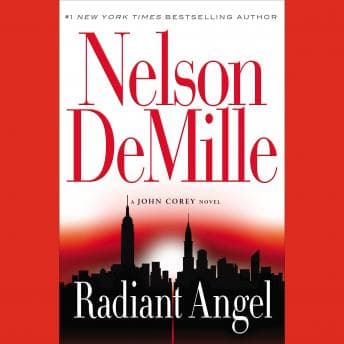

Is there anything more satisfying than a protagonist who says exactly what you're thinking - but would never say out loud at a faculty meeting?
John Corey is that guy. The wisecracking, authority-defying, perpetually sarcastic anti-terrorist agent who treats bureaucracy like a personal insult. And look, I teach high school English. I understand the appeal of a man who tells his supervisors exactly where they can file their protocols.
Scott Brick Gets It
Here's the thing about narrating a character like Corey - you can't play it straight. The whole appeal is the attitude, the timing, the way a one-liner lands. Scott Brick understands this. He's not just reading DeMille's words; he's channeling the specific brand of New York sarcasm that makes Corey work as a character.
The voice he gives Corey sounds like a guy who's seen too much, cares more than he lets on, and absolutely will not stop making wisecracks even when Manhattan might be in the crosshairs of a nuclear threat. It's a tightrope - too much snark and you lose the tension, too little and you lose the character. Brick nails it.
I was grading papers at 11 PM (the usual Thursday ritual) when the Russian subplot really kicked into gear. Suddenly I'm highlighting the same sentence three times because I'm too busy listening to Corey tail a Russian diplomat through Southampton. My students' essays on The Great Gatsby suffered. Worth it.
The Cold War Nostalgia Problem
Now, here's where I have to be honest with you. The premise is genuinely interesting - a resurgent Russia, diplomatic surveillance, the slow creep of a nuclear threat. DeMille wrote this before certain geopolitical events made it feel almost prescient. That's impressive.
But the execution? It's... fine. Just fine.
I've read enough DeMille to know what he's capable of, and Radiant Angel feels like he's working from a template. The beats are predictable. The twists aren't quite twisty enough. There's a certain paint-by-numbers quality to the plot that made me think of those Hemingway imitators who get the short sentences right but miss the iceberg underneath.
My students would say it's "mid." (They're teaching me their vocabulary. I'm teaching them Faulkner. We're both suffering.)
The saving grace - and I mean this sincerely - is that Brick's narration makes even the formulaic sections engaging. He's got this way of differentiating characters that keeps you locked in even when you know exactly where the scene is going. The Russian accents are convincing without being cartoonish. The secondary characters feel distinct. That same attention to vocal detail shows up in Camp of the Dog, where the narrator has to juggle an entire camping party's worth of distinct personalities. It's professional work from a narrator who clearly knows his craft.
Who This Works For (And Who Should Skip)
If you're a DeMille completist, if you've followed John Corey from Plum Island through The Panther, you're going to listen to this regardless of what I say. And you should. It's not his best work, but it's still Corey, still that voice, still that particular brand of thriller that pairs well with a long commute or a lakefront walk.
If you're new to the series? Start elsewhere. The Lion's Game is tighter. Plum Island has more surprises. This one feels like book seven in a series - comfortable, competent, but not essential.
The audiobook runs about ten and a half hours, which is perfect commute length if you've got a week of driving ahead of you. I listened at my usual 1.0x because - and my students roll their eyes at this - I believe the narrator chose those pauses for a reason. Brick's timing is part of the performance. Speed it up if you must, but you'll lose something.
Grading This One (Over Cold Coffee)
Here's what I keep coming back to: Radiant Angel is a perfectly serviceable thriller elevated by genuinely excellent narration. The plot won't surprise you. The geopolitics are interesting but not groundbreaking. The prose is workmanlike DeMille - which is still better than most thriller writers, don't get me wrong.
But Scott Brick? He turns a B-level plot into an A-level listening experience. That's not nothing. That's actually pretty rare.
Would I recommend it? For a long drive, absolutely. For your next beach vacation, sure. For a transformative literary experience that will change how you see the world? My students would say "bruh." They'd be right.
Sometimes you want Faulkner. Sometimes you want a wisecracking New Yorker chasing Russian spies through the Hamptons. Both have their place. I'm not too proud to admit that.