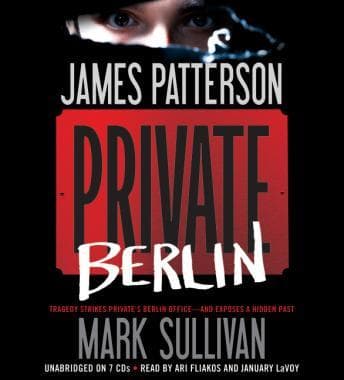

What does it say about a person when their most defining trait is the secret they've kept from everyone who loves them? That's the question I kept turning over during my Saturday morning jog along the Charles, earbuds in, watching crew teams slice through the water while Mattie Engel was metaphorically doing the same through Berlin's criminal underworld. I picked this up expecting a competent thriller. I got something more interesting than that — and also, occasionally, more frustrating.
When the City Is the Real Suspect
Private Berlin works best when it leans into the thing that actually makes it distinctive: Berlin itself as a psychological landscape. The city carries its history the way trauma survivors carry theirs — visible scars, buried ones, and a whole infrastructure built around pretending the past is resolved. Chris Schneider, the missing agent whose disappearance drives everything, is essentially a human Berlin. He's compartmentalized, historically fractured, and everyone who thought they knew him is discovering they had a partial map at best.
This is a fascinating case study in what psychologists call identity foreclosure — the way people adopt a fixed self-narrative to avoid processing something unbearable. Chris's secrets aren't just plot devices. They're the reason Mattie, his ex and the investigator searching for him, keeps hitting walls. She's not just chasing a missing person. She's excavating a self she was never allowed to see. The author — Patterson and Sullivan working together — understands that the most dangerous investigations are the ones where finding the truth means losing the person you thought you were looking for.
The three suspects Mattie works through — the cheating billionaire, the match-fixing footballer, the Russian mob-adjacent nightclub owner — are functional rather than psychologically rich. They're pressure points, not people. Which is fine, honestly. Not every thriller needs fully individuated antagonists. I ran into the same dynamic in Count to Ten: A Private Novel, where the Private franchise again asks one investigator to carry the psychological freight that the surrounding cast can't quite hold. But it does mean the emotional weight sits almost entirely on Mattie's shoulders, and she's carrying it.
The Narration Question (Where It Gets Complicated)
Ari Fliakos and January LaVoy split the load here, and the split is uneven in ways that matter. Fliakos handles the male-centered chapters with a taut, clipped quality that works for the thriller register — there's a controlled tension in his delivery that fits Berlin's post-Cold War emotional repression. When he's narrating scenes with genuine menace, you feel it.
LaVoy is where I have thoughts. She's a Golden Voice narrator, and I don't dispute the technical skill — she keeps the pacing tight and the plot moving, which for an 8-hour book with a lot of moving parts is genuinely hard. But some listeners found her character shifts less convincing, and I'd put a finer point on it: when LaVoy moves between Mattie's internal voice and the secondary characters Mattie encounters, the tonal jumps can feel like gear changes rather than organic transitions. It didn't pull me out of the story completely, but it did occasionally remind me I was listening to a performance rather than inhabiting one.
The Booktrack edition also adds a musical soundtrack, which — look, I'm a person who listens to binaural beats while reading academic papers, so I'm not opposed to audio layering. But I'd recommend the standard version. The music tells you how to feel at moments when the prose should be doing that work.
One structural note: the character roster expands fast in the early hours. Too many names, too quickly, without enough behavioral differentiation to anchor them. I found myself rewinding twice in the first two hours, which is not a great sign for a thriller that depends on momentum.
The Protagonist Exhibits Classic Motivated Reasoning (And I Mean That as a Compliment)
Here's what actually got me: Mattie's investigation is compromised from the start by her emotional investment in a particular version of Chris. She's not looking for the truth — she's looking for evidence that the truth is survivable. The research actually shows that grief and investigation make terrible bedfellows precisely because grief needs a fixed object and investigation requires you to follow evidence wherever it goes. Mattie is doing both simultaneously, and Patterson and Sullivan let that contradiction live in the text without resolving it too cleanly.
My therapist would have a field day with Mattie. In the best way.
Is this a perfect thriller? No. The pacing is uneven in the middle third, the secondary suspects are more plot architecture than character, and LaVoy's narration has genuine weak spots. But the central psychological engine — a woman investigating a man she loved and discovering she was investigating a fiction — is worth the eight hours.
If you want something you can half-listen to while folding laundry, this isn't it. If you want a thriller that uses Berlin's particular historical weight to say something real about the stories we tell ourselves to survive — and you're willing to pay attention — Private Berlin earns it.