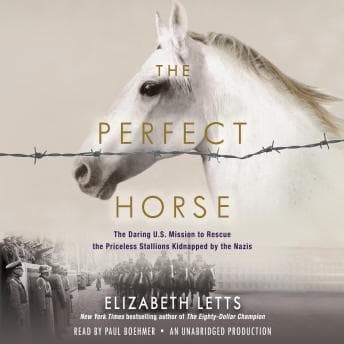

"The horses, the beautiful horses."
I heard this phrase so many times during this 12-hour listen that it became a running joke in my head. Around hour 6, stuck in LAX waiting for a delayed flight to Chicago, I started counting. Lost track after twelve repetitions. But here's the thing—despite the repetitive phrasing, I couldn't stop listening.
Quick Verdict: This is a genuinely remarkable WWII story that most people have never heard, wrapped in about 4 hours of padding. The core narrative—American cavalrymen racing to save Europe's finest horses from becoming Russian army rations—is legitimately thrilling. The execution? Let's just say my 2.0x speed got a workout.
The Pitch Meeting That Wrote Itself
Imagine walking into a studio and saying: "Nazi eugenics program, but for horses. Olympic athletes turned wartime diplomats. A senator's son on a midnight ride through enemy territory on a white stallion. General Patton gives the green light. Russians closing in. Go."
That's not fiction. That actually happened in April 1945, and Elizabeth Letts spent years tracking down the descendants and documents to prove it. The research here is impeccable—this won the PEN Award for Research Nonfiction, and you can feel the receipts on every page. Permanent Record had that same exhaustive documentation—Snowden's meticulous detail work made the story credible, even when it slowed the pace.
The problem is that Letts wants you to appreciate every single receipt. We get extensive background on Gustav Rau's breeding philosophy (interesting for about 20 minutes, present for about 90). We get detailed family histories of horses. We get the organizational structure of the Spanish Riding School. My parents ran a dry cleaning business on 12-hour days—they would have appreciated this level of thoroughness in their bookkeeping. In a narrative? It's a lot.
Paul Boehmer Earns His Keep
Here's where the audiobook format actually adds value. Boehmer handles Eastern European names and places with genuine facility—Hostau, Podhajsky, Czechoslovakia—all pronounced with confidence that suggests actual preparation. His narration is melodic, deliberate, almost documentary-style. When the action finally kicks in during the second half, his dramatic intonations sell the stakes without going full Hollywood.
Is it perfect? No. The deliberate pacing that works during tense rescue scenes becomes soporific during the breeding history chapters. I found myself drifting during a particularly detailed section on equine genetics—and I was standing in an airport, not lying in bed. That's a pacing problem the narrator can't fully solve.
The Real Story Buried in the Research
Skip to the second half. Thank me later.
That's where Colonel Hank Reed makes his decision to cross enemy lines. That's where Tom Stewart—actual senator's son, actual cavalryman—takes that moonlight ride on a white stallion to negotiate surrender. That's where you get the genuine tension of American soldiers, German turncoats, and starving Russian forces all converging on a farm full of irreplaceable horses.
This is the stuff that made me miss my boarding call. (Jenny would say I'm being dramatic. Jenny wasn't there.)
Letts does something clever here: she shows how the love of horses created strange alliances across enemy lines. Watership Down pulled off something similar—using animals to reveal human nature under pressure, finding unexpected solidarity in survival. German officers who'd spent the war serving Hitler suddenly found common cause with American cavalrymen. Austrian riding masters who'd fled Vienna with their entire stable trusted their animals to foreign soldiers. The horses themselves became a kind of neutral ground—living proof that some things transcended the war's brutality.
Who Gets Value Here (And Who Doesn't)
If you're a horse person, this is required listening. Full stop. The detail that annoyed me will probably fascinate you.
If you're a WWII buff looking for stories you haven't heard, the second half delivers. Just know you're paying for 13 hours to get about 6 hours of action.
If you're neither—maybe wait for the movie. The Christian Science Monitor wasn't wrong when they said the right director could make a Hollywood classic out of this. The source material is there. The pacing just needs an editor with a machete. Skip this one if you need tight, efficient storytelling; the ROI on your time isn't there.
The Dry Cleaning Test
My parents never had time for stories. They had a business to run, bills to pay, a family to feed. When I evaluate business books, I measure them against that reality—against people who couldn't afford to waste time on ideas that didn't work.
This isn't a business book, but the same test applies. Is the story worth your time? Yes. Is every hour of it worth your time? No. About 6 hours of genuine value in a 13-hour package.
But that rescue mission—those soldiers risking court-martial to save horses while the war was still technically happening—that's a story my parents would have understood. Doing something impractical because it mattered. Betting everything on a long shot. That's not just horse history. That's human history at its best.
Just maybe listen at 1.5x.