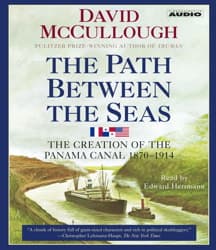

Look, I need to get something off my chest about this book: McCullough spends what feels like three solid hours on the French failure before the Americans even show up. Three hours. And you know what? Every single minute of it is earned.
I was up past midnight on a Tuesday - Linda already asleep, Ranger stretched across the hallway like a furry speed bump - listening to the section about Ferdinand de Lesseps and the catastrophic French attempt to dig a sea-level canal through the Isthmus. Couldn't stop. The man who built the Suez Canal, riding that reputation straight into a jungle that ate his workers alive. Yellow fever, malaria, landslides in the Culebra Cut - McCullough doesn't flinch from the body count, and as someone who's operated in places where the terrain itself is trying to kill you, I appreciated that honesty.
The Logistics Are the Story (And McCullough Gets That)
Here's what separates this from your average History Channel treatment: McCullough understands that the Panama Canal wasn't primarily a feat of engineering brilliance. It was a feat of logistics, medicine, and political maneuvering. The section on William Gorgas and his mosquito eradication campaign - that's where I sat up straighter. Gorgas basically had to convince the Army brass that mosquitoes, not "bad air," were killing his people. Sound familiar? Any veteran who's dealt with institutional resistance to common-sense solutions will feel that frustration in their bones.
The political chapters covering Teddy Roosevelt's maneuvering around Colombia - essentially backing Panama's revolution to secure canal rights - that's the kind of raw geopolitical chess that doesn't get taught honestly in most schools. McCullough lays it out without heavy editorial judgment. He gives you the facts, the cables, the backroom deals, and trusts you to form your own opinion. That same unsettling honesty about empire doing what empire does - without a narrator telling you how to feel about it - is something I wrestled with in Introduction to The Philosophy of History, though I'd argue McCullough handles the moral weight considerably better. I've seen this scenario play out in real life, and the parallels to modern interventionism are... uncomfortable.
The author clearly did their homework. This was originally published in 1977, and the depth of primary source research still holds up. McCullough quotes from personal letters, congressional testimony, engineering reports. You can feel the weight of the archives behind every claim.
Edward Herrmann Behind the Mic
Worth your time? Here's the debrief on the narration: Herrmann has that warm, authoritative baritone that works beautifully for this kind of sweeping historical narrative. He reads McCullough's prose the way it deserves to be read - with patience and respect for the material. His pacing suits the gravity of the subject.
But - and this is where it lost me occasionally - the character differentiation is thin. When you've got de Lesseps, Roosevelt, John Stevens, George Goethals, and dozens of other historical figures cycling through, they all sound pretty much like Edward Herrmann reading in a slightly different register. It's not a dealbreaker because McCullough's writing makes clear who's speaking, but don't expect distinct voices for the French engineers versus the American ones. Herrmann's attempts at French-accented passages are... polite. Let's leave it at that.
At 9 hours, this is actually an abridged version of the full text, which is worth noting. You're getting McCullough's narrative arc intact, but some of the granular engineering detail from the print edition is trimmed. For audio, honestly, that's probably the right call. The pacing stays tight enough that I never felt it drag, even through the dense political sections about the Hay-Bunau-Varilla Treaty negotiations.
I bumped it to 1.25x for the middle political chapters and dropped back to 1x for the construction sequences. Herrmann's delivery can run a touch deliberate during the diplomatic passages.
Who This Is For (And Who Should Skip It)
If you've ever driven through a military engineering project and thought "how the hell did they build this" - this book is for you. If you're interested in how American imperial power actually works at the operational level, not the bumper-sticker version, this is essential listening. Anyone in project management, construction, or public health will find their profession's DNA in this story.
Skip it if you want pure adventure narrative. This isn't a thriller dressed up as history. It's proper history that happens to contain extraordinary drama - 25,000 workers dead during the French effort alone. McCullough never sensationalizes those numbers, which somehow makes them hit harder.
Ranger slept through the political chapters but perked up during the dynamite descriptions. Make of that what you will.
Mission Debrief
Let me cut to the chase: this is McCullough at his best - massive scope, human-scale storytelling, and a genuine respect for the people who did the bleeding and dying. Herrmann's narration is solid if not spectacular. The abridged format keeps things moving without gutting the substance. It's the kind of book that makes you smarter about how the world actually works, which is about the highest compliment I can give.
Mission accomplished. Go listen to it.