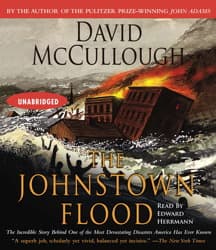

Most people hear "Johnstown Flood" and think they know the story. Dam broke, town got wiped out, tragic. I thought I knew it too - one of those American disaster footnotes you half-remember from a high school textbook. Turns out I didn't know a damn thing.
I started this one on a Monday morning drive to a client meeting in San Antonio, and by the time I pulled into their parking lot, I sat in the truck for another twenty minutes because McCullough was laying out the social dynamics of the South Fork Fishing and Hunting Club. Ranger was in the back seat giving me his "are we getting out or what" look. We were not getting out yet.
The Dam Was a Crime Scene Before It Broke
Here's what got under my skin. McCullough doesn't just tell you the dam failed - he walks you through every decision, every shortcut, every moment where someone with authority looked at a known hazard and shrugged. They lowered the dam's height to widen the road across it. They put fish screens over the spillway pipes that clogged with debris. The members of this club - Carnegie, Frick, Mellon, these titans of industry - treated the maintenance of an earthen dam holding back twenty million tons of water with the same seriousness I've seen corporate boards treat cybersecurity. Which is to say, not much seriousness at all until something catastrophic happens.
I've seen this scenario play out in real life. Different context, obviously, but the pattern is identical: warnings from people lower on the food chain get dismissed by people who have too much money and too little accountability. McCullough builds this case like a prosecutor. He's patient about it. That same methodical layering of context before the hammer drops reminded me of the narrative approach in Stormbird, though McCullough's payoff hits harder. He gives you the engineering details, the social hierarchy, the local politics. And you're sitting there knowing exactly what's coming, and it still hits you like a freight train when it arrives.
The flood sequence itself - and I'm not exaggerating - is some of the most harrowing nonfiction I've listened to. McCullough reconstructs it almost minute by minute. The wall of water carrying houses, locomotives, trees, and bodies. A temporary dam of debris forming at a stone bridge, then catching fire with people still trapped in it. He doesn't sensationalize. He doesn't need to. The facts are horrifying enough. There's a passage about the aftermath, people searching through mud for their families, that reminded me of things I'd rather not think about from my time overseas. Some realities are universal.
Herrmann Made This Sound Like Your Grandfather Telling a Story He Never Forgot
Edward Herrmann's narration is the kind you stop noticing because it's so right. No vocal gymnastics, no dramatic affectations. He reads McCullough's prose with a steady, authoritative clarity that feels like a seasoned journalist delivering a long-form report. During the slower sections - the geological history, the club membership rolls, the engineering specifics of earthen dam construction - his pacing keeps you engaged without rushing past important details. Then when the water hits, his delivery accelerates just enough to match the urgency without becoming breathless. It's controlled. Disciplined.
The man was an AudioFile Golden Voice narrator for a reason. I listened at my usual 1.25x and it held up perfectly - Herrmann's diction is clean enough that nothing gets lost at speed.
No sound effects, no musical score. Just one narrator and McCullough's words. Honestly, that's all it needs.
Where It Tests Your Patience (Briefly)
Look, there are stretches in the first few hours where McCullough is doing what McCullough does - building context with exhaustive detail about the region's industrial development, the history of the Western Division of the Pennsylvania Canal, the town's geography. If you're not a history person, these sections might feel like a briefing that runs long. But every piece of that context pays off when the disaster unfolds. You understand what was lost because he made you understand what was there. It's the literary equivalent of the pre-mission intelligence brief that seems tedious until you're on the ground and suddenly grateful for every detail.
The post-flood chapters covering the legal aftermath and the club members' near-total escape from accountability might actually be the angriest part of the book, though McCullough stays measured. He lets the facts generate the outrage. Smart move.
Who Needs This in Their Ears
Anyone interested in American history, disaster narrative, or the recurring pattern of wealthy negligence. If you liked Erik Larson's work or Isaak's Storm, this is essential listening. If bad things happening to good people because powerful people couldn't be bothered makes your blood boil - well, it should, and this book will make sure it does.
Skip it if you need constant action. This is a slow build with a devastating payoff. It demands your attention.
Mission Debrief
This was McCullough's first book, and it's remarkable how fully formed his approach already was. Ten hours well spent. The author clearly did their homework - decades before that became a cliché thing to say about popular historians, McCullough was actually doing it. Worth your time? Absolutely. Ranger slept through most of it, but he perked up during the flood chapters. Even he could tell something significant was happening.