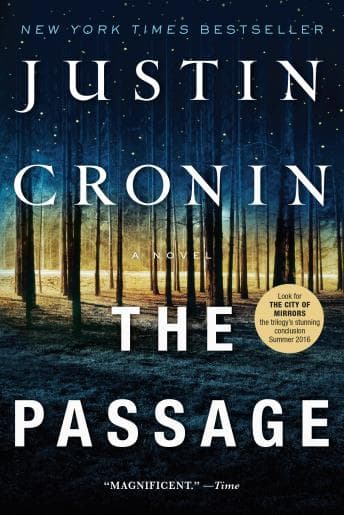

I was knee-deep in a 2AM production incident — load balancer config gone sideways, the whole nine yards — and after we rolled back, I was way too wired to sleep. So I did what any reasonable person does at 3AM: started a 15-hour post-apocalyptic vampire epic. By the time my alarm went off for the morning commute, I was already five hours in and genuinely unsure whether the dread I felt was from the book or from running on zero sleep. Probably both.
TL;DR: Worth your commute — but barely. This is basically The Stand meets The Road but with government-engineered vampires, and it demands more attention than your average 6AM zombie-shuffle listen. The payoff is there, but Cronin makes you work for it.
Two Books Duct-Taped Together (And I Mean That Mostly as a Compliment)
Here's the thing nobody tells you about The Passage: it's structurally weird. The first third is this intimate, devastating story about Agent Wolgast and Amy, a six-year-old girl the government wants to use as a test subject in a military experiment involving death-row inmates and a virus from the Bolivian jungle. Wolgast's assignment is to retrieve her. Instead, he basically adopts her. And Cronin writes this relationship with such quiet precision that I forgot I was listening to a sci-fi novel. It felt like literary fiction wearing a genre disguise.
Then — and I cannot stress how abrupt this is — the book jumps forward roughly 90 years into a post-apocalyptic colony setting. New characters. New world. New everything. It's like Cronin killed his darlings, burned the house down, and built a different house on the ashes. Some listeners apparently rage-quit here, and I get it. You spend hours falling for Wolgast and Amy's dynamic, and then suddenly you're learning the politics of a walled settlement called "the Colony" and memorizing a whole new cast. It took me a solid commute and a half to recalibrate.
But once I did? The Colony stuff is genuinely great. Peter Jaxon and the watchers on the Wall, the slow horror of their lights failing, the generation that's never known anything but survival — it's good world-building done the hard way, through accumulated detail rather than info dumps. The problem is that Cronin sometimes can't tell the difference between "atmospheric detail" and "tangent." There are stretches in the middle where I caught myself zoning out on the train, which at 1.5x speed is saying something. I bumped it to 1.75x for about two hours in the Colony's early chapters and didn't feel like I missed anything critical.
Edward Herrmann's Calm Authority in a Collapsing World
Edward Herrmann (and yes, I had to look up that it's that Edward Herrmann — the guy from Gilmore Girls and those FDR movies) narrates this with a gravity that's perfect for the first act and occasionally too steady for the second. His Wolgast is this weary, decent man and you hear it in every line. His Amy is restrained — he doesn't try to do a little-girl voice, which is the right call. Instead she comes across as eerily calm, which fits because, well, she's eerie.
Where he's less effective is the Colony ensemble. When you've got fifteen-plus characters in a survival settlement, vocal differentiation matters, and Herrmann leans on the same register for a lot of them. Peter, Alicia, Michael — they blend together in stretches, and I had to actively reconstruct who was talking from context clues. It's not bad narration. It's just not Ray Porter. (Sorry. I compare everyone to Ray Porter. It's a problem.)
That said, Herrmann's reading of the "night of the breach" sequence — when the virals finally get through the Colony's defenses — is legitimately terrifying at volume on a dark morning train. The woman next to me definitely noticed me flinch.
The Commute-Worthiness Problem
Here's my honest assessment as someone who uses audiobooks as commute fuel: The Passage is a focus listen. This is not background-while-coding material. The plot threads are numerous, the timeline jumps are disorienting if you're not tracking, and Cronin occasionally drops critical information into what feels like a throwaway paragraph about someone's backstory. I lost a plot thread once because BART was delayed and I got distracted arguing with Kevin over text about dinner, and I had to rewind ten minutes to figure out what happened with Lacey.
At 15 hours, this is a commitment — I finished it across about five commutes plus that insomniac night. The ROI on this audiobook is high if you're the type who loved The Stand and wished it had a tighter sci-fi premise. It's lower if you need consistent pacing.
Perfect for: road trip, dedicated weekend listen, insomnia. Skip for: gym, background, anything where you can't rewind.
Who Gets a Ticket and Who Stays on the Platform
If you like post-apocalyptic fiction with actual literary chops — not just "cool virus, things explode" — this is your book. If you loved Station Eleven's quieter apocalypse but wished it had more teeth (literally), The Passage delivers. If slow burns frustrate you, or if you need a single protagonist to anchor to for the full runtime, you might bounce hard off the structural pivot at the one-third mark.
I'm starting The Twelve on tomorrow's commute. So yeah. It got me. For contrast, I recently closed out Two for the Dough in exactly one round-trip with zero rewinds — sometimes your brain just needs something that doesn't ask so much of you.
Debug Report: Ship It With Known Issues
The Passage is a 4-star listen with 4.5-star ambitions and some 3-star pacing in the middle. Herrmann is solid if not spectacular. The story itself is genuinely epic in a way that word rarely earns. I just wish Cronin had a better editor — or at least someone willing to say "hey, do we really need another three pages about this character's childhood in Iowa?" But when this book hits, it hits. That opening line — "Thirty-two minutes for one world to die, another to be born" — isn't just marketing copy. It's a promise the book mostly keeps.