
Bottom Line: Worth your commute. All 36 hours of it. This is basically the MCU but for space opera - sprawling, interconnected, and you're gonna need a spreadsheet to track all the characters.
Star Wars Legends: Darth Plagueis has that same sprawling political intrigue vibe, though it's slightly less spreadsheet-intensive.
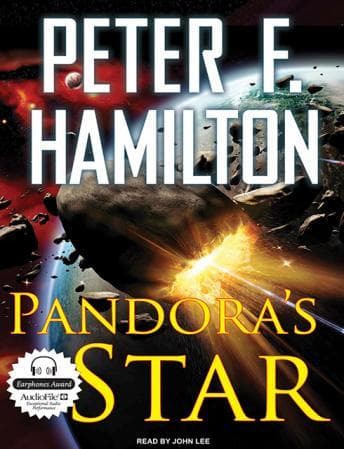
Okay so here's the thing about Pandora's Star: I started this during a particularly brutal on-call week, thinking "36 hours, that's like... two weeks of commutes, I can do this." Three months later, I finally finished it. Not because it's bad - it's genuinely excellent - but because Peter F. Hamilton writes like he's getting paid by the subplot. And honestly? I mean that as a compliment.
The Slow Burn That Actually Pays Off
Look, I'm not gonna lie to you. The first 10 hours of this book are a commitment. Hamilton doesn't do quick worldbuilding. He does the literary equivalent of a detailed architecture diagram for a distributed system with 47 microservices. You've got wormhole networks, rejuvenation technology, multiple planets, political factions, and approximately 400 characters whose names all blur together for the first few chapters.
But here's where it gets good - around hour 12, everything starts clicking into place like a perfectly optimized algorithm. The mystery of the disappearing star (yes, a whole star just... vanishes) becomes genuinely compelling. Wilson Kime, our centuries-old ex-NASA pilot, goes from "okay boomer" energy to someone I actually rooted for. And the Guardians of Selfhood cult? At first I thought they were the obvious crazy antagonists, but Hamilton plays with your expectations in ways that kept me guessing through multiple commutes.
The science actually holds up, mostly. The wormhole physics are internally consistent, the rejuvenation tech has interesting social implications that Hamilton actually explores (what happens to society when nobody dies?), and the alien threat - when it finally arrives - is genuinely terrifying in a way that doesn't rely on cheap horror tricks. That slow-burn dread reminded me of All the King's Men - different genre entirely, but both nail that creeping sense of inevitable catastrophe.
John Lee Runs an Ultramarathon
John Lee narrates this like he's running an ultramarathon, and somehow he maintains energy for the entire 36 hours. The guy does dozens of distinct character voices - British politicians, American astronauts, various alien-adjacent weirdos - and keeps them consistent across a book longer than some entire fantasy series.
That said, I gotta be honest about some issues. There are moments where the audio production gets... weird. Volume fluctuations that had me constantly adjusting my earbuds on the train. Some scene transitions are genuinely confusing - I'd suddenly be in a different POV character's head without any clear signal, and I'd have to rewind to figure out what happened. (Pro tip: don't listen to this at 6AM when you're half-asleep. I learned that the hard way.)
Lee's style can also feel a bit aloof in the slower sections. Some listeners might find it soporific - I definitely zoned out during a few of the political intrigue chapters. But when the action kicks in? He nails it. The tension in the Second Chance mission sequences had me missing my stop more than once.
Who's This For (And Who Should Skip)
This is not a book for the impatient. It's not a blog post masquerading as a novel. It's a genuine epic that rewards attention and punishes multitasking. I tried listening while debugging code once and completely lost the thread of a major subplot.
Listen if: You want complex worldbuilding that doesn't insult your intelligence, characters with actual arcs across hundreds of pages, and the kind of slow-burn mystery that makes you genuinely anxious to get back to your commute. Skip if: You need instant gratification, or if audio quality issues drive you crazy - maybe grab the print version instead. (And yes, there's a sequel. Judas Unchained is another 36 hours. I'm already planning my listening schedule.)
47 Commutes Later
I finished this in approximately 47 commutes, give or take a few sick days where I just lay on the couch and binged. No regrets. Hamilton writes like he's got centuries to tell his story, and honestly, in a world of rushed trilogies and stretched-thin series, that's kind of refreshing.
Would I listen again? Probably not soon - I've got a backlog that's giving me anxiety. But in a few years, when I've forgotten half the subplots? Yeah. I'll be back.