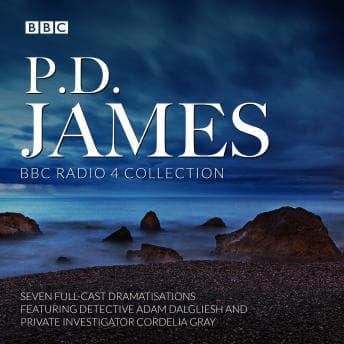
BBC Radio dramas are a completely different animal from standard audiobooks, and this collection reminded me why I fell in love with them in the first place.
I didn't listen to this one on my usual drive home. I picked it up during a stretch of night shifts last month where the unit was mercifully quiet between 2 and 4 AM - the kind of quiet where you're charting and double-checking labs and trying not to jinx anything by acknowledging the calm out loud. P.D. James at low volume through my earbuds, with the ambient hum of monitors in the background? Honestly kind of perfect. Her mysteries have this slow, deliberate intelligence that matches that liminal headspace where you're alert but the world feels muted.
Seven Dalglieshes Walk Into a BBC Studio
Here's what makes this collection weird in the best way: you get multiple actors playing Adam Dalgliesh across the seven dramas. Robin Ellis takes him on in Cover Her Face and Devices and Desires. Richard Derrington picks him up for A Taste for Death and The Private Patient. Philip Franks gets A Certain Justice. Three different men playing the same detective, and each one brings a slightly different temperature to the role. Ellis plays Dalgliesh with a kind of reserved warmth - you can hear the poet underneath the detective. Derrington is colder, more procedural, which works beautifully for A Taste for Death where two bodies in a London church demand that clinical distance. Franks splits the difference. It's actually fascinating to track how the same character shifts depending on who's wearing him.
Now, some people find Dalgliesh bland. I've seen the complaint - too literary, too many poetry references, not enough hard-boiled grit. And honestly? I get it. He's not your adrenaline-junkie detective. But as someone who spends her nights surrounded by people making life-and-death decisions while speaking in controlled, measured tones - yeah, I recognize Dalgliesh. Though I'll admit, sometimes after a brutal shift I want something with more velocity — Dark Horses scratched that itch recently, even if it's a very different world from a Norfolk murder scene. That quiet competence IS the personality. You just have to be tuned to that frequency.
The Cordelia Gray Dramas Hit Different
The two non-Dalgliesh entries - An Unsuitable Job for a Woman with Judi Bowker and The Skull Beneath the Skin with Greta Scacchi - are honestly the ones that stuck with me. Bowker's Cordelia is young and stubborn and a little in over her head investigating a supposed suicide, and you can hear that uncertainty in her voice without it ever tipping into weakness. Scacchi brings more worldliness to the second Cordelia story, which makes sense given the plot involves protecting a theatrical actress. The shift between the two Cordelias mirrors the Dalgliesh rotation - different actor, same character, new angle.
And can we talk about the supporting cast? Hugh Grant shows up. Siân Phillips shows up. Anna Massey, Geraldine James. This is BBC Radio 4 pulling out the heavy artillery. You can hear the difference between a dramatization staffed by working theater actors versus a standard audiobook with one narrator doing voices. Every character has their own actual voice because they are, in fact, their own actual person.
Full-Cast Production Is Not the Same as an Audiobook (And That Matters)
I need to be straight about this: if you're expecting a traditional audiobook experience - a narrator guiding you through prose, internal monologue, descriptive passages - this isn't that. These are radio plays. There's music. Sound effects. Doors opening, footsteps, rain on Norfolk coastline. The stories are condensed from full novels into dramatized scripts, which means you lose some of James's gorgeous descriptive writing but gain immediacy. It's a trade-off.
For me, the production quality justified that trade. The Devices and Desires Norfolk setting - a serial killer loose in that bleak, windswept landscape - works SO well as audio drama. You hear the isolation. The Private Patient set in a cosmetic surgery clinic gave me feelings, professionally speaking. (The medical details were... fine. It's a murder mystery, not a clinical rotation. I'll allow it.)
At 16 hours and 40 minutes across seven dramas plus a documentary, the pacing is surprisingly manageable. Each drama runs about two hours, so you can treat them as individual listens. The bonus documentary where P.D. James discusses her life is a quiet treasure - hearing her talk about working in the NHS and how that shaped her fiction? My mom would love this. (She still thinks I should've been a doctor, but she respects a woman who worked in British healthcare and became a baroness.)
Who This Is For and Who Should Keep Walking
If you love classic British mystery and you're open to radio drama format, this is a genuinely excellent collection. Night shift approved. If you need fast pacing and a detective who punches first and thinks later, Dalgliesh will bore you to tears and that's okay - he's not for everyone. If you've only ever done standard audiobooks and full-cast drama is new territory, this is actually a great entry point because BBC Radio 4 has been doing this longer than most of us have been alive.
Charting Complete, Signing Off
Carlos asked why I was so quiet driving home after one of those shifts. I told him I was just thinking about Norfolk and murder and poetry. He didn't ask follow-up questions. Smart man. This collection doesn't grab you by the throat - it sits down across from you with tea and a very sharp mind and waits for you to catch up. I caught up. I'm glad I did.