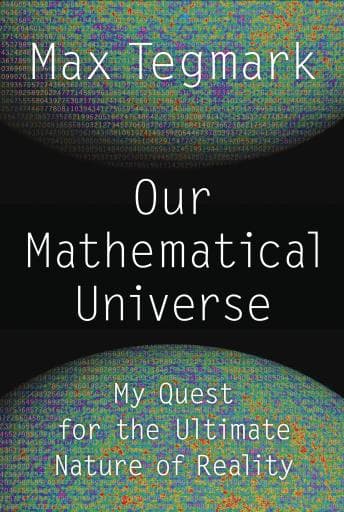

Look, I need to lodge a formal complaint. I am a psychologist. I study people. I study why humans lie, why they self-sabotage, why they convince themselves that their ex was "the one" despite overwhelming evidence to the contrary. I did not sign up to spend fifteen hours having an existential crisis about whether I — and all the humans I study — am basically just a math equation.
And yet. Here I am. Chopping onions for chana masala at 10 PM on a Tuesday, tears streaming down my face (the onions, but also arguably the implications of Level IV multiverse theory), genuinely questioning whether my entire field of study is just... a pattern in a mathematical structure. Tegmark, what have you done to me.
The Mind Behind the Madness
Max Tegmark is a fascinating case study in what happens when a physicist decides he's not going to play it safe. The book starts reasonably enough — cosmology, the history of our understanding of the universe, inflation theory. Standard pop-science fare, the kind of thing you'd expect from a Brian Greene or a Hawking. But then Tegmark does something that I genuinely respect as someone who studies human cognition: he tells you, essentially, "I know this next part is going to sound unhinged, and I'm going to walk you through exactly why I believe it anyway."
His Mathematical Universe Hypothesis — the idea that physical reality doesn't just use math but literally is a mathematical structure — is the kind of claim that makes you want to put the book down and also never put it down. I found myself asking: why does Tegmark really believe this? Is this conviction or compulsion? He's refreshingly honest about the professional risks, about colleagues who think he's lost the plot. There's a vulnerability in that which I wasn't expecting from a cosmology book. The protagonist exhibits classic traits of the obsessive truth-seeker — someone who'd rather be right and ridiculed than comfortable and wrong.
What makes Tegmark compelling as a narrator of his own intellectual journey is that he doesn't pretend the leaps are easy. He builds his four levels of multiverse like a staircase, and at each level he basically says, "I know, I know, but stay with me." That rhetorical self-awareness? That's someone who understands human resistance to ideas that threaten identity. The research actually shows that when people encounter information that challenges their worldview, the brain processes it like a physical threat. The physiological reality of that threat response — what it actually does to the body and mind under pressure — is something On Combat gets into with uncomfortable precision, though in a very different context. Tegmark seems to intuit this and works with it rather than against it.
Rob Shapiro and the 15-Hour Marathon Problem
Here's where things get complicated. Rob Shapiro's narration is... fine. Genuinely fine. His tone is conversational, his accent neutral enough that it doesn't distract, and he carries Tegmark's enthusiasm without tipping into that annoying SCIENCE IS AMAZING voice that plagues half the pop-science audiobooks out there. He's a solid B+.
But — and this is a real problem — at 15 hours and 23 minutes, this book demands more than B+ narration. There are stretches in the middle sections where Tegmark gets deep into mathematical formalism, and Shapiro's pacing doesn't adjust. He maintains the same conversational clip through equations and conceptual heavy-lifting that really needed slower, more deliberate delivery. I had to rewind multiple times during my morning jog through Cambridge, which is not ideal when you're also trying not to get hit by a cyclist on Mass Ave. The moments where the production layers in sound effects or musical cues are hit-or-miss — sometimes they punctuate a big idea nicely, sometimes they feel like someone's ringtone going off during a lecture.
The Neil deGrasse Tyson foreword is a nice touch, though it's brief. Sets the stage without overstaying.
When Physics Accidentally Becomes Psychology
Here's what got me. Really got me. Tegmark spends a chunk of the book discussing consciousness and what it means if we're mathematical structures experiencing ourselves. And suddenly I wasn't listening to a physics book anymore — I was listening to someone accidentally stumble into the deepest questions of narrative psychology. If every mathematically possible structure exists, then every possible version of "you" exists. Every choice you agonized over? Already made, every way, somewhere. My therapist would have thoughts about this. Many thoughts.
Psychologically, this either liberates you or destroys you, and Tegmark doesn't fully reckon with that. He's a physicist, not a psychologist, so I'll forgive him. But I wanted more. I wanted him to sit in the discomfort of what his theory means for human meaning-making, for the stories we tell ourselves about who we are and why our choices matter. He gestures at it. He doesn't live there.
Who Needs This in Their Ears (And Who Doesn't)
If you're the kind of person who reads "what if reality is literally made of math" and feels a dopamine hit rather than a headache — this is your book. If you liked A Brief History of Time but wished Hawking had been a little more personal, a little more willing to show the human behind the equations, Tegmark delivers that. If you need your science books under 8 hours or can't tolerate sections that require genuine concentration, skip the audio and get the print version. Some of the diagrams and visual concepts just don't translate to audio, and no amount of good narration can fix that.
The Diagnosis
Tegmark wrote a book that's half brilliant pop-science, half philosophical grenade, and I mean that as a compliment. It's not perfect — the pacing sags in the mathematical middle chapters, and Shapiro's narration, while competent, doesn't quite have the dynamism a 15-hour science epic deserves. But the ideas? The ideas kept me up past midnight, staring at my ceiling, wondering if somewhere in a Level IV multiverse there's a version of me who became a physicist instead of a psychologist. She's probably also lying awake. Thinking about narrative identity. We're all just math, apparently.









![Steve Jobs [unabridged audiobook] audiobook cover](/_next/image?url=https%3A%2F%2Fcovers.audiobooks.com%2Fimages%2Fcovers%2Ffull%2F9788499923406.jpg&w=1920&q=75)