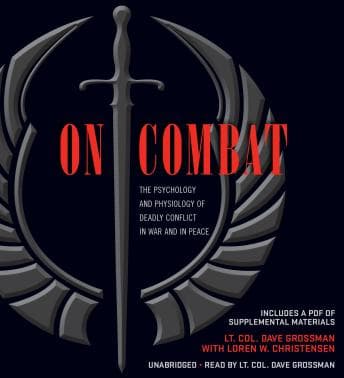

I was halfway through a batch of dal makhani—the kind that takes three hours and makes your entire apartment smell like your grandmother's kitchen—when Grossman started explaining what happens to human memory under extreme stress. And I just stood there, wooden spoon frozen mid-stir, thinking: this is the textbook I wish existed when I was struggling through my trauma cognition coursework.
Let me be clear about something. I came into this with skepticism. The "warrior" framing, the military bravado, the whole aesthetic of it—not exactly my academic lane. But the research here? The research actually shows what happens when your sympathetic nervous system hijacks your prefrontal cortex. Grossman breaks down the physiological cascade—heart rate spikes, auditory exclusion, tunnel vision—with the precision of someone who's both studied the literature AND watched it happen in real time.
When Your Body Becomes the Enemy
The protagonist here isn't a character. It's the human nervous system under siege. Grossman treats it like a case study in maladaptive survival responses. What makes this compelling is his explanation of why trained professionals—people who've drilled thousands of hours—suddenly can't remember pulling the trigger. It's not psychological weakness. It's neurochemistry. Your brain literally stops encoding memories the same way when cortisol floods the hippocampus. Soul of an Octopus explores similar questions about consciousness under stress—though admittedly with fewer gunfights and more tentacles.
I found myself asking: why does this matter for people who'll never see combat? Because trauma is trauma. The mechanisms he describes—the dissociation, the memory fragmentation, the hypervigilance that follows—these patterns show up in my research participants who've survived car accidents, assaults, medical emergencies. The context changes. The physiology doesn't.
The Breathing Technique That Actually Has Evidence Behind It
I'm usually the first person to roll my eyes at "just breathe" advice. My therapist would have thoughts about how dismissive I can be. But Grossman's tactical breathing protocol—the 4-count inhale, 4-count hold, 4-count exhale pattern—he actually explains WHY it works. It's not woo-woo. It's parasympathetic activation. Mindful Athlete applies this same physiological understanding to performance anxiety, which is basically combat without the bullets. You're manually triggering your vagus nerve to tell your amygdala to calm down.
He spends considerable time on stress inoculation training, and this is where my psychology brain got genuinely excited. The concept that you can build tolerance to extreme stress through controlled exposure—that's not just military doctrine. That's exposure therapy. That's what we do with phobia patients. Grossman is basically describing systematic desensitization for lethal force encounters, and he's doing it with enough scientific grounding that I wasn't constantly muttering "citation needed" at my kitchen ceiling.
When the Author IS the Authority
Here's the thing about author-narrated nonfiction. It can go very wrong. But Grossman has clearly spent decades giving these presentations to rooms full of skeptical cops and soldiers. His delivery has that lived-in quality—the pauses land where they should, the emphasis feels natural rather than performed. He's not reading his book. He's teaching it.
The 18-plus hours is a commitment. I won't pretend otherwise. This isn't background listening material. I tried that once while grading papers and realized I'd absorbed nothing for twenty minutes. This book demands your focused attention, and honestly? It earns it.
The Parts That Made Me Uncomfortable (In Productive Ways)
Psychologically, I had to sit with some tension here. Grossman's framework is explicitly about making people more effective at violence. As someone who studies why humans hurt each other, there's something unsettling about a manual for doing it better. But—and this is important—he's equally invested in the aftermath. The PTSD chapters aren't afterthoughts. They're central to his thesis: that understanding the psychology of killing means understanding the psychological cost.
The Judeo-Christian framing in the later chapters won't work for everyone. I'm Hindu-adjacent-agnostic at best, and some of the moral framework felt culturally specific in ways Grossman doesn't quite acknowledge. But his core point—that warriors need some ethical framework to process what they've done—that tracks with everything we know about moral injury.
Who Needs This (And Who Should Steer Clear)
Military and law enforcement, obviously. But also: trauma therapists who want to understand their clients' physiological experiences. Researchers in stress psychology. Anyone who's ever wondered why eyewitness testimony is so unreliable (hint: it's the cortisol). First responders. ER nurses. People who've survived violence and want to understand why their bodies reacted the way they did.
Skip this if you're looking for light listening—it isn't. If military culture makes you viscerally uncomfortable, Grossman won't convert you. And if you need trigger warnings for detailed discussions of violence and its aftermath, they're warranted here.
Case Closed, Notes Filed
I finished this audiobook while running through Cambridge at 6 AM, breath visible in the cold air, and I kept thinking about one of Grossman's central claims: that understanding the mechanism of trauma is itself therapeutic. That knowledge creates distance. That naming the beast gives you power over it.
My therapist would probably agree. I certainly do.