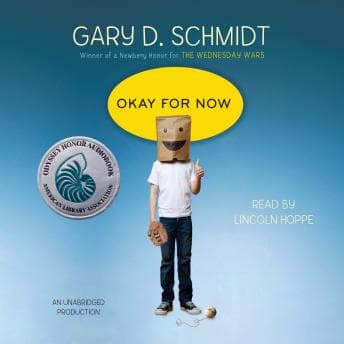

What happens when a kid who's been told he's worthless his whole life walks into a library and sees something beautiful for the first time?
That's the question at the heart of Okay for Now, and I wasn't ready for how hard it would hit me. I started this one at like 2 AM because I couldn't sleep — my thesis proposal draft was due the next morning and my brain was doing that thing where it refuses to shut off but also refuses to be productive. So I figured, okay, nine hours of middle-grade historical fiction, that'll knock me out. Reader, it did not knock me out. I was wide awake at 4 AM with genuinely wet eyes over a thirteen-year-old boy learning to draw birds.
Doug Swieteck Is the Character I Didn't Know I Needed
Doug is not your typical kid protagonist. He's angry, he's defensive, he's been beaten down — literally — by a father who hits and brothers who steal. Schmidt writes him with this incredible shell of toughness that cracks in these tiny, devastating moments. When Doug sees the Audubon plates at the Marysville library for the first time, there's this shift. He doesn't suddenly become an art lover. He doesn't have some big epiphany. He just... stops. And Lincoln Hoppe nails that moment — the narration goes quiet, almost reverent, and you can feel Doug encountering beauty for maybe the first time in his life without knowing what to do with it.
The 1968 setting isn't just window dressing either. Vietnam is pulling Doug's oldest brother Lucas apart. That same kind of historical immersion — where the era bleeds into the characters' bones rather than just decorating the backdrop — is something I ran into reading Family Romanov: Murder, Rebellion, and the Fall of Imperial Russia, which does the same heavy lifting through lived detail rather than exposition. Apollo missions are on TV. Joe Pepitone is playing for the Yankees and Doug clings to baseball stats like they're lifelines. Schmidt weaves all of this together so that the era feels lived-in, not like a history textbook cosplaying as a novel. My D&D group would call this "environmental storytelling" — the world does the heavy lifting.
Hoppe's Downstate New York Accent Carries This Whole Thing
Okay, so here's the thing about narrating a kid character: most narrators either go full squeaky teenager (awful) or just use their normal adult voice and hope you forget (lazy). Lincoln Hoppe does neither. He pitches Doug's voice with this matter-of-fact roughness — a downstate New York kid who's learned to keep his guard up — without ever slipping into caricature. No falsetto. No exaggerated "tough guy" affectation. Just a boy who sounds exactly like a boy who's been hit too many times and is trying very hard not to care about anything.
The character differentiation is subtle but effective. Lil Spicer gets this warmth and directness that makes you understand immediately why Doug gravitates toward her. Mrs. Windermere is all sharp edges and theatrical energy. Doug's father... man. Hoppe gives him this flat, cold delivery that made my stomach clench. You know that voice. If you grew up around someone like that, you recognize it instantly. It's not a villain voice. It's worse than that. It's just a guy who's empty inside and takes it out on his kids.
The pacing is steady — not fast, not dragging. This is a 9-hour listen that earns every minute. Schmidt's prose has this dark lyrical quality, almost poetic in places, and Hoppe reads it like he understands the rhythm. The moments of humor land (Doug's Saturday grocery deliveries are genuinely funny), and the gut-punches — Lucas coming home from Vietnam, Lil's cancer diagnosis — hit without warning because Hoppe doesn't telegraph them with dramatic vocal shifts. They just arrive, the way bad news actually arrives.
A Middle-Grade Book That Hit Me Harder Than Most Adult Fantasy
Look, I read — sorry, listen to — a lot of epic fantasy. Sanderson-level world-building, 40-hour doorstoppers, magic systems with their own Wikipedia pages. I love all of that. But sometimes a 9-hour book about a kid learning to draw Audubon's Arctic Tern will wreck you in ways that a thousand-page battle sequence can't. The progression is satisfying in a completely different way — it's not stats going up or power levels increasing. It's a kid slowly, painfully learning that he's worth something. That art can be his. That people can be kind.
I read this instead of writing my thesis. Dr. Patel, if you're reading this, I regret nothing.
Who Gets a Seat at This Table
If you want explosions and stat blocks, this isn't your book. (Come back to me for those recommendations.) But if you've ever been the weird kid who found something in a library that changed how you saw the world — and if you grew up playing D&D in the back of a public library because it was the only air-conditioned place that would have you — this one's going to find its way under your skin. Parents, teachers, anyone who works with kids: put this in their ears. Content warnings for abuse, war trauma, and childhood cancer, so be aware. But the hope in this book is earned, not manufactured, and that makes all the difference.
Hoppe's narration won an AudioFile Earphones Award and was an Audies finalist, and yeah, both of those are deserved. This is quiet excellence. No fireworks, no full-cast production. Just one narrator, one kid's voice, and a story that trusts you to feel it.