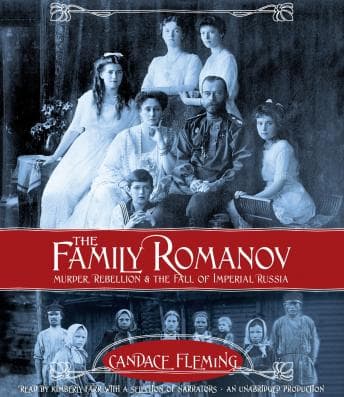

Look, I need to complain about something first. This audiobook made me feel things about the Romanovs, and I was NOT prepared. I'm supposed to be listening to fantasy epics and LitRPG progression systems, not getting emotionally wrecked by a family of doomed Russian aristocrats. But here I am, 3 AM, thesis document open in another tab (untouched, naturally), absolutely gutted by the story of a hemophiliac kid and his four sisters.
Candace Fleming, what have you done to me?
When History Hits Like a Nat 20 Critical
Here's the thing about The Family Romanov that caught me completely off guard: it's structured like a really good campaign. You've got your main party—the imperial family living in their gilded bubble—and then these "Beyond the Palace Gates" interludes that cut to the peasants, the revolutionaries, the people actually starving while the Tsar's kids are playing tennis on private courts.
The contrast is brutal. Fleming doesn't let you forget for a second that this family's tragedy is happening alongside—and because of—millions of other tragedies. It's the kind of world-building I usually only see in fantasy. Except it's real. Which makes it worse.
Kimberly Farr handles the main narration with this clear, almost clinical precision that somehow makes everything MORE emotional? Like she's presenting evidence in a trial where you already know the verdict. Then the Russian-accented narrators come in for those peasant sections, and suddenly you're hearing letters and diary entries from people who are just... done. Done with the aristocracy, done with the war, done with watching their children starve.
My D&D group would absolutely use this for historical campaign research. (We've been talking about a Russian Revolution-era game. This is homework now.)
Eight Narrators Walk Into a Recording Booth
Okay, I was skeptical about the full cast thing. Eight narrators for a YA nonfiction book? That's ambitious. That's the kind of thing that either works brilliantly or becomes a confusing mess of voices.
It works brilliantly.
The decision to use Russian-accented narrators specifically for the "Beyond the Palace Gates" segments creates this immediate, visceral class divide. You don't just read about the difference between the aristocracy and the peasants—you HEAR it. Stefan Rudnicki and the crew bring this weight to the primary source material that made me stop what I was doing and just... listen.
And Tsarevich Alexei's sections? The kid with hemophilia, the heir who could die from a bruise? Farr handles those with such care. Not melodramatic, not manipulative. Just honest. Which somehow made it worse when I remembered how this all ends.
(I knew how it ended going in. Everyone knows how it ended. Still hit different.)
The Sanderson Problem, But Make It History
Here's my one critique, and it's barely a critique: this book is DENSE. Nine and a half hours of Russian history, political intrigue, family drama, and revolutionary context. If you don't like info-dumps, this isn't for you. (But you're wrong.)
Fleming does this thing where she'll spend chapters building up the Romanov family's humanity—their inside jokes, their devotion to each other, Nicholas's genuine love for Alexandra—and then cut to a section about the Bloody Sunday massacre or the conditions in factory towns. It's whiplash, intentionally so.
The pacing reminded me of Sanderson-level world-building, honestly. Kitchen Confidential does something similar with the restaurant industry—building this complete picture of a world most people never see, piece by piece, until you understand exactly how the whole system works (or doesn't). You're getting all these pieces, all this context, and you can feel the avalanche coming. The revolution isn't just an event in this book—it's an inevitability you watch build, chapter by chapter, while a family plays with their dogs and worries about their sick son.
Who Should Roll Initiative (And Who Should Sit This One Out)
This is perfect for: history nerds, anyone who loved The Great Fire or Bomb, people who appreciate narrative nonfiction that doesn't talk down to you, and honestly? Anyone who wants to understand how empires fall. It's labeled YA but don't let that fool you—this is sophisticated stuff.
Skip if: you need fast-paced action, you're looking for light listening, or you're not in the mood to feel emotionally devastated by events from 1918.
Campaign Complete, Party Eliminated
I finished this at 4 AM. Thesis still untouched. No regrets.
The full cast narration elevates what's already a meticulously researched, beautifully structured piece of narrative nonfiction into something that feels almost cinematic. The Russian accents for the peasant voices, Farr's steady hand with the imperial family's slow-motion catastrophe, the way the book refuses to let you root for anyone without also showing you their blind spots—it's the kind of history that sticks.
Yes, it's nine hours. Yes, it's worth it.
Dr. Patel is going to ask about my thesis progress tomorrow. I'm going to tell her I learned a lot about the fall of imperial Russia instead. She'll be disappointed. I'll be thinking about Alexei and his sisters. Some trades are worth it.