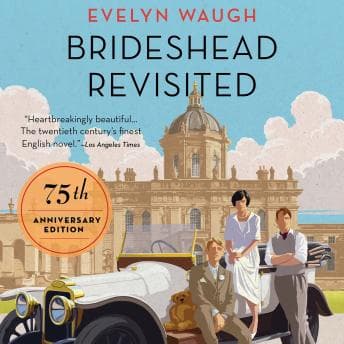

I was grading sophomore essays on The Great Gatsby - ironic, I know, given that novel's debt to Waugh - when Jeremy Irons started reading about Charles Ryder arriving at Brideshead for the first time. And I just... stopped. Red pen hovering mid-correction. Because Irons doesn't read this opening. He inhabits it.
Look, I've been teaching English literature for two decades. I've read Brideshead Revisited three times. Taught it twice. Thought I knew this book. But hearing it? That's something else entirely.
When the Narrator IS the Character
Here's the thing about Jeremy Irons narrating this particular novel: he played Charles Ryder in the 1981 BBC adaptation. The definitive adaptation. So when he reads Charles's lines, there's this strange, beautiful collapse of distance - he's not interpreting the character, he's returning to him. Decades older. Wiser. More melancholy.
And Waugh's prose demands that kind of treatment. This is a novel about memory, about looking backward at a world that's already dying even as you're living in it. Irons understands that every sentence carries weight. His pacing is measured - some listeners have called it slow, and honestly? They're not wrong. But they're missing the point. The prose deserves to be savored. You don't rush through Waugh the same way you don't rush through a cathedral.
His character differentiation is subtle rather than theatrical. Sebastian Flyte gets this slightly breathless, golden quality. Julia is cooler, more guarded. Lord Marchmain carries the weight of exile in every syllable. But Irons never does "voices" in that cartoonish audiobook way that makes me want to throw my phone into Lake Michigan. He trusts the writing.
The Catholicism Problem (And Why It Works Here)
My students would hate this book. I love it.
Not because I'm Catholic - I'm not - but because Waugh is doing something genuinely interesting with faith as a narrative force. The Flyte family's Catholicism isn't just background decoration. It's the gravitational center that pulls everyone into orbit and eventually tears them apart. Irons reads the religious passages with this fascinating ambivalence. You can hear Charles's skepticism. His frustration. His reluctant, grudging respect.
There's a scene late in the novel - I won't spoil it - involving Lord Marchmain's deathbed that had me sitting in my parked car in the school lot for an extra ten minutes. Denise texted asking where I was. I couldn't explain. How do you text your wife "sorry, having feelings about Catholic guilt and the English aristocracy"?
(Don't tell my students I cried in my Camry. They already think I'm soft because I teared up during our Steinbeck unit.)
The Slow Burn That Rewards Patience
At eleven and a half hours, this isn't a quick listen. The first hour or so - the Oxford sections, the endless champagne and strawberries, Sebastian's teddy bear Aloysius - can feel like Waugh is just showing off his pretty sentences. Which, fair. He is.
But if you stick with it, the payoff is extraordinary. The novel shifts from comedy of manners to something much darker, much sadder. Charles's entanglement with the Flytes becomes genuinely tragic. Irons modulates his performance accordingly - the golden nostalgia of the early sections gives way to something rawer, more painful.
I listened at 1.0x because I'm apparently ancient and believe the author chose those words for a reason. But I'll admit: during a particularly long faculty meeting about standardized testing (sorry, Principal Martinez), I was tempted to speed up. I didn't. Worth it.
Who Should Listen (And Who Should Skip)
If you loved The Remains of the Day - and you should, it's magnificent - this is its spiritual predecessor. That same exploration of what we lose to propriety shows up in Story of a New Name, though Ferrante's Naples couldn't be further from Waugh's England. Same elegiac tone, same preoccupation with class and duty and the things we sacrifice for both. Ishiguro was clearly reading his Waugh.
If you're looking for plot-driven entertainment, skip this one. Things happen, but slowly. The real action is internal - Charles watching himself fall in love with a family, a house, a world that's already disappearing.
If you're skeptical about audiobooks for "serious" literature: this is the one that might convert you. Irons proves that great narration is performance art. He's not just reading. He's interpreting. There's a difference.
Final Grade
I finished this walking the lakefront at sunset, which felt almost too perfect. The Chicago skyline across the water. Irons describing Brideshead in wartime, stripped of its beauty, requisitioned by the military. Two worlds ending at once.
This is why we still read the classics. Because they keep finding new ways to break your heart.