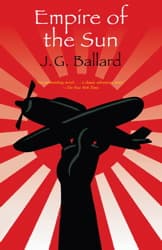

Most people know this story from Spielberg's film - Christian Bale as the wide-eyed kid running through the chaos of occupied Shanghai. I'd seen the movie twice, figured I knew the territory. I was wrong. Ballard's novel is a different animal entirely, darker and stranger, and hearing it through Jeremy Irons' voice at 2 AM while I couldn't sleep after a late client call... that hit me in ways I wasn't prepared for.
Let me cut to the chase: this is a deeply unsettling book about a boy who adapts to war so completely that peace becomes the foreign concept. And at just over three hours, it moves fast - maybe too fast.
A Boy Who'd Have Made a Good Soldier (And That's the Problem)
Jim isn't your typical war victim. He's fascinated by the Japanese aircraft. He admires their pilots. He trades and schemes and survives the Lunghua internment camp not through innocence but through a kind of feral intelligence that Ballard clearly drew from his own childhood imprisonment during WWII. The kid doesn't just endure - he thrives in the wreckage, and that's what makes the book so uncomfortable.
I've seen this scenario play out in real life. Kids in combat zones who adapt faster than adults, who learn the rhythms of violence like a second language. Ballard nails that psychology without sentimentalizing it. Jim's not crying for his parents by chapter three. He's figured out the camp hierarchy, he's working angles with the Japanese guards, he's hoarding food. It's survival instinct stripped bare, and it's honestly more disturbing than any firefight scene I've read. I've encountered that same stripped-down ruthlessness in historical fiction before - Dragon and the Raven puts young men through comparable crucibles, though it wraps the brutality in a cleaner moral frame that Ballard deliberately refuses.
What separates this from the Spielberg version is the ambiguity. The film gave you emotional beats you could hold onto. Ballard gives you a kid who watches bodies float down the Yangtze and catalogs them like weather observations. That flatness - that clinical distance - is the whole point.
Jeremy Irons' Quiet War
Here's where opinions split, and I get why. Irons reads this book in a near-monotone - quiet, controlled, almost detached. Some listeners hate it. I nearly bounced off it myself in the first twenty minutes. But once I stopped fighting the delivery and let it settle in, I realized Irons is doing something deliberate. He's matching Jim's emotional register. This is a boy who's processed trauma by flattening it, by treating horrors as normal. Irons' voice becomes the sound of dissociation.
Is it the most dynamic narration I've ever heard? Not even close. There's minimal character differentiation - you won't always know who's speaking without context clues. And at points, especially during dialogue-heavy stretches, I wished he'd punch certain lines harder. But the approach works for this particular story in a way that a more theatrical reading wouldn't. It's like the difference between a documentary and an action movie. Both valid. Different missions.
That said - and I'll be straight about this - at 1.25x speed, the flatness is more tolerable. Irons' pacing is already measured, and bumping it up keeps momentum without losing the tone.
Three Hours Is a Reconnaissance, Not a Campaign
Here's my real complaint. This audiobook clocks in at 3 hours and 9 minutes, which means it's abridged. The full novel is substantially longer. And you can feel the cuts. Transitions that should breathe get compressed. Character relationships that need room to develop - particularly Jim's strange bond with Basie, the American hustler who uses him - feel sketched rather than lived-in.
If you've read the full text, this version works as a reminder, a concentrated dose. If this is your first encounter with the story, you're getting the skeleton without all the muscle. It's still powerful - Ballard's prose is too sharp to lose its edge even in truncated form - but I kept wanting more. The death marches near the end, the absolute disintegration of order, the moment Jim sees the flash from Nagasaki across the horizon... these scenes deserve the space the unabridged version would give them.
I had to go back and relisten to that final section. The ending wrecked me in a way I wasn't expecting from such a short listen.
Who Should Deploy With This One
Anyone who's served overseas and watched a population - especially kids - adapt to conditions that should be unlivable. You'll recognize things in Jim that no civilian author could fake. Ballard lived this. The author clearly did their homework because it was his homework - his own childhood.
Skip it if you want a conventional war thriller with clear heroes. This isn't that. And if flat narration drives you crazy regardless of artistic intent, Irons' approach will test your patience.
Worth your time? Here's the debrief: it's a significant piece of war literature given a performance that's polarizing but defensible. The abridgment costs it points. If an unabridged Jeremy Irons version existed, we'd be talking about a must-listen. As it stands, it's worth your time but maybe not a full credit at three hours. Ranger fell asleep during this one, but he's not much for introspection.