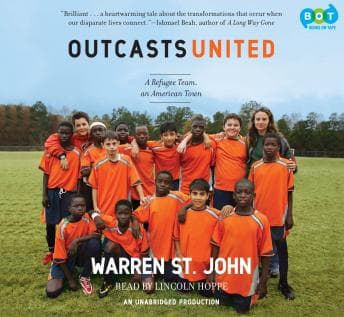

Everyone kept telling me this was an inspiring sports story. A feel-good tale about soccer kids and community. And sure, yes, on the surface it is that. But I was chopping onions for a chana masala at 10 PM on a Tuesday - actual onions, actual tears - and what hit me wasn't the inspiration. It was the psychology of displacement. Of what happens when you strip identity down to nothing and ask a child to rebuild it in a place that doesn't want them.
Warren St. John, a former New York Times reporter, clearly did his homework. This is Clarkston, Georgia - a fading Southern town that got designated as a refugee resettlement center in the 1990s without much say in the matter. Suddenly you've got Liberians, Sudanese, Iraqis, Afghans, all dropped into a community that was already struggling with its own sense of identity. And then there's Luma Mufleh, a Jordanian woman educated in the US, who starts a youth soccer team called the Fugees.
The Protagonist Exhibits Classic Savior-Complex Traits - Except She Doesn't
Here's what I found myself asking: why does Luma really do this? St. John is smart enough not to paint her as a saint. She's fierce. She's demanding. She benches kids for bad grades. She cuts players who miss practice, even when missing practice means their family couldn't afford the bus fare. The research actually shows that effective mentorship in displaced populations requires exactly this kind of structured accountability - it creates the predictability that trauma steals from kids. Luma seems to understand this instinctively. She's not running a charity. She's running a psychological intervention disguised as a soccer team.
What makes Luma compelling is that she's also an outsider. Not a refugee, but an immigrant, a queer Jordanian woman estranged from her family. St. John doesn't belabor the parallel, but it's there. She's building belonging because she needs it too. My therapist would have thoughts about this character - about the way people who've lost their own safety net become obsessed with constructing one for others.
The kids themselves are fascinating case studies in resilience and its limits. You've got boys from war zones who've seen things no child should see, now navigating American middle school hallways where the biggest social currency is fitting in - something they're structurally incapable of doing. The book tracks a single season, and within that frame you get kids losing apartments, families facing eviction, parents who speak no English trying to navigate a system designed to confuse native speakers. The soccer field becomes the one space where competence is legible. You don't need English to score a goal. Psychologically, that tracks perfectly. The psychological mechanics of how combat and extreme stress rewire a person's sense of safety are laid out with real rigor in On Combat: The Psychology and Physiology of Deadly Conflict in War and in Peace - and reading it alongside this book gave me a much sharper lens for understanding what these kids were actually carrying onto that field every single practice.
Thirteen Hours With the Flattest Delivery You'll Ever Hear
Okay. Lincoln Hoppe. Let me be fair. His pronunciation is clean. His pacing is steady. He handles the many non-English names - Luma Mufleh, the Sudanese and Liberian kids' names - without stumbling, and that's genuinely not nothing in a book with this many cultural touchpoints.
But good lord, the monotone. One listener said he has "the most monotone voice I have ever heard" and I wouldn't've put it quite that harshly, but - actually, no, I might. There are scenes in this book about children fleeing war. About a boy whose father was killed. About families separated across continents. And Hoppe reads them with the same even cadence he uses for describing soccer drills. It's like watching a documentary about the refugee crisis narrated by a GPS.
Thirteen hours is a real commitment when the narrator gives you nothing to hold onto emotionally. I genuinely think I would've abandoned this at hour five if the story weren't so inherently powerful. I ended up speeding it to 1.25x, which actually helped - compressed the flat stretches and made the pacing feel less like wading through warm oatmeal.
Who This Is Actually For
If you're interested in immigration, identity formation, community psychology, or just how messy and complicated and beautiful the American experiment actually gets when it's happening in real time in a small town in Georgia - this is worth your time. The story earns its emotional weight. St. John understands human nature. He doesn't flinch from showing the racism and resentment in Clarkston, but he also doesn't reduce the existing residents to villains. Everyone here is protecting something. That's what makes it real.
But the audiobook specifically? That's harder to recommend. The narration doesn't ruin the material, but it definitely doesn't serve it. If you're someone who can lock in on content regardless of delivery - say, during a focused commute or a long solo cooking session - you'll be fine. If you need vocal performance to keep you engaged, consider the print version.
My Case Notes
This is a book about what happens when the world's problems show up on your street, and you have to decide who you are in response. The Fugees aren't just a soccer team. They're an answer to the question every displaced kid carries: do I belong anywhere? Luma's answer - you belong here, but only if you show up and do the work - is psychologically sound and deeply human. St. John captured something real. I just wish the narrator had too.