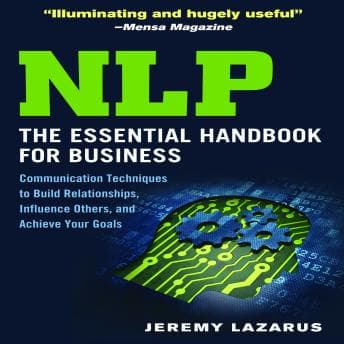

Look, I need to rant for a second. The title of this book is "NLP: The Essential Handbook for Business: The Essential Handbook for Business: Communication Techniques to Build Relationships, Influence Others, and Achieve Your Goals." They literally repeated the subtitle. TWICE. In the title. If you're writing a book about effective communication, maybe start with your own metadata? This is the software equivalent of shipping a README with a merge conflict in it.
Okay. Deep breath. Let's talk about what's actually inside.
The Blog Post Problem, But Make It 6 Hours
TL;DR: Worth your commute if you've never touched NLP concepts before. Skip if you've read literally any other NLP book.
I listened to this over about four commutes - at 1.75x, naturally, because this is firmly in "business book that could've been a blog post" territory. Actually, let me be more generous: it could've been a solid three-part blog series. Jeremy Lazarus clearly knows his stuff. The guy was a management consultant, finance director, and now runs an NLP training company with blue-chip clients. His credentials aren't the issue.
The issue is that at 6 hours 50 minutes, we're getting a lot of repetitive framing around concepts that genuinely useful people could absorb in half the time. There's a pattern that repeats across chapters: introduce concept, explain why it matters for business, give a workplace scenario, then walk through an exercise. Which sounds great on paper! But by the fourth or fifth cycle, you start to feel the template.
The practical exercises are where this earns its keep, though. Lazarus walks through reframing techniques for negotiations and a pretty decent breakdown of rapport-building through mirroring - and he does it in jargon-free language that doesn't require you to already be an NLP practitioner. The section on removing limiting beliefs has some genuinely applicable frameworks. That whole territory of reprogramming your own mental defaults is something Awaken the Giant Within covers with a lot more depth and a lot more Tony Robbins yelling, if you want the full immersion. I found myself mentally running one of his exercises during a 1:1 with my skip-level manager last week. Did it "work"? I mean, I didn't get yelled at for a deployment that went sideways, so... maybe?
Walter Dixon Does Exactly What You'd Expect
Walter Dixon's narration is... fine. It's clean. It's clear. It's the plain oatmeal of audiobook narration - perfectly functional, zero personality. For a practical business guide, that's actually not a bad thing. You don't need Ray Porter energy here (and honestly, imagining Ray Porter reading NLP exercises would be deeply weird). Dixon reads like a competent corporate trainer giving a presentation. No weird pronunciation issues, no pacing problems. He just doesn't bring anything extra.
The production is straightforward - single narrator, no music, no sound effects. Exactly what you'd expect from a business audiobook. Nothing to complain about, nothing to praise.
The Distributed Systems Engineer's Take
Here's where my day job colors my opinion. A huge chunk of NLP is about modeling - figuring out what successful communicators do, breaking it into components, and replicating those patterns. As someone who spends all day thinking about system design and pattern recognition, this actually clicked for me more than I expected. Lazarus frames influencing skills almost like debugging: identify the current state, understand the desired state, figure out what's blocking the transition.
But - and this is a big but - if you've already read "Crucial Conversations" or "Never Split the Difference," you're going to find maybe 30% new material here. I had a similar "I've seen this pattern before" experience with Principles: Life and Work - useful frameworks, but the further you are into the genre, the more it feels like refactored code you already understand. A lot of the communication techniques overlap with standard negotiation and leadership books. The NLP-specific stuff (anchoring, meta-programs, perceptual positions) is genuinely different, but it's sandwiched between concepts you've probably encountered elsewhere.
I'll also say: some of the NLP claims feel a bit hand-wavy on the evidence front. Lazarus presents techniques with confidence but doesn't always cite research backing them up. My engineer brain wanted footnotes. My 6AM-zombie-on-Caltrain brain didn't care.
Who Gets Value, Who Doesn't
Perfect for: train, gym. Skip for: deep work (ironically, given the subject matter).
Grab this if you're early in your career and haven't read much on workplace communication. It's a solid 101-level survey of NLP techniques applied to business contexts. The ROI on this audiobook is decent if it's your first exposure to these ideas.
Skip this if you've already consumed 3+ books in the communication/influence space. You'll spend most of the runtime going "yeah, I know" and that's not a great use of 4 commutes.
The ROI on this audiobook is basically an entry-level course: high if you need the foundations, diminishing fast if you don't. At 1.75x speed, it's a painless enough listen. At 1x, I think I'd have bailed by hour 4.