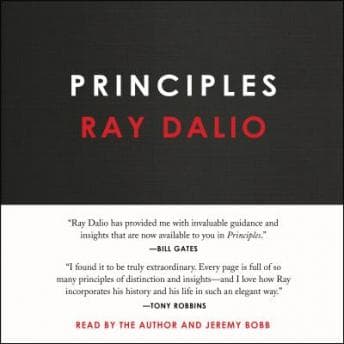

The "Ray" Factor (And Why You Need the 2.0x Button)
I tried. I really tried to listen to this at normal speed. I lasted about twelve minutes.
Here's the situation: I was stuck on the 101 in gridlock, staring at a billboard for a personal injury lawyer, listening to Ray Dalio read the introduction to his life's work. And look, the man is a genius. You don't build Bridgewater Associates by being an idiot. But Ray Dalio narrating his own book sounds exactly like what you'd expect a billionaire hedge fund manager to sound like—monotone, deliberate, and completely devoid of urgency.
It's heavy. It's mechanical. It's... a lot.
(My wife Jenny heard five minutes of it while I was cooking dinner and asked if I was listening to a manifesto from a depressed robot. She's not entirely wrong.)
So, rule number one: Crank the speed up. I hit 2.5x during the biographical sections. Ray reads the first part—his history, the rise of Bridgewater, the failures. It's interesting stuff, but his delivery is so overwrought with this "I am dispensing wisdom from the mountaintop" vibe that it can be a slog. He enunciates every. Single. Word.
Radical Transparency vs. Your Actual Workplace
Once you get past the bio, Jeremy Bobb takes over for the actual "Principles" section. Thank God for Jeremy Bobb. The guy is a professional. His cadence is crisp, he understands pacing, and he actually makes the lists—and there are hundreds of lists—digestible.
The content itself? It's classic McKinsey-style rigor on steroids. Dalio treats life and business like a machine. Input -> Process -> Output. Fix the machine, fix the output. I love this stuff. It's aggressive efficiency. It appeals to the part of my brain that wants to optimize my morning coffee routine. I got a similar vibe from Fundamentals of Prosperity—same obsession with systems, though mercifully shorter.
But let's be real for a second.
Dalio talks a big game about "Radical Truth" and "Radical Transparency." The idea is that you tell everyone exactly what they're doing wrong, constantly, in real-time, to get to the best answer. In a hedge fund filled with hyper-competitive quants? Sure. Works great.
But I tried to imagine applying this to my parents' dry cleaning business in K-Town back in the 90s. If my dad practiced "Radical Transparency" with Mrs. Kim about her stained silk blouse, we would've gone bankrupt in a week. Sometimes, business isn't about the raw data. It's about the soft skills that Dalio seems to view as inefficiencies to be engineered out.
(I actually tried a "believability-weighted decision making" process with a startup client last month. They looked at me like I had three heads. We went back to voting on Slack.)
A Reference Manual Disguised as a Story
Here's the bottom line.
This audiobook is 16 hours and 30 minutes long. That is a massive ask. The "Principles" section—the core value of the book—is basically a reference manual. It's bullet points. It's flowcharts converted into words. Listening to Jeremy Bobb read "Principle 4.3.a: Don't let loyalty stand in the way of truth" is fine, but you can't see the structure.
This is one of those rare cases where the physical book beats the audio hands down. You want to flip through this. You want to highlight it. You want to keep it on your desk to intimidate your employees.
If you're going to listen, do it for Part 1 (the biography). It's a fascinating look at how a guy goes from a middle-class kid on Long Island to the "Steve Jobs of investing." But when he starts listing the rules? You're going to zone out. I zoned out. And I literally get paid to listen to this stuff.
Who should listen: Systems-obsessed operators who want Dalio's origin story and can tolerate 2.5x speed. Who should skip: Anyone expecting a smooth narrative listen—buy the hardcover instead, put it on your shelf, and listen to the first 4 hours for the backstory. Your time is an asset. Allocate it better.