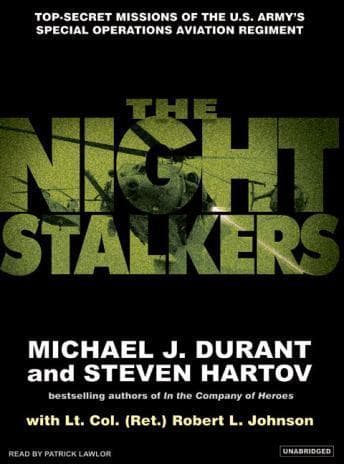

"Night Stalkers Don't Quit." That motto shows up early in the book, and if you've ever worked with the 160th SOAR, you know it's not bumper sticker bravado - it's a statement of operational fact. I was halfway through a late-night review of a client's facility assessment when I fired this one up, figured it'd be good background. Ranger was already asleep on his bed. Within twenty minutes I'd closed the laptop and was just... listening.
Let me cut to the chase: the content here is outstanding. The narrator situation is a problem. And that tension between the two is going to define your experience.
These Guys Flew Into Places That Made the Rest of Us Nervous
Durant and Hartov structure this as a chronological walk through the 160th's evolution - from the wreckage of Desert One in Iran (which essentially birthed the unit) through Grenada, Panama, the Gulf War, Somalia, and into the post-9/11 era. What makes it work is the granularity. These aren't Wikipedia summaries of operations. You're getting the pre-mission brief anxiety, the specific aircraft configurations, the comms chatter when things go sideways at 0200.
The old strategists could only theorize this kind of pressure - Art of War reads like a classroom exercise next to pages like these.The Grenada chapters hit particularly hard because they expose just how much of early special operations aviation was held together with duct tape and sheer stubbornness. The 160th didn't start as the precision instrument it became - they earned that reputation mission by mission, and sometimes the cost was brutal. The book doesn't shy away from the crashes, the losses, the missions that went wrong before the unit figured out what right looked like.
I've seen this scenario play out in real life - units that forge their identity through failure as much as success. The author clearly did their homework, and since Durant literally lived this stuff (he's the same Mike Durant from the Mogadishu shoot-down, the guy whose face was broadcast worldwide), the insider perspective is genuine. You can tell which stories came from debrief rooms and which came from bar conversations at Fort Campbell, and both kinds matter.
Where Patrick Lawlor and I Parted Ways
Here's where it gets complicated. Patrick Lawlor is a competent narrator in plenty of genres. I caught his range earlier on Once a Runner, where the material seemed to meet him halfway. But military nonfiction - especially special operations military nonfiction - demands a specific kind of delivery. There's a cadence to how these stories get told. Dry. Matter-of-fact. The humor is deadpan, buried three layers deep. The serious moments don't get dramatic because the operators telling them have processed that trauma into something flat and controlled.
Lawlor reads it like a narrator reading a book. Which technically he is, but you feel the disconnect. The pacing feels off on tactical sequences - moments that should punch hit with the energy of someone reading a bedtime story. And conversely, some quieter reflective passages get more dramatic treatment than the culture warrants. It's not bad narration in a vacuum. It's wrong narration for this specific material.
His strengths lie elsewhere - Rise and Fall of the Dinosaurs suits his voice far better than a debrief room ever will.I kept thinking about how this would sound if someone like Scott Brick or - better yet - an actual military guy had read it. (Ray Porter would've knocked this out of the park.) The content deserves a voice that understands the difference between a Little Bird and a Chinook not just as words but as machines with distinct personalities. That understanding bleeds into delivery whether you notice it or not.
At 1.25x it was tolerable. Honestly, speeding it up helped because it compressed some of the pacing issues into something closer to natural military storytelling rhythm. Your mileage will vary.
The Content Carries the Load
Despite the narrator mismatch, I kept coming back to this one. At 11-plus hours, it's a serious commitment, but the operational accounts justify the time. The Somalia sections obviously benefit from Durant's firsthand experience, but the lesser-known operations - the stuff in Central America, the early Afghanistan insertions - are where I learned the most. I've been around SOF my entire career and there were missions in here I'd never heard the full story on.
The book does lean heavily into the heroic - this isn't a critical examination of special operations policy or the cost of perpetual deployment cycles. It's a love letter to the unit, written by people who bled for it. That's fine. Just know what you're getting. If you want the complicated political context, read something else alongside it. If you want to understand what it feels like to fly NOE at night into a hot LZ with Rangers hanging off your bird, this is your book.
Worth your time? Here's the debrief: buy the physical book or the ebook if you can. If audio is your only option, bump the speed and push through the narrator mismatch. The stories deserve to be heard - I just wish they'd been read by someone who'd heard them told in person first.
Ranger slept through most of it, which is actually his highest compliment. Means the house was calm enough that even an 11-hour listen didn't make me yell at anything. The narrator came close a few times, though.