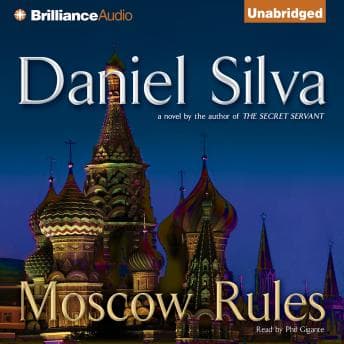

"It is not the grim, gray Moscow of Soviet times but a new Moscow, awash in oil wealth and choked with bulletproof Bentleys."
That line hit me somewhere around hour two, and I had to pause the audiobook because it felt less like fiction and more like prophecy. I was shelving returns at the library — late shift, just me and the fluorescent buzz — and Moscow Rules had me so locked in that I nearly filed a Patricia Cornwell novel into the children's section. Twice.
Look, I know what you're thinking. Jordan, this is spy fiction, not horror. Why do you care? Because Daniel Silva understands something that the best horror writers understand: dread doesn't come from the monster. It comes from the machinery. The systems. The slow realization that the walls are closing in and nobody's coming to help. Moscow Rules operates on that frequency, and it's genuinely unsettling in ways that most thrillers can't touch.
The New Moscow Is Its Own Kind of Haunted House
Silva's Russia isn't the Cold War relic we've seen recycled a thousand times. This is post-Soviet oligarch Russia — grotesque wealth stacked on top of Soviet-era paranoia, and the combination is frankly more terrifying than any nuclear standoff. Ivan Kharkov is the kind of villain who makes your skin crawl not because he's cartoonishly evil but because he's plausible. A former KGB colonel turned arms dealer, hiding weapons sales to al-Qaeda inside a legitimate investment empire. The way Silva constructs Kharkov's world — his wife Elena trapped in a gilded cage, his security apparatus that makes the old KGB look quaint — it all feels lived-in and claustrophobic.
Gabriel Allon, eight books into this series, is a fascinating protagonist for a thriller. He's not a blunt instrument. He's an art restorer who happens to be a spy, and that duality gives him a vulnerability that most thriller heroes wouldn't be caught dead showing. When he's operating in Moscow, genuinely out of his depth, playing by rules he didn't write — that tension is real. Silva earns it.
But here's my issue, and I can't let it slide: the ending. Without spoiling, there's a resolution that involves a character who essentially materializes to solve the problem. It's the literary equivalent of a deus ex machina wearing a trench coat. After ten-plus hours of careful, patient suspense-building, to have the climax resolved by what feels like an authorial shortcut? It stung. Like spending an entire haunted house experience in genuine terror only for someone to flip the lights on and say "just kidding." The journey is excellent. The destination is... fine.
Phil Gigante Knows What He's Doing (And It Shows)
Here's where I have to give credit. Phil Gigante has been narrating this series for a while, and it shows in the best way. He doesn't just read the book — he inhabits its geography. His handling of the international cast is precise without being showy. The Russian characters sound Russian without descending into Boris-and-Natasha caricature. His Israeli characters carry a different weight, a different rhythm. And when Allon is in operational mode — terse, focused, calculating — Gigante's delivery gets tight and controlled in a way that mirrors the character's discipline.
The narrator commits. That's rare. Especially in dialogue-heavy sections (and Silva loves his dialogue), Gigante maintains distinct voices without ever pulling you out of the scene to think "oh, that's the narrator doing a voice." It's invisible craft, which is the hardest kind.
I don't have a specific complaint about the audio production. Clean, no background issues, solid pacing. At eleven hours, it's a focused listen — not bloated, not rushed. I ran it at 1x speed because the plot demands attention. There are layers of tradecraft and character relationships (particularly the dynamic between Allon and Elena Kharkov) that reward close listening.
Who Gets to Enter and Who Should Stay Home
If you're deep into the Allon series, this is essential. If you're new to Silva, you can start here — there's enough context that you won't be lost — but you'll miss some of the emotional weight that comes from knowing Allon's history. If you want your thrillers loud and fast, with explosions every chapter, you'll be frustrated. This is a slow-burn. It's chess, not a bar fight. Inferno plays a similar game — Langdon piecing together clues while the clock ticks, though Silva's pacing is tighter.
My podcast listeners are going to love this — it scratches the same itch as a good paranoia horror. The sense that someone is always watching, that the rules are rigged, that survival depends on being smarter than a system designed to crush you. It's the same suffocating paranoia that King builds so masterfully in It, where the real terror isn't the clown — it's the town that lets it happen. That's horror-adjacent territory, and Silva plays it well.
Shrley (my cat) was unimpressed. I was genuinely tense for about seven straight hours.
Closing the Case File
Moscow Rules is a smart, patient thriller with a narrator who elevates already strong material. The ending keeps it from greatness — I can't pretend that didn't bother me — but the ride there is worth your time and your credit. Silva writes espionage the way the best horror writers write dread: slowly, deliberately, with the understanding that what you don't see is scarier than what you do. I listened in the dark. Not a mistake this time — it just felt right.