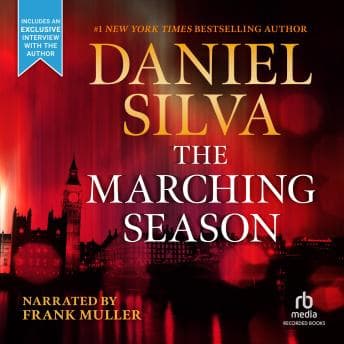

"No place is safe, and no detail too small to ignore."
That line from the description kept rattling around in my head while I sat in the back office at the library, supposedly doing inventory on our mystery section, actually white-knuckling through the last two hours of this thing with one earbud in. Northern Ireland. The Troubles. Political assassination. A ghost of a hit man called October. This is the kind of thriller that reminds you real-world horror doesn't need the supernatural to make your skin crawl.
The Troubles As Horror Story
Look - I grew up in a household where horror was forbidden, and I've spent my adult life cataloging every shade of dread fiction has to offer. But sometimes the scariest stuff is the stuff that actually happened. Daniel Silva sets The Marching Season against the 1998 Good Friday accords, and he doesn't romanticize the violence. He weaponizes it. The assassinations come in quick, clinical bursts. Michael Osbourne chasing October through layers of espionage and counter-espionage has this inevitability to it, like watching someone walk toward a door you know they shouldn't open. Silva's background as a journalist covering the Middle East and Washington gives the political machinery a texture that feels uncomfortably authentic. This isn't a writer playing dress-up with geopolitics. He knows how the sausage gets made, and he's not shy about showing you the grinder.
What works particularly well is the slow revelation that October isn't the apex predator - that there's a larger organization pulling strings. That's horror structure, whether Silva intended it or not. The monster you see is never the real monster. Shirley Jackson walked so this paranoia could run. That same slow-burn dread of realizing the threat is bigger and closer than you thought is something Dean Koontz weaponizes in a completely different register in Whispering Room - worth a listen if the paranoia engine Silva built here is the part that got its hooks into you.
Frank Muller: Genius or Too Much?
Okay. Frank Muller. This is where it gets complicated, and I'm going to be honest because that's the only mode I have.
Muller was one of the greats. Full stop. His dramatic delivery in this book drives the tension forward like a hand on your back pushing you down a dark hallway. There are stretches - particularly in the espionage scenes, the backroom deals, the moments where Osbourne realizes how deep the conspiracy goes - where Muller's voice drops to this near-whisper and it's genuinely electric. The narrator commits. That's rare. He understood that a thriller about political assassination in Northern Ireland shouldn't sound like someone reading a grocery list.
But.
That whispering thing? It's not just for the tense moments. It becomes a pattern. Nearly every phrase ends on this dramatic downward slide into a hush, and after about hour five, I started noticing it like a dripping faucet. Some listeners have straight up said they couldn't finish the book because of it, and while I wouldn't go that far - Muller's talent is undeniable - I get it. It's the audio equivalent of a director who loves slow-motion so much that even people walking to the car gets the treatment. When every moment is dramatic, nothing is.
The AudioFile Earphones Award wasn't unearned. Muller's control, his pacing, his ability to build and sustain tension across an eleven-hour runtime - that's craft. But I'd be lying if I said the style didn't occasionally pull me out of the story and into awareness of the performance itself. And for a thriller that depends on you forgetting you're listening and just being there? That's a problem.
Who Needs This in Their Ears
If you're a political thriller person who wants something rooted in real history with real stakes - not some invented supervillain nonsense - this delivers. If you scare easily, skip. If you don't, you need this. Not because it's horror in the traditional sense, but because the dread of watching peace get dismantled by people who profit from violence is its own kind of nightmare.
Skip if: you're sensitive to narration style quirks. Muller's dramatic whisper is either going to pull you deeper in or shove you right out, and there's not much middle ground. Also skip if you need a light listen - this demands focus. The conspiracy layers stack, details matter, and zoning out for even five minutes means losing the thread.
My podcast listeners are going to love this - it sits right at the intersection of thriller and real-world horror that I keep trying to convince people exists.
Closing the Book, Lights Still On
I finished this one during a late shift at the branch, alone in the building except for Shirley (the cat, not the Jackson - she was at home being unimpressed by something). The parking lot was dark. The rain was doing that Oregon thing where it's not quite falling, just hovering. And I sat there for a minute before starting my car because the paranoia Silva builds is the kind that lingers. Not jump-scare paranoia. The slow, creeping kind. The kind where you start wondering who's really pulling the strings.
Finally, horror that respects the genre - even when it doesn't know it's horror at all.