
Can you teach a 176-year-old polemic to a generation raised on TikTok? I ask myself this every semester when I slot excerpts of Marx and Engels into my AP English curriculum, right between Thoreau and Orwell, and watch thirty teenagers try to figure out if I'm a radical or just a guy who likes old books. (Both, kids. Both.)
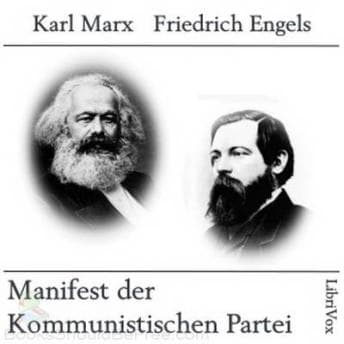
I listened to this German-language audiobook of the Manifest der Kommunistischen Partei on a Saturday morning walk along the lakefront with Denise, who after about twenty minutes asked me why I was muttering "Klassenkampf" under my breath. Fair question.
The Pamphlet That Ate The World
Here's the thing about the Communist Manifesto that people forget: it's not a treatise. It's not Das Kapital. It's a pamphlet. A piece of political advertising, really - written in about six weeks in late 1847 by two guys in their twenties who were convinced they'd figured out the entire arc of human civilization. And the audacity of that? It's kind of thrilling. At two hours and twenty-three minutes, this audiobook captures the breathless, argumentative energy of the original text in a way that reading it on the page sometimes doesn't. Marx's sentences - those long, coiling German constructions that pile clause upon clause before delivering the rhetorical punch - were built to be spoken aloud. They're oratory disguised as philosophy. Listening in German, you hear the rhythms that get flattened in English translation: the way "Die Geschichte aller bisherigen Gesellschaft ist die Geschichte von Klassenkämpfen" hits harder than "The history of all hitherto existing society is the history of class struggles." The German has this hammering cadence, almost biblical.
If you loved Rousseau's Social Contract or Paine's Common Sense, this is their spiritual successor - same DNA of revolutionary pamphleteer energy, same absolute confidence that the author has cracked the code of human misery.
What The Narrator Gets Right (And What's Missing)
Now, I have to be honest: the narrator is uncredited, and I couldn't find specific details about the performance. This appears to be a LibriVox-style production - a volunteer reading a public domain text. And look, I respect that project enormously. But the narrator here delivers a competent, steady reading rather than an interpretive performance. The prose deserves to be savored, and what I wanted was someone who understood that Marx writes in two registers - the analytical passages where he's dissecting bourgeois economics with surgical precision, and the apocalyptic passages where he's basically a secular prophet thundering about the inevitable fall of capitalism. A great narrator would shift between those modes. What I got was consistent. Reliable. But flat where the text demands fire.
The production is clean. No audio issues, no distracting background noise. For a free or budget recording, that's not nothing. But compare this to, say, a professionally produced reading of The Prince or On Liberty, and you feel the gap. The text itself is doing all the heavy lifting.
Why I Still Assign This (And Why My Students Would Hate This Version)
My students would hate this. I love it. Not because the audio performance is exceptional - it isn't - but because listening to this in the original German forced me to slow down with a text I'd become too familiar with. I've taught excerpts of this thing for fifteen years. I can practically recite the opening of Section I from memory. But hearing it spoken, at 1.0x (because the author chose those words), I caught things I'd glossed over. The way Marx and Engels spend more time praising the bourgeoisie's achievements than most people realize - that whole passage about how capitalism "has accomplished wonders far surpassing Egyptian pyramids" - it's easy to skip past on the page. Spoken aloud, you hear the grudging admiration before the knife twist.
At two hours and twenty-three minutes, this is closer to a long podcast episode than a serious audiobook commitment. You could finish it in a single lakefront walk. And honestly? That's how it should be consumed. This was written to be urgent, immediate, digestible. It's not War and Peace. It's a call to arms dressed up as political theory.
This is why we still read the classics - not because Marx got everything right (he very much did not), but because the questions he asked about who owns what and why are still the questions keeping people up at night. The narrator understands that pause is punctuation, even if they don't always deploy it with the drama the material warrants.
The Assignment
If you're a German speaker or student wanting to engage with the original text, this is a serviceable way in - especially at this price point and length. If you want the definitive audio experience of the Manifesto, you're probably better served by one of the professionally produced English versions with a narrator who can match the rhetorical heat. But if you want to hear Marx's actual words in Marx's actual language, tumbling out in those long Germanic sentences that build and build toward their inevitable conclusions about the proletariat and the bourgeoisie - well, there's something to that. Something a translation can't quite replicate.
Worth pausing the faculty meeting for? Probably not this specific recording. But the text itself? Always. I've been thinking lately about how few books — across any genre — carry that same stubborn conviction that the world can be explained, and I couldn't find it in Newcomer: A Novel either, which I picked up hoping for something with similar intellectual urgency and found instead a quieter, more personal kind of reckoning.