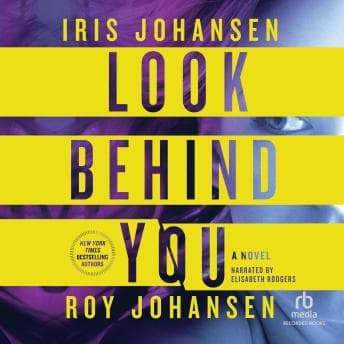

"He's leaving souvenirs from other killers' cases."
That line hit me somewhere around hour two, and I had to pause the audiobook because my brain needed a second to process the implications. A serial killer who collects trophies from other serial killers' unsolved cases and plants them at his own crime scenes? That's not just a gimmick. That's a psychopath building a résumé. And the fact that the Johansens commit to that premise - really dig into what it means for the investigation, for the profiling, for Kendra Michaels' particular skill set - is what separates this from the pile of interchangeable FBI-chases-killer thrillers cluttering up every audiobook storefront.
The Killer Who Collects Killers
Let me be honest about something: I came into this skeptical. I'm a horror person first, and procedural thrillers can feel sanitized to me - all the violence neatly contained inside forensic reports, none of it allowed to breathe or unsettle. But Look Behind You earns its creep factor in a way I wasn't expecting. The M.O. itself is genuinely unsettling because it implies this killer has been studying, traveling, researching other murderers for years. He's not impulsive. He's curating. And the Johansens let that realization unfold slowly enough that by the time Kendra and her team grasp the scope of what they're dealing with, you're already looking over your shoulder. That same slow-dawning dread around a killer who operates in the shadows of history is part of what made Black Dahlia, Red Rose stick with me - real unsolved cases carry that same weight of someone getting away with it, someone who never got studied the way they deserved.
Kendra Michaels is an interesting protagonist for me because she's built around perception - she was blind for the first twenty years of her life, and now that she can see, she notices everything. Details other people miss. It's a hook that could easily feel like a superpower, but the writing keeps it grounded. She doesn't just "notice clues" - she processes sensory information differently, and the narrative actually lets you feel the weight of that. When she walks into a crime scene and picks apart what doesn't belong, it doesn't read as magic. It reads as someone who learned to survive by paying attention, and now she can't stop.
The "dream team" dynamic between Kendra, Adam Lynch, and Jessie Mercado works better than most thriller ensembles. Lynch is the competent-but-morally-flexible operative, Jessie is the PI who doesn't take anyone's nonsense, and Kendra is the one holding the investigation together while also being the killer's primary target. There's tension in every direction - romantic tension with Lynch, professional friction with the FBI, and the ever-present question of whether someone on the inside might be the killer. That last thread is the sharpest one. The Johansens seed enough doubt about enough characters that I genuinely didn't call the reveal until pretty late.
Elisabeth Rodgers Doesn't Let You Breathe
I was shelving returns at the library - late shift, mostly empty building, fluorescent lights buzzing that particular frequency that makes everything feel like a horror movie set - when Rodgers hit a stretch of narration that made me stop mid-stack. She doesn't do anything flashy. No dramatic whisper-to-scream transitions, no overwrought villain voice. What she does is maintain this steady, controlled tension in her delivery that mirrors Kendra's hyperawareness. When things escalate, Rodgers doesn't raise the volume. She tightens the rhythm. Sentences come faster. Breaths get shorter. It's subtle, but it works.
Her character differentiation is solid - Lynch gets a slightly smoother register, Jessie's a touch more clipped, and the FBI agents each have their own cadence. Nothing showy, but you always know who's talking. For a series this deep (this is the fifth Kendra Michaels book), that consistency matters. Rodgers has clearly internalized these characters, and it shows.
The narrator commits. That's rare. She's not just reading a thriller - she's pacing one.
Where It Stumbles (Because Nothing's Perfect)
Here's the thing: at nine hours and fifty minutes, the middle section drags. There's a stretch around hours five and six where the investigation hits a plateau and the Johansens fill the space with relationship dynamics that don't quite earn their weight. Lynch and Kendra's will-they-won't-they simmers in a way that feels more like genre obligation than genuine character development. It's not bad. It's just... there. Taking up space where another twist could live.
And look - the Johansens are skilled plotters, but some of the dialogue leans procedural-generic. Characters explain things to each other that they should already know, purely for the reader's benefit. It's a common thriller sin, and it pulled me out of the story a couple of times.
Who Needs This in Their Ears
If you're already deep in the Kendra Michaels series, you don't need me to tell you to grab this. Rodgers is consistent, the character arcs build on previous entries, and the central case is one of the more inventive in the series. If you're new? You can start here - the Johansens provide enough context - but you'll miss some of the relationship shorthand.
If you scare easily, skip. If you don't, you need this. Well - let me qualify. This isn't horror-scary. It's thriller-scary. The kind where you're not afraid of what's in the dark but of who's standing right next to you in the light.
My podcast listeners are going to love this one for the M.O. alone. A killer who studies other killers? That's a concept that deserves its own episode.
Shelve It Under: Smart Procedural, Dark Premise
Solid thriller with a killer concept (pun intended) and a narrator who knows exactly what she's doing. The mid-section bloat keeps it from greatness, but the premise and the payoff earn the listen. Shirley (my cat) was unimpressed. I was genuinely tense. That's usually how it goes.