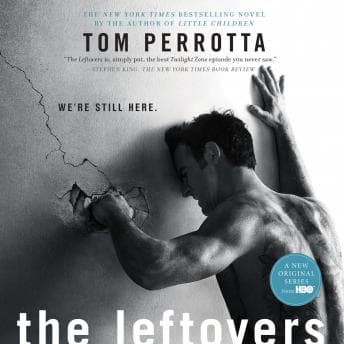

Tom Perrotta wrote a Rapture novel for people who don't believe in the Rapture. That's the trick of The Leftovers, and it's a good one.
I finished this one during a late Saturday walk along the lakefront with Denise, and she actually asked me to take my earbuds out because I'd gone completely quiet for about ten minutes. Not because the book was boring - because the silence in it had gotten into me. This is a novel where the quiet parts do most of the heavy lifting, and Dennis Boutsikaris knows it.
The Apocalypse Nobody Gets to Understand
Here's what Perrotta does that I keep turning over in my head: he gives you a supernatural event - millions of people just vanish - and then refuses to explain it. No theology. No conspiracy. No grand unifying theory. Instead, he drops you into Mapleton, a regular suburban town, and watches people try to keep being people when the rules have stopped making sense. Kevin Garvey's trying to be mayor. His wife Laurie has joined the Guilty Remnant, this cult that chain-smokes and doesn't speak - they just stand around staring at you, like your grief made visible and refusing to let you look away. His son Tom is off following some charlatan called Holy Wayne who claims he can hug your sadness out of you. And his daughter Jill is doing that teenage free-fall thing where you can't tell if she's coping or drowning.
Some listeners have called this "soul-destroyingly depressing." I get it. But I think they're confusing sadness with hopelessness, and Perrotta is very careful about the difference. The book isn't hopeless. It's bewildered. Every character is asking the same question my students ask when I assign Camus: "Okay, but what's the point?" And Perrotta's answer is essentially the same as Camus's - you keep going, you find small connections, you try not to lose yourself to the cults or the prophets or the numbness.
This reminds me of what Hemingway said about writing - the dignity of movement of an iceberg is due to only one-eighth of it being above water. Perrotta keeps almost everything below the surface. The Sudden Departure is the iceberg. The novel is what floats above it.
Boutsikaris and the Art of Not Trying Too Hard
Dennis Boutsikaris doesn't do voices, really. No funny accents for Holy Wayne. No breathy whisper for the Guilty Remnant scenes. He reads with this matter-of-fact mellow tone that makes the surreal premise feel domestic, which is exactly right - because Perrotta isn't writing science fiction. He's writing about a marriage falling apart, a father losing his kids, a woman named Nora Durst who lost her entire family and is trying to figure out what "moving on" even means when there's no body, no funeral, no explanation.
What Boutsikaris does brilliantly is tempo. He slows down in the gaps between characters' thoughts, lets the pauses breathe. The narrator understands that pause is punctuation. There's a kind of quiet authority in his delivery - he's not performing grief, he's just... present in it. The way a good teacher reads a passage aloud to a class: no drama, just clarity, and trust that the words will do their work.
I listened at 1.0x, obviously. The prose deserves to be savored. Speeding this up would be like fast-forwarding through the silences in a Chekhov play. You'd technically get through it faster, but you'd miss the whole thing.
What the HBO Show Can't Give You
If you watched the series - and the series is genuinely great television - the audiobook is a different animal. The show broke out of Perrotta's quiet suburban register pretty quickly, especially in seasons two and three. The book stays small. Deliberately small. It's interested in faculty meetings and teenage parties and the awkwardness of dating after your wife joins a doomsday cult. My students would hate this. I love it. There's no big dramatic set piece, no explosive revelation. Just people trying to have breakfast when the world doesn't make sense anymore.
Some readers were frustrated by the lack of resolution - and yeah, Perrotta doesn't tie things up. But that's the point, isn't it? The Departure has no explanation. Why should the aftermath?
Who This Is For (and Who Should Walk Away)
If you loved Revolutionary Road or The Virgin Suicides - stories about the ordinary American life cracking under pressure - this is their spiritual successor. I reviewed Public Secrets a while back and kept circling the same idea - how much weight a story can carry when it trusts ordinary life to be interesting enough without manufacturing crisis. If you need plot momentum, alien explanations, or a clear ending, you'll be climbing the walls by hour six.
This is a focus listen. Don't put it on while doing dishes. Give it the lakefront at dusk, or 11 PM with the papers graded and the house quiet. It earns that attention.
Worth Pausing the Faculty Meeting For
Perrotta wrote a grief novel disguised as a premise novel, and Boutsikaris reads it like he understands exactly what it is. Ten hours. No explosions. No answers. Just people, left behind, trying to figure out how to stay. This is why we still read the classics - and why some contemporary novels deserve to sit on that shelf too.