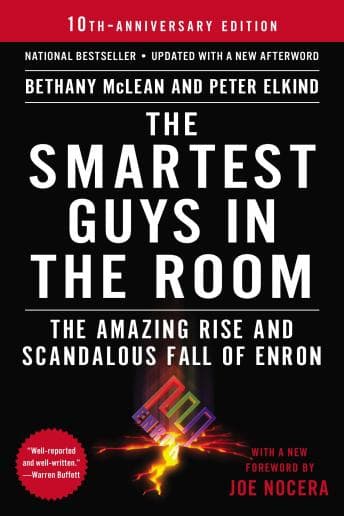

"We're Enron. We're the smartest guys in the room." Somewhere around hour 3, Boutsikaris delivers that line with this perfect sardonic edge, and I actually laughed out loud on the train. Got a few looks from the 6:47 AM zombie crew. Worth it.
TL;DR: Worth your commute — but barely. This is a 22-hour beast that demands more focus than your average business audiobook, and it rewards you for it. Think of it as debugging a massive legacy codebase where every module is a different financial fraud scheme.
Mark-to-Market Accounting Is Basically Technical Debt for Wall Street
So here's the thing about Enron that I didn't fully appreciate until this book: the fraud wasn't one big scam. It was hundreds of small ones, layered on top of each other, each one enabled by the previous one. As a distributed systems engineer, this hit different. It's exactly how cascading failures work — each component looks fine in isolation, but the interdependencies create a system that's fundamentally broken. Andy Fastow's SPEs (Special Purpose Entities) were basically microservices that all had hidden circular dependencies. When one failed, everything collapsed.
McLean and Elkind trace this from Jeff Skilling's earliest days at McKinsey through to the congressional hearings, and the level of detail is... a lot. The sections on Enron's energy trading operations and how they manipulated California's electricity market — causing rolling blackouts while traders literally joked about grandmothers losing power — made me genuinely angry. Like, I was gripping my coffee on the train angry. The authors don't editorialize much; they just lay out the facts and let the sociopathy speak for itself.
Ken Lay comes across as this weirdly passive figurehead who either didn't know what was happening (unlikely) or chose not to (almost certainly). Skilling is the more fascinating character — brilliant, arrogant, the kind of guy who'd ship code to production without tests because he was convinced he was smarter than the compiler. The book spends a lot of time on his transformation from visionary to someone who literally could not process the idea that Enron might be wrong about anything.
Dennis Boutsikaris: Not Ray Porter, But He'll Do
Let me be real — Boutsikaris has five Audie Awards for a reason. His voice has this dry, almost newscaster quality that works really well for investigative journalism. There's a sardonic humor to his delivery that matches the material perfectly. When he's describing Fastow strutting around the office or Skilling berating analysts who questioned Enron's numbers, you can hear the barely-contained "can you believe these people" in his tone.
But — and this is a meaningful but — the pacing is a problem. Complex financial structures fly by at a speed that assumes you already know what a Raptor transaction is. I had to rewind at least four or five times during the sections on LJM partnerships and the off-balance-sheet entities. At my usual 1.5x, some of the accounting explanations became genuinely unintelligible. I dropped to 1.25x for the middle third of the book and it helped a lot.
This is NOT a 1.75x business book. This is not a book that could've been a blog post. This is 22 hours of dense investigative journalism that earns every minute. Respect it.
The 22-Hour Elephant in the Room
I finished this in roughly 10 commutes plus a few cooking sessions (Kevin was impressed I didn't burn anything while tracking Enron's balance sheet gymnastics). That's a significant time investment. Is it worth it? Yes, but with caveats.
The first third is excellent — the rise is genuinely exciting, and you understand why smart people got swept up. The middle third is where it gets dense, where you're deep in the SPE structures and the accounting games. If you zone out here — and on a packed Caltrain at 6 AM, you will zone out — you'll lose the thread. The final third, the collapse, is absolutely riveting. Watching the dominoes fall when you understand exactly how each one was rigged? Chef's kiss.
Perfect for: focus sessions, road trips where you can actually concentrate. Skip for: gym, background listening, anything where your attention splits. This book punishes multitasking.
Who This Is Actually For
If you work in tech and think corporate governance is someone else's problem, read this. Swap "innovative energy company" for "innovative AI company" and half of the cultural red flags transfer directly. The ROI on this audiobook is understanding how smart, well-intentioned systems become engines of fraud when nobody's willing to say "I don't understand how this makes money."
If you want a lighter business scandal book, go for Bad Blood first. If you want the full 22-hour forensic autopsy of American capitalism's most spectacular implosion, this is it.
Ship It (But Read the Logs)
I'm giving this a strong recommend with the caveat that it requires actual engagement. It's not commute-friendly in the half-asleep sense — it's commute-worthy in the "this will make you smarter" sense. Boutsikaris handles the material well, the reporting is bulletproof, and twenty years later, the lessons haven't been learned. Which is maybe the scariest part.