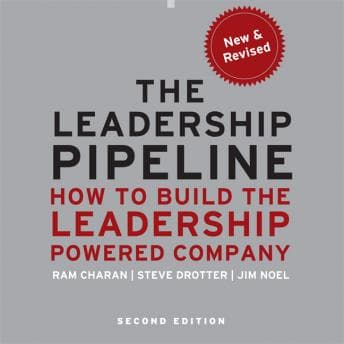

Everyone told me this was the essential leadership development book. The framework that Fortune 500 companies actually use. The mental model that would make me sound smart in those awkward skip-level meetings where my director asks what I think about "growing the next generation of tech leads." So I queued it up for a Monday morning, 6:07 AM Caltrain, Mountain View bound, coffee barely hitting my bloodstream.
I was zoned out by Millbrae.
The Framework That Could've Been a Confluence Page
TL;DR: Worth your commute — barely, and only if you 1.75x it and stay locked in for the first half.
Here's the thing: the actual core idea of The Leadership Pipeline is genuinely useful. It's basically a state machine for career transitions. You move from managing yourself → managing others → managing managers → functional manager → business manager → group manager → enterprise manager, and at each transition (they call them "passages"), three things change: your required skills, how you allocate time, and your work values. That's it. That's the model. And honestly? It's a good model. It maps surprisingly well to the IC-to-management ladder at any big tech company. When they describe someone who gets promoted to manage managers but keeps doing the work of a frontline manager — yeah, I've had that skip-level. We all have.
The problem is that this core idea, which I just explained in one paragraph, gets stretched across nearly 10 hours of audio. The first 3-4 hours are solid. They walk through each passage with enough specificity that you can actually picture the failure modes. Like when they describe a new functional leader who can't let go of their favorite discipline and keeps micromanaging that one team while ignoring the others — I literally texted Kevin "this is my old manager" at a red light. (I was walking. I text at red lights when walking. I'm not a monster.)
But then somewhere around hour 5, the content starts looping. Same concepts, slightly different framing, case studies that blur together because they're all anonymized into generic "Company X promoted Leader Y too fast." The second half feels like you're stuck in a recursive function with no base case. I kept checking my phone thinking I'd accidentally rewound.
Walter Dixon and the Narrator Problem
Okay, I need to be honest here. Walter Dixon has theater chops and decades of broadcast experience, and on paper he should be fine for a business book. But this narration is... flat. Like, systemd-log-output flat. There's no energy modulation, no vocal shift when the authors are making a critical point versus just providing context. For a book that already struggles with repetition in its back half, the monotone delivery is a force multiplier — in the wrong direction.
I'm someone who listens to business books at 1.75x specifically because most of them pad their runtime. At 1.75x, Dixon becomes tolerable, even decent. The pacing snaps into something that feels more like a brisk briefing than a lecture. But at 1x? On a 6 AM train? I was fighting my eyelids. And I say this as someone who stayed up until 2 AM fixing a cascading failure in prod last month and still managed to finish a 12-hour sci-fi binge afterward. The content has to meet the narration halfway, and here neither side showed up with enough energy.
Ray Porter narrates this. Need I say more? ...Just kidding. He doesn't. But God, imagine if he did.
Who Should Actually Listen to This
If you're a senior IC thinking about moving into management, or you just got promoted to manage a team of leads, the first half of this book is legitimately worth your time. The passage model gives you vocabulary to articulate why certain leadership transitions feel so jarring — why your brilliant staff engineer is a terrible engineering manager, or why your great team lead is drowning as a director. It's a diagnostic framework, and in that capacity it works.
Perfect for: train, gym — but only if you commit to 1.75x and treat it like a 5-hour book by skimming the second half. Skip for: deep work, bedtime (you WILL fall asleep), or anyone looking for modern tech-specific leadership advice.
If you're already a director or above, or you've read any of Charan's other work, the ROI on this audiobook is diminishing fast. You probably already internalize most of this intuitively. And if you just want the model without the padding, there are blog summaries and podcast episodes that'll give you the 80/20 in 20 minutes.
Could've been a blog post. Well — could've been a really good blog post. Or maybe a tight 4-hour audiobook. At 10 hours with this narration, it's asking a lot. The bloat problem isn't unique to leadership books — What It Takes has the same runtime generosity problem, though Schwarzman at least keeps the anecdotes personal enough that the padding feels earned.
The Commit Message
I finished this in about 5 commutes at 1.75x, and I'm glad I did — but mostly for the mental model from the first half that I'll actually use. The Leadership Pipeline has a genuinely useful core framework buried under corporate consulting prose and a narration style that doesn't fight hard enough for your attention. Read the first half, absorb the passage model, apply it to your org chart, and move on. Your commute time is a finite resource. Allocate accordingly.