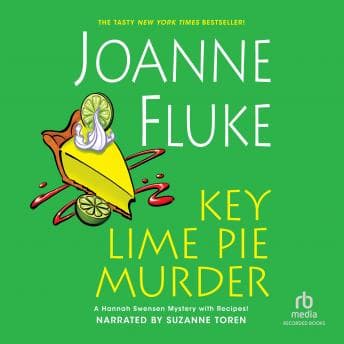

Everyone told me the Hannah Swensen series was comfort food in audiobook form. Cozy mysteries, small-town charm, recipes included. What nobody mentioned was that by book nine, you're basically eavesdropping on a woman whose life has become a case study in boundary violations and codependent family dynamics.
I was making dal makhani at 10 PM—the kind of elaborate cooking project I undertake when I'm avoiding my own manuscript revisions—when Willa Sunquist's body appeared next to that upended key lime pie. And I found myself asking: why does Hannah keep stumbling onto corpses? This is what happens when a small community unconsciously deputizes their local baker as an amateur detective. The research actually shows that people in tight-knit communities often develop informal justice systems. That same small-town dynamic—where everyone knows everyone and secrets fester—drives the tension in Evil Beneath, though the stakes there are considerably darker. Hannah Swensen is Lake Eden's informal justice system, and nobody seems concerned about this.
Classic Caretaker Syndrome, Exhibit A
Hannah's juggling act in this installment borders on pathological. She's baking for the chamber of commerce booth. Judging a contest. Playing magician's assistant for her business partner's husband. Managing her mother's demands. Worrying about her sisters. And—here's the detail that genuinely concerned me—trying to coax her cat Moishe out of a hunger strike.
Psychologically, this tracks perfectly. Hannah can't say no. She derives her identity from being needed, from being the reliable one, from fixing things. When a body drops, of course she investigates. It's just another problem requiring her attention. My therapist would have thoughts about this character—specifically about how Hannah's compulsive helpfulness might be avoidance of her own internal life.
Joanne Fluke understands human nature, even if she's packaging it in sugar cookies and fair booth drama. The supporting cast feels like actual people with their own agendas, not just props for Hannah's sleuthing.
Suzanne Toren's Minnesota Is Very Specific
I've listened to narrators attempt regional accents before. Most sound like they learned from YouTube videos. Toren's been doing this for thirty years, and it shows. She's nailed the tonal patterns of Minnesotans—that particular flatness, the way vowels stretch just slightly, the polite passive-aggression that Midwesterners perfect by age twelve.
Her character differentiation is solid throughout. Hannah sounds different from her mother, who sounds different from her sisters. The men have distinct voices without Toren straining into caricature. There's a fine sense of pacing here—she knows when to speed through exposition and when to let tension build.
AudioFile named her a Golden Voice, and honestly? Earned. She's the audio equivalent of a perfectly calibrated oven temperature. You don't notice her technique because you're too busy following the story. I had a similar experience with the narration in Holes—the voice work was so invisible it let the story take center stage.
The Cookie Jar Problem
Some listeners complained there's too much action outside the bakery. They wanted more baking in their baking mystery. I understand the impulse—we come to cozy mysteries for the cozy—but this doesn't track as a real criticism. The Tri-County Fair setting gives Fluke room to introduce suspects, create atmosphere, and place Hannah in unfamiliar territory where her usual advantages don't apply.
The fair scenes work. The baking contest judging provides stakes beyond the murder. And that carnival ride tension at the end? Classic thriller construction, even if we're pretty sure Hannah will survive to bake another day.
What makes this character compelling is her ordinariness. She's not a genius detective. She's a baker who notices things because she pays attention to people—an underrated skill in both mystery-solving and psychological research.
Who Should Queue This Up (And Who Should Skip)
If you need a palate cleanser between heavier reads, this delivers. If you're a completionist working through the series, Toren's consistency across books means no jarring narrator changes. If you're cooking, cleaning, or doing any activity requiring 60% of your attention, the mystery plot is engaging enough to follow without demanding your full focus.
Skip if you need your mysteries dark and gritty. Skip if you're annoyed by protagonists who can't establish healthy boundaries. Skip if you require your female leads to be single-mindedly focused on crime-solving rather than also managing family drama.
Session Notes
Nine books in, the Hannah Swensen series knows exactly what it is. Comfort food with a body count. Suzanne Toren's narration elevates the material—she's the reason I finished instead of abandoning for something denser. The mystery itself is serviceable, the fair setting charming, the recipes presumably functional (I haven't tested them; my dal was already complicated enough).
Hannah Swensen would make an interesting therapy client. All that caretaking, all that boundary-crossing, all that compulsive problem-solving. But she'd probably bring cookies to her sessions, and honestly, that would help.