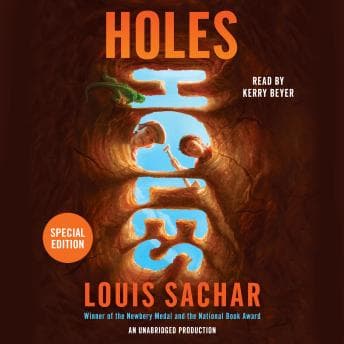

Look, I need to talk about Holes for a second. Because this book - this weird, brilliant, cursed-family-digging-holes-in-the-desert book - shaped an entire generation's understanding of what middle-grade fiction could be. And listening to it as an adult? It hits different. Way different.
I first read this in sixth grade, hiding it inside my math textbook because my teacher was droning on about fractions. Now I'm a librarian recommending it to kids who remind me of myself, and I finally got around to the audiobook. Listened to most of it shelving returns in the quiet hours. Shirley (my cat, not Jackson, though obviously named after her) was thoroughly unimpressed when I came home still thinking about yellow-spotted lizards.
The Curse That Keeps On Giving
Here's the thing about Louis Sachar's storytelling - it shouldn't work. You've got a kid named Stanley Yelnats (palindrome, yes, it matters) getting sent to a juvenile detention camp for a crime he didn't commit. You've got flashbacks to 19th century Latvia, a doomed romance in a Texas town, and a curse that spans generations. The narrative jumps around like it's got somewhere to be. And yet? It all clicks together like the most satisfying puzzle you've ever solved.
Kerry Beyer gets this. His narration is smooth - almost deceptively so. There's no theatrical grandstanding here, no over-the-top character voices that scream "I'M ACTING NOW." Instead, he's got this slightly boyish quality with just a hint of Texas twang that feels exactly right for the setting. It's unvarnished. Dry. The kind of delivery that lets the dark humor land without telegraphing every joke.
That same dry wit shows up in Kid Normal, though with more superhero absurdity and less existential dread.
And this book IS darkly funny. Sachar understood that horror isn't always about monsters - sometimes it's about authority figures who make you dig holes in 110-degree heat while pretending it's "character building." The Warden with her rattlesnake venom nail polish? Genuinely unsettling. Beyer plays her with this cold restraint that made me deeply uncomfortable in the best way.
Where the Timeline Gets Tricky
Okay, so here's my one real gripe. The flashback structure - which is genius on the page - gets a little murky in audio format. You're bouncing between Stanley's present-day hole-digging, the story of Kissin' Kate Barlow, and the tale of Stanley's no-good-dirty-rotten-pig-stealing-great-great-grandfather. Beyer does shift his tone for different timelines, but it's subtle. Maybe too subtle.
I caught myself rewinding a few times, especially during the Kate Barlow sections. Not because the narration was bad - it wasn't - but because I'd zone out for thirty seconds and suddenly we're in a completely different century. If you're listening while doing something else (dishes, driving, existential dread), you might miss the transitions.
The payoff when all the threads come together, though? Absolutely worth the occasional confusion. This is a book that rewards attention. Every weird detail - the onions, the peaches, the shoes falling from the sky - it all matters. Sachar trusted his readers to keep up, and Beyer trusts his listeners the same way.
The Voices That Work (And the Ones That... Don't Quite)
Beyer's Stanley is pitch-perfect. He sounds like a kid who's been beaten down by life but hasn't lost his fundamental decency. The other boys at Camp Green Lake - X-Ray, Squid, Armpit, Zero - each get their own subtle vocal distinction. It's not showy, but you can tell who's talking.
Some listeners apparently found Zero's voice too slow, too "doofus-like." I didn't get that at all. Zero is a kid who's been failed by every system that was supposed to protect him. His quietness, his hesitation - it felt intentional. Respectful, even.
The bonus content with Louis Sachar himself narrating is a nice touch. Hearing the author talk about his own work adds a layer of authenticity I genuinely appreciated. It's short, but it matters.
Would I Listen Again?
Honestly? Yes. This is one of those audiobooks I'd throw on during a long drive without hesitation. It's under five hours, the pacing is tight, and even knowing exactly how everything connects, there's something satisfying about hearing it unfold again.
If you're introducing a kid to audiobooks, this is a solid choice. If you're an adult who read it as a child and wants to revisit it - do it. The themes of systemic injustice, generational trauma, and the weird magic of breaking curses through kindness? They hit harder now than they did when I was twelve. Skip it if you need big, theatrical narration or can't handle a story that asks you to juggle three timelines at once - Beyer's restraint is a feature, not a flaw, but it won't work for everyone.
I got a similar feeling revisiting Alice In Wonderland as an adult—childhood classics that reveal new layers when you're old enough to catch what you missed.
The narration won't blow you away with theatrical fireworks. But it doesn't need to. Beyer understands that sometimes the best thing a narrator can do is get out of the way and let a genuinely great story breathe.
My podcast listeners are going to love this recommendation. Finally, a middle-grade book that respects both its genre and its audience.