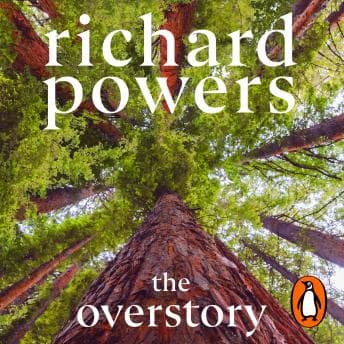

Twenty-three hours. That's how long Richard Powers asks you to sit with trees. Trees! I teach Faulkner to teenagers who can't sit still for a sonnet, and here I am, a grown man, complaining about the length of a Pulitzer Prize winner because it's about - and I cannot stress this enough - trees.
Except it's not about trees. Or rather, it is, the way Moby-Dick is about a whale. Which is to say: barely, and entirely.
The Prose Deserves to Be Savored at 1.0x, Even When It Hurts
I started this on a Sunday lakefront walk with Denise. We got maybe forty minutes in before she pulled out one earbud and said, "Is this going to be nine separate origin stories?" And yes. Yes it is. Powers opens with what amounts to a short story collection - an artist inheriting a century of photographs of a single American chestnut tree, a Vietnam airman falling through a banyan canopy and surviving, a scientist named Patricia Westerford who can barely hear the human world but somehow hears what trees are saying to each other. Each strand is gorgeous in isolation. The Patricia sections alone - her childhood discovering that trees send chemical warnings to each other through the air, her being laughed out of academia for it, her slow vindication - that's a complete novel I'd teach in my AP class.
But Powers is doing something ambitious and frankly maddening. He's writing on tree-time. The structure mirrors dendritic growth: roots, trunk, crown, seeds. And the pacing matches. This is not a book that respects your schedule. By hour eight, the nine strangers start converging around old-growth forest activism in the Pacific Northwest, and suddenly you're in a different novel entirely - part eco-thriller, part philosophical argument, part elegy for everything we've already lost.
This reminds me of what Hemingway said about prose being architecture, not interior decoration. Powers builds a cathedral here. Some rooms are transcendent. Some you wander through wondering when you'll find the exit.
Suzanne Toren Is the Right Narrator for the Wrong Reasons
Here's where I need to be honest. Toren's voice has this quiet authority that matches Powers' dense, lyrical prose perfectly. When she reads the botanical passages - and there are many, pages of them, describing mycorrhizal networks and crown shyness and the chemical vocabulary of a forest - she finds a register that makes science sound like prayer. The narrator understands that pause is punctuation, and she uses silence well in those moments.
But the accents. Oh, the accents. There's a Hui Chinese character, his immigrant father speaking broken English, a Gujarati programmer, Dutch ancestry woven through one family's history - and Toren attempts all of them with roughly the same vaguely foreign inflection. Her Douggie is serviceable. Her Patricia Westerford is genuinely moving - you can hear the hearing loss in the way she flattens certain vowels, though I'm not confident that's intentional craft versus limitation. The character differentiation works better through pacing and emotional register than through any accent work.
I kept thinking about this contradiction: a narrator whose strengths are exactly right for 70% of the book and whose weaknesses are impossible to ignore for the other 30%. If you loved the audiobook of, say, Middlemarch (and I did, Principal Martinez, during your Q3 budget review), you'll appreciate Toren's patience with long sentences. If you need sharp character voices in a book with nine protagonists, you might struggle to track who's speaking.
What the Author Is Really Saying (And Why Some Readers Push Back)
I've seen the complaints. "Too many plots." "Characters are flat." "Drawn out." And look - I get it. Powers isn't writing people the way we usually demand novelists write people. His characters are deliberately reduced to almost archetypical roles: the activist, the scientist, the artist, the coder. They function more like individual trees in a forest than like the complex psychological portraits we expect from literary fiction.
That's the point. That IS the argument. Powers is asking whether our obsession with individual human interiority - the very thing that makes us love novels - is the same narcissism that's killing the planet. My students would hate this. I love it. But I also understand why someone at hour fifteen, during yet another passage about root systems, might throw their phone into a lake.
The book changed something in how I see the elms along my walk to school. I notice them now. Not as backdrop. As neighbors. That sounds ridiculous. Powers would say that's the whole problem - that it sounds ridiculous.
Who This Is For (and Who Should Politely Decline)
If you loved Middlemarch or Moby-Dick or anything that asks you to expand your definition of what a novel can care about, this is their spiritual successor in the ecological tradition. If you need plot momentum and tight character arcs, this will test you. If you're considering the audiobook specifically: commit to focused listening sessions. This is not background audio. I tried grading papers to it once and realized I'd listened to forty minutes of mycology without absorbing a word.
Twenty-three hours is a real commitment. But the prose deserves to be savored, accent stumbles and all.
The Assignment I'd Give My Students (That They'd Refuse)
Read one section. Just "Roots." Then go stand next to a tree for ten minutes without your phone. See if you feel anything. If you do, the other twenty hours are worth it. If you don't, Powers would argue you just haven't listened long enough. The man wrote a 23-hour argument that patience is a moral act, and then had the audacity to be right about it.