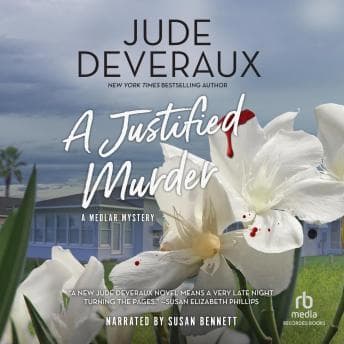

Shot, stabbed, AND poisoned. That's not murder—that's a committee decision.
I was chopping onions for a biryani that would take three hours and feed one person (again, don't pity me, I genuinely prefer it this way) when Janet Beeson's murder was discovered. And immediately, my brain went into overdrive. The research actually shows that overkill—multiple methods of death on a single victim—typically indicates either extreme rage or multiple perpetrators with different ideas about how to get the job done. Jude Deveraux knows this. She's built an entire mystery around the psychological question: what kind of person inspires that much hatred?
When the Victim Is Too Perfect
Here's what makes this a fascinating case study in motive construction. Janet Beeson is described as the town's kindest, most helpful resident. Sweet little old lady. Everyone loved her. And yet—shot, stabbed, poisoned. The protagonist exhibits classic cognitive dissonance when confronted with this: how do you reconcile the public persona with the violence of her end?
Deveraux understands something fundamental about small-town psychology. The helpful neighbor who knows everyone's business isn't just kind—she's powerful. Information is currency. And Janet Beeson was apparently the Federal Reserve of Lachlan, Florida. The book slowly peels back this dynamic, revealing how "helpfulness" can become its own form of control. My therapist would have thoughts about this character.
What I found myself asking: why does Janet really insert herself into everyone's lives? The answer, when it comes, reframes everything you've heard. That's solid mystery construction.
The Amateur Detective Problem (And Why It Works Here)
I'll be honest—amateur sleuths usually make me twitchy. In real investigations, civilians contaminate evidence and get people killed. But Deveraux sidesteps this by making the setup organic. Sara, Kate, and Jack don't want to investigate. They explicitly vow not to. But the townspeople won't stop talking to them. The sheriff actively recruits them. It's less "nosy neighbors playing detective" and more "reluctant consultants who can't escape their own reputation."
The trio's dynamic is genuinely interesting from a group psychology perspective. You've got Sara—the elder with life experience and social capital. Kate—younger, more impulsive, emotionally invested. And Jack—the wild card with his own secrets. Their interactions feel like actual family negotiations, not just plot-convenient teamwork. There's friction. Disagreement about methods. Real stakes in their relationships beyond "will we solve the murder."
Susan Bennett's Quiet Authority
The narration here is doing something subtle that I appreciated. Bennett doesn't go for theatrical differentiation between characters—no cartoonish accents or dramatic vocal shifts. Instead, she modulates tone and pacing. Sara sounds measured, careful with words. Kate has more urgency in her delivery. The effect is naturalistic rather than performative.
For a 10+ hour listen, this matters. Overly dramatic narration exhausts me. Bennett maintains engagement without demanding constant attention, which meant I could focus on the actual psychology of the mystery rather than being distracted by vocal gymnastics. The emotional beats land because she trusts the material rather than overselling it.
Psychologically, This Tracks
The thing about small-town mysteries is they live or die on whether the community dynamics feel authentic. Full Bloom attempted similar community dynamics, though it didn't quite nail the layered relationships the way this one does. Deveraux gets something right that many authors miss: everyone in a small town has multiple roles. The pharmacist is also your neighbor's brother-in-law who dated your aunt in high school. Relationships are layered, complicated, impossible to untangle without understanding decades of history.
When secrets start emerging—and they do, steadily, like water finding cracks—they make sense within this web. Nobody's hiding things for arbitrary plot reasons. They're hiding things because exposure would destroy relationships they've spent lifetimes building. That's human nature. That's how real secrets work.
The resolution genuinely surprised me, which doesn't happen often. (I've read too many mysteries. Occupational hazard of analyzing narrative patterns.) Deveraux plants clues fairly, but the emotional logic of the killer's motivation is what sells it. When you understand why, the how becomes almost secondary.
Who Should Listen (And Who Should Skip)
If you want action-packed thriller pacing, this isn't it. Deveraux takes her time building the social architecture of Lachlan before the dominoes fall. It's a slow burn that rewards patience. Skip if you need constant momentum.
But if you're someone who reads mysteries for the character psychology—who wants to understand why people do terrible things to each other—this delivers. It's cozy mystery adjacent but with genuine darkness underneath the small-town charm. The violence of Janet's death isn't sanitized. The implications are allowed to be disturbing.
Series readers will find this a satisfying continuation. Newcomers can start here, though you'll miss some relationship context from the first book.
The Case File Closes
I finished this audiobook around 2 AM, biryani long since eaten, my notes full of character motivation diagrams that would make my dissertation committee proud (or concerned). Deveraux has constructed something that works both as entertainment and as a study in how communities protect their own—until they can't anymore.
The research actually shows that most murders are solved not through forensic brilliance but through social networks. Someone talks. Someone always talks. Deveraux understands this, and builds her mystery accordingly. Worth the time investment.