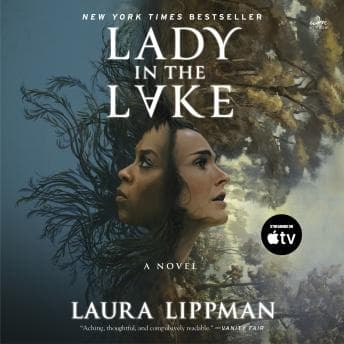
Look, I need to rant for a second about how we treat dead women in fiction. Specifically, how we treat Black women in fiction. Because Laura Lippman wrote a book that's ostensibly about Maddie Schwartz—ambitious white housewife reinventing herself in 1960s Baltimore—but the real ghost haunting every page is Cleo Sherwood. And Cleo? Cleo doesn't want to be found. Doesn't want to be Maddie's stepping stone to journalistic glory. Doesn't want to be anyone's redemption arc.
This understands that horror isn't about gore—it's about dread. And the dread here? It's watching a woman with good intentions pave her road straight to hell.
I was reorganizing the horror section at the library (Shirley Jackson was, predictably, misshelved under "Women's Fiction" again) when I started this one. Ten hours and forty-five minutes later, I'd missed my lunch break and genuinely forgotten what year I was living in. That's either a compliment or a cry for help.
The Dead Don't Want Your Savior Complex
Here's what Lippman does that's genuinely unsettling: she gives voice to the dead. Literally. Cleo Sherwood narrates portions of this book from beyond the grave, watching Maddie dig into her life with all the sensitivity of a bulldozer at a crime scene. It's a structural choice that could've been gimmicky. Instead, it's devastating.
Because Cleo sees everything Maddie doesn't. The way Maddie treats the Black police officer who loves her as a convenience. The way she uses people's stories without ever really seeing them. The way ambition in a woman—especially a woman escaping the suffocation of 1960s domesticity—can curdle into something ugly when it's built on other people's tragedies.
Susan Bennett narrates the whole thing solo, which is ambitious given the rotating perspectives. There's Maddie, of course. There's Cleo. There's Cleo's eldest son, whose chapter—I'm not exaggerating—made me sit down in the middle of the stacks because my legs stopped working. There's a jewelry clerk, a waitress, a Baltimore Orioles player, a cop. Bennett creates distinct identities for each of them, shifting her register in ways that feel earned rather than showy.
When One Voice Carries Multitudes
Some listeners found Bennett's delivery monotone. I get it—she's not doing vocal gymnastics. Her approach is understated, almost journalistic, which makes sense given the subject matter. But here's the thing: when she hits the emotional beats, she commits. The chapter from Cleo's son's perspective? Bennett lets the grief sit there, unadorned, and it's more effective than any theatrical sobbing would've been.
The pacing is slow-burn in the truest sense. This isn't a thriller that sprints—it's a thriller that tightens like a noose you didn't notice around your neck. Lippman was a Baltimore Sun reporter, and you feel that in the procedural details, the way she builds the city as a character with its own secrets and prejudices. If you're looking for constant action, you'll be frustrated. If you're looking for dread that accumulates in your chest like pressure before a storm? This is your book.
(My podcast listeners are going to love this one. Or hate it. Probably both.)
The Uncomfortable Mirror
What makes this genuinely unsettling—in that way I live for—is that Maddie isn't a villain. She's sympathetic. She's a woman who was told to be small and quiet and is finally, desperately, trying to matter. And Lippman makes you root for her even as you watch her fail the people around her in ways that are achingly, recognizably human.
That's the horror, really. Not the dead woman in the lake. The living woman who can't see past her own reflection in the water.
Content warnings: racism (period-accurate and unflinching), sexism, violence, and language. This is 1960s Baltimore with its ugliness intact. Lippman doesn't sanitize. That Affair Next Door takes a more traditional approach to its mystery—less morally complicated, but still satisfying if you're looking for something lighter.
Who Needs This (And Who Should Run)
If you want a mystery where the detective is the hero, skip. If you want a fast-paced thriller with constant twists, skip. If you want comfortable listening while you're half-distracted, definitely skip—this requires your full attention or you'll lose track of the perspectives.
But if you want literary noir that interrogates who gets to be a victim and who gets to be a savior? If you want a book that trusts you to sit with discomfort? If you want horror that lives in the space between good intentions and terrible outcomes?
Shirley Jackson walked so Laura Lippman could run.
Shelved in the Dark
I listened to the last hour in the dark. (Mistake? Maybe. Worth it? Absolutely.) The ending doesn't give you the catharsis you want, and that's entirely the point. Some stories don't get solved. Some women don't get justice. Some ghosts just want to be left alone.
Susan Bennett carries the weight of all those voices, and mostly, she carries it well. A few flat moments aside, this is a performance that understands the assignment: horror isn't about gore. It's about the things we do to each other while convincing ourselves we're helping.
Finally, horror that respects the genre—even when the genre is dressed up as literary fiction.