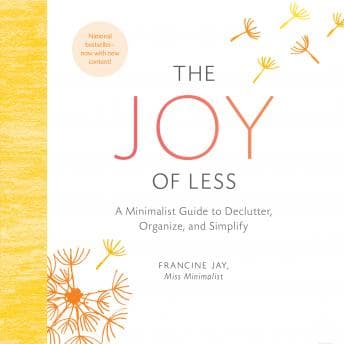

I was standing in my closet at 6 AM on a Saturday, staring at a shelf of grad school anthologies I haven't opened since the Clinton administration, when it hit me: I should probably listen to a book about getting rid of books. Denise had been making pointed comments about the guest room closet for months. So I queued up Francine Jay's The Joy of Less and spent the next few weekends decluttering while the book played through my earbuds. There's something almost too on-the-nose about listening to a minimalism guide while literally holding a trash bag.
Here's the thing I discovered about halfway through: this book isn't really about stuff. I mean, it is - there's a whole room-by-room breakdown in Part Three that gets granular about bathroom cabinets and kitchen gadgets and what to do with that third set of sheets nobody needs. But what Francine Jay is really saying - and this is what surprised me - is that clutter is a symptom of how we've confused accumulation with identity. She talks about how every object in your home is essentially asking for your attention, your time, your mental energy. That landed for me. I've got twenty years of lesson plans in filing cabinets that I will never look at again, but somehow throwing them away felt like throwing away proof that I'd been a good teacher.
The STREAMLINE Method Actually Streams
Jay structures the practical half of the book around an acronym - STREAMLINE - where each letter represents a decluttering principle. Start over, Trash/Treasure/Transfer, Reason for each item, Everything in its place, and so on. Now, I'll be honest: I usually hate acronym-based frameworks. They feel like something from a professional development seminar where Principal Martinez is trying to get us excited about "GROWTH mindsets." But Jay's version works because each step builds logically on the last rather than just spelling a cute word. The "Reason" step - asking yourself to articulate WHY you own something - was the one that actually changed my behavior. I couldn't give a single good reason for keeping four coffee mugs from conferences I barely remember attending.
That said, there's repetition. Real repetition. Jay circles back to the same core ideas - own less, live more, question every possession - across all four parts of the book. In print, you'd skim past it. In audio, at six hours, you feel it. By Part Three, when she's applying the same principles room by room, I caught myself thinking "Yes, I know, I should ask if it sparks purpose, you've said this." It's not that she's wrong. She's just thorough in a way that tests your patience when you can't skip ahead easily.
Teri Schnaubelt Reads Like Your Organized Friend
Schnaubelt's narration is clean. Clear. Professional. She sounds like the friend who actually uses label makers and doesn't apologize for it. There's a motivational warmth in her delivery that kept me going through the more repetitive stretches - she reads Jay's encouragements with genuine conviction rather than infomercial energy. But here's my honest assessment: for a book this practical, I sometimes wanted more personality, more variation in pace. The prose is conversational and light, and Schnaubelt matches it faithfully. Maybe too faithfully. A little more vocal dynamism during the inspirational passages versus the how-to sections would've helped my brain distinguish between "philosophy" and "instructions." At six hours, the evenness of tone starts to blend together.
I listened at my standard 1.0x, and for once, I'd actually say this is a book where bumping to 1.25x wouldn't sacrifice anything. The ideas don't require the kind of sentence-level savoring that fiction demands. The prose deserves to be clear, not necessarily savored. That's not an insult - it's a different kind of writing serving a different purpose.
Compared to the KonMari Universe
If you've read Marie Kondo, Jay's approach is the no-nonsense American cousin. No thanking your socks. No holding each item to your chest to see if it "sparks joy." Jay's framework is more logical, more systematic, and frankly more useful if you're the kind of person who finds Kondo's philosophy a bit precious. (Denise is a Kondo person. I am now, apparently, a Jay person. We coexist.) Where Kondo is spiritual, Jay is strategic. Neither is wrong, but they'll appeal to very different brains. I went deeper into Kondo's visual approach when I reviewed Spark Joy, and if the illustrated format sounds more your speed than six hours of audio, that one's worth a look.
Who Gets the Most From This
This is ideal for someone who's never seriously thought about minimalism and wants a friendly, structured entry point. If you've already read five decluttering books, you'll find the content light - the ideas aren't groundbreaking so much as well-organized. It's the difference between a survey course and a seminar. My students would hate this comparison, but Jay is essentially teaching Minimalism 101, and she does it well.
Best listened to while actually cleaning. Not while grading papers at 11 PM. I tried both. The cleaning session was productive and motivating. The grading session just made me resentful of my paper piles.
The Shelf It Earned
I donated fourteen boxes of stuff the weekend I finished this. Denise can park in the garage now. The book did its job. It didn't change my philosophy of life, but it gave me a framework I actually used, which is more than most self-help books manage. For a six-hour listen that costs you one credit, the question is whether you need the push or the method. If you need both, this delivers. If you just need one, you might want to browse Jay's blog first and save the credit for something with more depth.