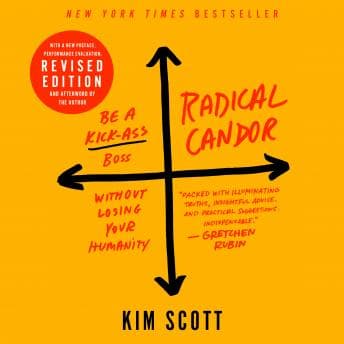

How many management frameworks have you seen die on the whiteboard? Because I've watched at least a dozen get introduced at all-hands meetings, printed on laminated cards, and then quietly abandoned within a quarter. So when I tell you Kim Scott's 2x2 matrix - Care Personally on one axis, Challenge Directly on the other - has actually stuck with me through three client engagements and one very tense conversation with my accountant, that should mean something.
I listened to this one on a Saturday morning while assembling IKEA furniture for Jenny's home office. Which turned out to be weirdly appropriate, because Radical Candor is basically an instruction manual for something most managers try to build without reading the directions: honest workplace relationships.
The Framework That Earned Its Keep
Bottom line: the core insight is genuinely useful. The four quadrants - Radical Candor, Ruinous Empathy, Obnoxious Aggression, Manipulative Insincerity - give you language for dynamics you've felt but couldn't name. Scott's example of her boss Sheryl Sandberg telling her after a presentation, essentially, "You said 'um' so much it made you sound stupid" - and framing it as an act of caring - that lands. It's memorable. It's the kind of story that makes you rethink every piece of vague feedback you've ever given.
The Ruinous Empathy quadrant hit me hardest. I've been that manager. I once let a direct report at McKinsey coast for six months because I liked him and didn't want the confrontation. He got PIP'd by someone else. That was my failure, not his. Scott names this pattern with surgical precision.
But here's where my parents' dry cleaning business enters the chat: my mom gave Radically Candid feedback to employees every single day. She didn't need a quadrant. She cared about people AND told them directly when they pressed a shirt wrong. This is what my parents did instinctively. Now it has a TED talk.
12 Hours Is About 7 Hours Too Many
And this is the problem. The key takeaway is worth the listen. The other 7 hours? Not so much. At nearly 12 hours, this book commits the cardinal sin of business audiobooks: repeating the same insight with different anecdotes until you want to throw your AirPods into traffic. The GSD (Get Stuff Done) wheel she introduces later - Listen, Clarify, Debate, Decide, Persuade, Execute, Learn - is fine but feels like a separate, less interesting book stapled onto the back of a great one.
The revised edition adds a preface, afterword, and a bonus chapter on performance reviews. The performance review chapter is actually practical - concrete guidance on separating developmental conversations from compensation discussions. That's worth your time. The original edition, Radical Candor: How to Get What You Want by Saying What You Mean, delivers the same framework without the extra chapters, if you prefer leaner. The preface mostly contextualizes the original book's reception and addresses some criticisms. Fine, but not essential.
Skip to chapter 5 if you're already a manager who understands the basic framework. That's where the tactical stuff on giving guidance actually lives. Thank me later.
Teri Schnaubelt Does the Job (No More, No Less)
Schnaubelt's narration is clean and professional. She reads like a competent executive coach presenting slides - clear diction, good pacing, no dramatic flourishes. Which is exactly right for this material. You don't need vocal pyrotechnics for a management book. You need someone who won't get between you and the content. She does that. I've heard her bring that same clean, no-fuss delivery to Do You Remember?, though the material there asks a bit more from a narrator.
What she doesn't do is differentiate voices in the many anecdotes. When Scott quotes a conversation between herself and a direct report, then transitions to a story about Steve Jobs, it all sounds like the same person telling you things in the same register. At 2.0x speed this occasionally made me rewind to figure out who was saying what. Not a dealbreaker, but noticeable.
Won the Earphones Award, which I mention only because it confirms: professional, competent narration. Not electric, not bad. Solid B+.
Who Gets the Most Out of This
First-time managers. Full stop. If you've never managed people and you're about to, this is one of three books I'd actually recommend (the other two are "The Manager's Path" and "High Output Management"). The framework gives you a vocabulary for feedback conversations that most new managers desperately lack.
Seasoned leaders? You'll nod along for the first two hours and then start checking your email. The concepts aren't new to you - you just might not have had this specific language for them.
If you're a founder burning through your Series A and wondering why your team keeps quitting - listen to the Ruinous Empathy section on repeat. I've seen this fail at three different companies. Being "nice" is not the same as being kind.
The Consulting Engagement Is Over
Jenny would say I'm being harsh. Jenny is right. This is a good book with a great framework trapped inside too many pages. The 2x2 matrix alone has probably saved more management relationships than couples therapy has saved marriages. But at 12 hours, Kim Scott tests even my 2.0x patience. Read the matrix, internalize the quadrants, listen to the stories about Sandberg and Jobs, skip the GSD wheel unless you're building your first team playbook. Your ROI peaks around hour 4 and it's diminishing returns from there.