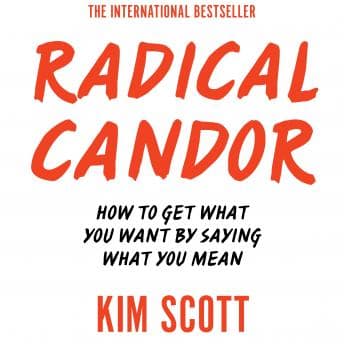

What if the thing holding your team back isn't strategy or talent—but the fact that nobody will just say what they actually think?
I've been asking this question in boardrooms for years. Usually while watching executives dance around obvious problems like they're at a corporate cotillion. Kim Scott's answer is simple: stop being nice, start being honest. And she's got the Google and Apple credentials to back it up.
The Framework That Actually Works
Here's the thing about management books—90% of them could be a blog post. Radical Candor is different. The 2x2 matrix Scott introduces (Care Personally vs. Challenge Directly) is the kind of framework that sticks. It's the rare business tool that actually simplifies decision-making, unlike the convoluted prosperity formulas in Fundamentals of Prosperity, which felt more like academic exercises than actionable tools. I've used it in client meetings. I've drawn it on whiteboards. My parents ran their dry cleaning business on pure instinct, but if I had to translate their management style into MBA-speak? They were radically candid before it had a name.
The core insight: most managers fail because they're either too aggressive (they challenge but don't care) or too empathetic (they care but won't challenge). Scott calls the second one "Ruinous Empathy" and—ugh—I've seen this kill more startups than bad product-market fit. The nicest founders often build the most dysfunctional teams. This avoidance-of-conflict dynamic is exactly what Who Moved My Cheese? tries to address, though that book takes the parable route instead of Scott's direct, framework-driven approach.
The Google and Apple stories are genuinely useful. Not the usual "I was in a meeting with Steve Jobs and he said something profound" name-dropping. Actual situations with actual lessons. When Scott describes getting feedback from Sheryl Sandberg about her verbal tic, you get a clinic in how to deliver criticism without destroying someone.
About That Narration (Let's Be Real)
Okay, so here's where I have to be radically candid about Radical Candor.
Kim Scott narrates this herself. I respect that choice—there's authenticity in hearing an author's own voice, especially for a book about honest communication. But the delivery is... challenging. Flat. Monotone at points. My 2.0x speed couldn't save this one. Some listeners have compared her voice to Roseanne Barr, which is harsh but—yeah, I get it.
The irony isn't lost on me. A book about giving honest feedback, and I'm sitting here thinking "someone should have told her to hire a professional narrator." Maybe someone did and she pushed back. That would actually be on-brand.
The content is strong enough that I pushed through. But I'd be lying if I said there weren't moments where I zoned out and had to rewind. If you're sensitive to narration style, this might be a read-instead situation. The print version delivers the same insights without the vocal friction.
Where to Spend Your Time
The book runs nearly 9.5 hours, and honestly? There's probably 4 hours of essential content here. The framework chapters are gold. The stories are engaging. But some sections meander into territory that feels like padding.
My recommendation: chapters on giving guidance, getting guidance, and the whole "Get Stuff Done" wheel are worth every minute. The team-building sections toward the end? Skim-worthy at best.
What I appreciated: Scott doesn't pretend this is easy. She shares her own failures. The time she fired someone badly. The times she was the problem. That vulnerability is rare in business books, where authors usually position themselves as enlightened beings who descended from Management Olympus to share their wisdom.
The ROI Calculation
Radical Candor is one of maybe ten business books I'd actually recommend to a first-time manager. The framework is practical. The examples are real. The advice is actionable without being simplistic.
But the audiobook experience? Tougher sell. Scott's narration adds authenticity but subtracts enjoyment. I finished it during a long consulting project—lots of airport time, lots of hotel treadmills. The content kept me engaged even when the delivery made me want to switch to a podcast.
Listen if: You're a manager who's never learned how to give feedback without either being a jerk or being useless. The framework alone is worth the time investment. Skip if: Flat narration derails your focus, or you're already comfortable with direct feedback—you'll find the 9.5 hours hard to justify.
Jenny would say I'm being harsh about the narration. Jenny is right. But Kim Scott wrote a book about being honest, so I figure she'd appreciate that.