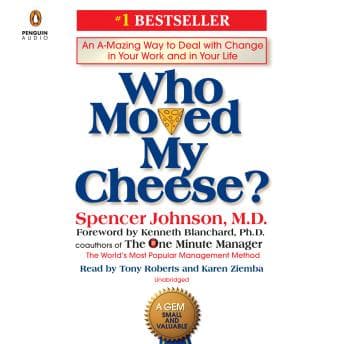

Bottom Line: Look, I'm going to be honest. I avoided this book for years. It felt like the kind of thing an HR rep hands you right before they announce a "strategic restructuring" (read: layoffs). It's the "Hello World" of business self-help. But last Tuesday, the Caltrain was delayed—again—and I had exactly 90 minutes of dead air and a brain fried from debugging a race condition that shouldn't exist. So, I hit play.
And? It's... actually decent. (Don't tell Kevin I said that, he'll try to make me read The 7 Habits next.)
It's Basically a Pixar Movie for Middle Management
Here's the premise: You've got a maze. You've got cheese. You've got two mice (Sniff and Scurry) and two "Littlepeople" (Hem and Haw). The cheese moves. Panic ensues.
It sounds ridiculous when you say it out loud. Seriously, I felt a little silly listening to a fable about rodents while sitting next to a guy coding in Rust. But the simplicity is the feature, not the bug. In tech, we overcomplicate everything. We build Rube Goldberg machines to solve simple problems. This book does the opposite. It strips away the jargon and just asks: "Why are you freaking out because the API changed?"
It's not deep philosophy. It's not going to teach you how to scale a database. But when Haw finally stops complaining and starts running through the maze again? I felt that. A solid reminder that staring at the empty space where your "cheese" (or your legacy code, or your favorite perk) used to be won't bring it back.
The "Therapy Voice" Factor
Let's talk about the audio. We've got Tony Roberts and Karen Ziemba here. I couldn't find a ton of specs on their setup, but the vibe is very... nurturing.
Most business books are narrated by guys who sound like they want to sell you a timeshare or yell at you to wake up at 4 AM. These two? They sound like supportive parents. Or that one engineering manager who actually cares about your burnout. Ziemba's voice, in particular, is super warm.
That said—it is slow. The pacing is deliberate. I cranked this up to 1.75x immediately. At 1.0x, it felt a bit like storytime at the library. But at 1.75x? It flows perfectly. Turns a sermon into a pep talk.
The ROI on 99 Minutes
Here's the main selling point for me: It's short.
You can finish this entire book in one commute. Or one solid gym session. The ROI is high because the investment is so low.
Is it groundbreaking? No. If you've been in the industry for more than five years, you've probably lived this story ten times over. But sometimes you need a simple reset. You need someone to tell you that it's okay to be scared of change, but it's stupid to stand still.
Who Should Listen (And Who Should Skip)
If you're currently dealing with a reorg, a breakup, or a massive platform migration, give it a listen. It's cheaper than therapy and shorter than a Marvel movie. Skip it if you're allergic to fables or need something with actual tactical frameworks—this is mindset, not methodology.
Though if you want something that actually is therapy-adjacent and won't make you roll your eyes, Wired for Love surprised me with how practical it was—way less woo-woo than the title suggests.