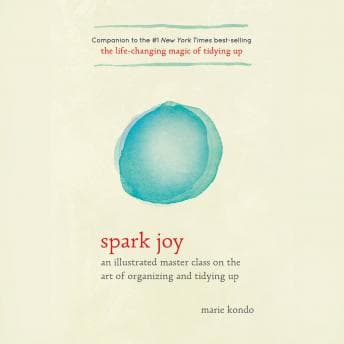

I was elbow-deep in my spice cabinet at 10 PM on a Tuesday—cumin from 2019, three half-empty bottles of vanilla extract, a mysterious jar labeled only with a question mark—when I finally admitted I needed help. Not therapy (well, also therapy), but practical intervention. So I put on Marie Kondo's Spark Joy and started touching every object in my kitchen like some kind of domestic archaeologist.
Here's the thing about listening to a book about tidying while actually tidying: it creates this weird feedback loop where you feel both productive and slightly judged. In a good way? My therapist would have thoughts about this.
The Psychology of Your Sock Drawer
What makes Kondo's approach fascinating from a research perspective is that she's essentially doing cognitive behavioral therapy for your stuff. The KonMari Method isn't really about organization—it's about forcing you to confront your relationship with objects, which is really about confronting your relationship with memory, identity, and the future self you're afraid you'll never become. (That bread maker you used once in 2017? That's not a bread maker. That's crystallized guilt about the person you thought you'd be.)
The book gets granular. We're talking specific folding techniques for underwear, detailed instructions for storing cleaning supplies, guidance on what to do with those digital photos cluttering your phone. Some listeners apparently found this "too detailed." To which I say: that's... the point? This is a master class. It's in the title. You don't attend a master class expecting broad strokes.
The research shows that our attachment to objects operates on surprisingly predictable psychological patterns—sunk cost fallacy, identity projection, anxiety about future need. Kondo addresses all of these, though she frames them in terms of "joy" rather than clinical language. Smart move. Nobody wants to hear they're exhibiting classic hoarding-adjacent behaviors while sorting their Tupperware.
Sumalee Montano's Voice as Meditation
Sumalee Montano's narration won an AudioFile Earphones Award, and I get it. Her voice has this quality—calm without being sleepy, warm without being saccharine—that makes you feel like a reasonable adult making reasonable choices rather than someone who just discovered four sets of measuring cups.
The pacing is deliberate. Purposeful pauses that let Kondo's instructions land. There's a lightness in her tone when describing the relief of letting go, and a gentle steadiness when walking through the more prescriptive sections. It's the audio equivalent of a clean, well-lit room.
I'll note this doesn't register as a flaw, exactly, but: at five and a half hours, you're not getting dramatic range. This isn't a book that requires it. But if you're coming off a thriller with seventeen distinct character voices, the single-note calm might feel almost too peaceful. I found myself adjusting—this is background-compatible listening, not edge-of-your-seat engagement.
The Illustrated Problem (Or: Why Audio?)
Here's where I found myself asking: why does someone really choose the audiobook for a book called "An Illustrated Master Class"? The companion PDF helps, but let's be honest—you're probably not pausing to consult diagrams while folding your shirts. The audio version works best as philosophy and motivation, less well as literal instruction manual.
If you've already read The Life-Changing Magic of Tidying Up, this functions as both refresher and deep-dive. If you haven't, you might want to start there. Spark Joy assumes you're bought in on the basic premise and ready for advanced techniques.
Who Gets Joy, Who Gets Frustrated
You'll love this if: you find detailed organization content genuinely soothing, you're ready to actually implement rather than just think about tidying, or you need someone's calm voice telling you it's okay to throw away the broken umbrella you've kept for three years.
Skip it if: you want philosophy without prescription, you're resistant to the idea that objects can "spark joy" (some people find this anthropomorphizing irritating—valid), or you need high-energy motivation rather than gentle encouragement.
The Diagnosis
Kondo understands human nature in a way that's genuinely useful. She knows we keep things out of guilt, fear, and misplaced hope. That same understanding of how we sabotage ourselves shows up in POSITIVE THINKING POWER: HOW TO CHANGE YOUR LIFE AND DEFEAT THE INNER CRITIC, though it tackles the mental clutter instead of the physical kind. She knows the sock drawer is never really about the socks. And Montano delivers all of this with the exact energy it requires—peaceful, practical, non-judgmental.
I finished the audiobook. I also finished my spice cabinet. The question mark jar turned out to be cardamom. I kept it. It sparked joy.
(My mother would still say I have too many books. But that's a different conversation.)