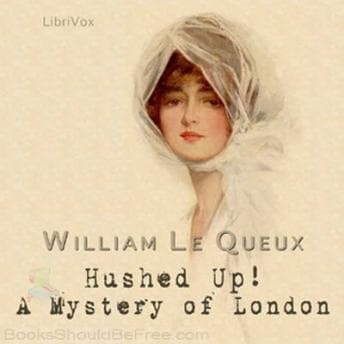

William Le Queux is a name most modern thriller readers have never heard, and that's a shame.
I stumbled onto this one late on a Tuesday night - couldn't sleep, Ranger sprawled across the foot of the bed, Linda long since out. Figured a 7-hour Edwardian mystery would either hook me or knock me out. It did both, actually, across two nights.
Let me cut to the chase: Hushed Up! is a product of its era, for better and worse, and understanding that going in matters more than anything.
Pre-War Paranoia With a Stiff Upper Lip
Le Queux was writing spy and mystery fiction before Ian Fleming's parents had even met. The guy was a journalist who genuinely believed German spies were crawling all over Britain in the early 1900s, and that paranoid worldview bleeds into everything he wrote. Hushed Up! isn't a spy novel per se - it's more of a romantic mystery - but that same atmosphere of hidden motives and concealed identities runs through it like a current.
Owen Biddulph, our protagonist, gets tangled up with a young woman whose past is apparently dangerous enough that a mysterious clergyman warns him off at risk to his own life. Now, if this were a modern thriller, you'd get the reveal in chapter three and spend the rest of the book in a firefight. Le Queux doesn't work that way. He slow-rolls everything. The mystery of who this woman really is - and what threat she actually poses - unfolds through drawing room conversations, chance encounters in London, and the kind of social maneuvering that defined Edwardian life. It's less Jack Reacher, more Downton Abbey with a body count lurking in the background. Enemy of Mine occupies similar territory - that slow-burn dread of concealed identities and pasts that refuse to stay buried, though it gets there through a more modern lens.
I've seen this scenario play out in real life, actually - the idea that someone's past can reach forward and grab them. It's never as dramatic as fiction makes it, but the paranoia is real. Le Queux captures that creeping dread pretty well, even if his prose can feel overwrought by 2024 standards. Sentences that would get red-penned by any modern editor just... go on. And on. But there's a rhythm to it once you adjust, like tuning into a radio frequency you haven't used in years.
Tom Weiss Does the Heavy Lifting
Here's where it gets interesting. Some folks have said this book needs a female British narrator, and I get that argument - the story has a strong romantic thread and the Edwardian London setting practically demands a proper English accent. But Tom Weiss is solid. Clear, steady pacing, and he builds the suspense in the right places without overselling it. He's not doing vocal gymnastics with different characters - this is pretty much a straight read - but his delivery is clean and he keeps you moving forward.
Is he the ideal narrator for this material? Probably not. An English voice would've added an authenticity layer that's missing here. When you're listening to a story set in turn-of-the-century London with characters named Dorise and Owen Biddulph, an American-sounding read creates a subtle disconnect. It's like watching a war movie where the actors are holding their rifles wrong - most people won't notice, but once you do, you can't unsee it.
That said, Weiss is clearly a fan of Le Queux's work, and that genuine enthusiasm comes through. He treats the source material with respect, which counts for something when you're narrating a 100-year-old novel that most publishers have forgotten exists.
The Pace Problem (And Why It Doesn't Fully Matter)
At 7 hours 23 minutes, this isn't a massive commitment, but the pacing feels longer than it is. Le Queux was writing serialized fiction for a readership that had nothing competing for their attention - no smartphones, no streaming, no 24-hour news cycle. The plot advances in measured steps, and there are stretches where you're waiting for the next reveal while Owen does a lot of hand-wringing about whether to trust this woman.
I bumped to 1.25x about an hour in and never looked back. At that speed, the slower passages become atmospheric rather than tedious, and the plot reveals hit with better timing.
Compared to his contemporaries - Arthur Conan Doyle, Erskine Childers - Le Queux sits somewhere in the middle. He's not as sharp as Doyle or as politically prescient as Childers' The Riddle of the Sands, but he's got a knack for maintaining an undercurrent of unease that keeps you listening past your bedtime. Which, for the record, I did. Twice.
Who Should Bother
If you're strictly a modern thriller reader who needs gunfights every 30 pages, skip this. But if you've got any interest in the roots of the spy/mystery genre, or you just want something different from the usual airport novel fare, this is worth your time on a streaming service or library app. It's a window into how suspense worked before Hollywood taught us to expect explosions every ten minutes.
Ranger slept through most of it. But he sleeps through everything that doesn't involve the word "walk," so that's not a reliable metric.
Mission Debrief
Worth your time? Here's the debrief: Hushed Up! is a pleasant, slow-burning mystery from an era when the genre was still finding its legs. The author clearly did his homework on London society and the mechanics of secrets. Weiss delivers a clean narration that gets the job done without quite nailing the atmosphere. It's a library listen, not a credit spend - but for the right listener on the right night, it scratches an itch you didn't know you had.