
I'd expected a quaint Victorian curiosity piece - something to half-listen to while making dal makhani on a Sunday afternoon. What I got was genuinely interesting as a psychological artifact, but deeply uneven as a listening experience. And honestly? That unevenness is the most fascinating thing about it.
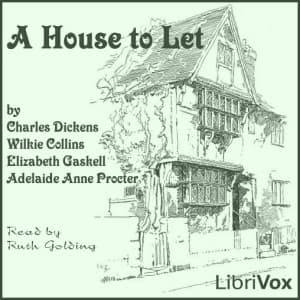
Here's what nobody tells you about House to Let: this isn't really a novel. It's a literary experiment from 1858 where Charles Dickens essentially played showrunner, writing the framing narrative and the finale with Wilkie Collins, then farming out the middle chapters to different contributors - including Adelaide Anne Procter, who apparently decided the mystery format needed... poetry. The result is less a cohesive mystery and more a case study in collaborative storytelling, and I found myself asking: why does this structure work at all? The answer is Dickens' framing device. Sophonisba, the elderly woman obsessing over a seemingly empty house across the street, is doing exactly what any good psychologist does - observing behavior, forming hypotheses, recruiting help to test them. The protagonist exhibits classic hypervigilance patterns, and Dickens seems to know it. She's not presented as paranoid; she's presented as right.
When Five Authors Share One Brain (And Don't)
The real tension here isn't whether the house holds a dark secret. It's whether these wildly different authorial voices can sustain a single story. Spoiler: kind of. Dickens and Collins handle the bookends with their usual sharp characterization - Jabez Jarber, Sophonisba's would-be suitor, is a perfectly drawn portrait of male ego disguised as devotion. My therapist would have thoughts about this character. He's helping her investigate not because he cares about the mystery but because proximity to her attention is the prize. That's 1858 and it's also last Tuesday.
But then you hit the middle sections, the stories-within-stories, and the tonal shifts are jarring. One chapter reads like gothic melodrama, another pivots into sentimental domestic fiction, and then Procter's poetry arrives like someone changing the radio station mid-sentence. At four hours and thirteen minutes, it's short enough that these shifts don't become punishing, but they do break whatever atmospheric spell the framing narrative builds. Psychologically, this doesn't track as a unified mystery. It tracks as a Christmas magazine issue - which is exactly what it was.
The Multiple Narrators Problem (Or Feature?)
The audiobook uses various readers, and here's where I have to be honest about what I'm working with: the research doesn't give me specific narrator names or distinct performance details. What I can tell you is that the multi-narrator approach actually mirrors the book's original structure in a way that feels appropriate - different voices for different authorial contributions makes the patchwork nature transparent rather than pretending it's something seamless. Whether that's a deliberate production choice or just practical logistics, I can't say. But it works conceptually even if it prevents you from ever fully settling into one voice.
The 4-hour runtime is actually the sweet spot for this kind of thing. Any longer and the structural cracks would become canyons. At this length, you can process it as a literary curiosity without the commitment a full Dickens novel demands.
Why Your Psych 101 Professor Would Assign This (But Your Book Club Would Revolt)
This is a fascinating case study in how Victorian writers understood surveillance, obsession, and the stories we construct about strangers. Sophonisba watching that house is essentially nineteenth-century true crime podcasting - she sees fragments and builds a narrative, drags others into her investigation, and refuses to accept "it's nothing" as an answer. That same obsessive pattern-completion energy is exactly what makes Family Upstairs: A Novel so compulsively listenable - a contemporary story that understands the same psychological truth Dickens was working with in 1858. The research actually shows that our brains are wired to complete incomplete patterns, and Dickens weaponizes that impulse. The empty house isn't scary because something terrible might be inside. It's compelling because not knowing is intolerable.
But let's be real: the middle chapters dilute this beautifully sharp premise. If you're coming for a tight mystery with satisfying payoff, you'll be frustrated. If you're coming for a window into how collaborative Victorian fiction worked - and didn't work - you'll be fascinated. I was both, simultaneously, standing over my stove stirring a pot I'd forgotten to season because Jabez Jarber was being insufferable in the most psychologically accurate way.
Who Needs This and Who Doesn't
If you love Dickens completionism or Victorian literary history, this is a worthy four hours. If you study collaborative fiction, narrative framing devices, or the psychology of mystery structures, there's genuine material here. If you want a thriller that actually thrills? Skip it. The pacing is contemplative at best, sluggish at worst, and the stories-within-stories fracture whatever momentum Dickens builds.
The Diagnosis
A psychologically sharp framing device trapped inside a structurally messy experiment. Worth it for Dickens and Collins. Endurable for the rest. I wouldn't spend a credit, but on a free platform or streaming service? There are worse ways to spend an afternoon with your dal makhani.