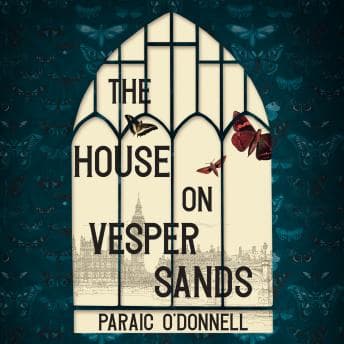

I was chopping onions for a biryani that would take three hours to make (my mother's recipe, which I've never gotten quite right) when the seamstress jumped. Not from my kitchen, obviously. From a window in 1893 London, with a cryptic message sewn into her own skin.
I put down the knife.
Here's the thing about Victorian mysteries: they're usually either all atmosphere and no substance, or they're so busy being clever that they forget to be human. The House on Vesper Sands does something I genuinely didn't expect—it's actually interested in why people do terrible things. Not just who did them.
The Case Study I Didn't Know I Needed
Gideon Bliss is a fascinating character because he shouldn't work. A Cambridge dropout chasing a missing girl he loves? That's the setup for a dozen forgettable heroes. But O'Donnell gives him this particular quality of earnest desperation that reads as psychologically authentic. He's not playing detective—he's a young man whose entire identity has been destabilized by loss. The research actually shows that people in acute grief often develop almost obsessive focus on a single task. Gideon's entire arc is essentially a case study in complicated grief response.
And then there's Inspector Cutter, who I found myself thinking about during my morning jog the next day. His wry humor isn't just comic relief—it's a defense mechanism. Classic compartmentalization. My therapist would have thoughts about this character, specifically about how he uses wit to maintain emotional distance from the horrors he investigates. It's the kind of detail that tells me O'Donnell understands human nature, not just Victorian aesthetics.
Octavia Hillingdon, the reporter fighting to write real stories instead of society fluff, exhibits the classic pattern of someone whose competence is consistently undervalued by authority figures. Her frustration isn't just plot-convenient feminism—it's the specific, grinding exhaustion of being dismissed. I recognized it immediately.
Charles Armstrong's Class Warfare
The narration does something subtle that I almost missed at first. Armstrong creates distinct voices that reflect social status—the way a character speaks immediately tells you where they fall in the Victorian hierarchy. It's not just accents. It's rhythm, vocabulary choice, the amount of space they take up in a sentence. The upper classes drawl and expand; the working classes are clipped, efficient.
This matters because the book is fundamentally about exploitation. About who gets to disappear without anyone noticing. Armstrong's vocal class markers make that theme visceral in a way the text alone might not achieve.
The seance scene—and I won't spoil the context—benefits enormously from his pacing. He knows when to let silence do the work.
Where the Threads Tangle
I should be honest about something. Some listeners found the blend of mystery and occult elements unconvincing, and I can see why. The book asks you to hold two genres in your head simultaneously, and around hour seven, I found myself asking: why does this need supernatural elements when the human evil is already so compelling? Fellowship of the Ring manages a similar genre blend—grounded character work alongside genuine magic—though Tolkien commits fully to the fantastical in a way O'Donnell seems hesitant to do.
Psychologically, this doesn't quite track for me. The occult aspects feel like they're doing thematic work—something about hidden knowledge, forbidden power—but they also undercut the grounded character work that makes the mystery satisfying. It's not a fatal flaw. But it's a tension I never fully resolved.
The characters, too, are occasionally sacrificed to plot momentum. O'Donnell is so busy peeling back layers of mystery that some figures remain sketches when they could be portraits. I wanted more time with Octavia in particular. Her psychology is rich enough to sustain a whole novel.
Who Should Wander These Fog-Choked Streets (And Who Should Hail a Cab Home)
If you love Victorian London as a character in itself—the fog, the gaslight, the sense of a city with too many secrets—this is your book. If you're drawn to mysteries where the detective's emotional investment matters as much as the clues, you'll find a lot here.
Skip it if you need your genre boundaries clean. The occult elements are real, not just atmosphere, and if that's not your thing, it will frustrate you. Also skip if you need every character fully developed—this is plot-driven, ultimately, even when it pretends otherwise.
I finished the biryani around the same time I finished the book. Both were imperfect. Both were worth the effort.
Case Notes, Final
The House on Vesper Sands is a genuinely intelligent mystery that respects its characters' psychology more than most Victorian pastiches. Charles Armstrong's narration elevates material that could have been merely atmospheric into something with real emotional texture. The genre-blending won't work for everyone, and I wish the character development matched the plot's ambition. But I found myself thinking about Gideon Bliss for days afterward—about grief, about obsession, about how we construct meaning from loss.
That's not nothing. That's actually quite a lot.