
Agatha Christie understood something about Christmas that most writers miss entirely. The holiday isn't just tinsel and warmth—it's the perfect cover for mischief. Everyone's distracted by puddings and presents, which makes it the ideal time to steal a ruby from an Eastern prince.
I finished this one during a late December faculty meeting. Principal Martinez was explaining next semester's standardized testing schedule, and I was absolutely riveted. (I was not riveted. I was listening to Poirot deduce his way through an English country house Christmas party.)
The Joy of a Tight 85 Minutes
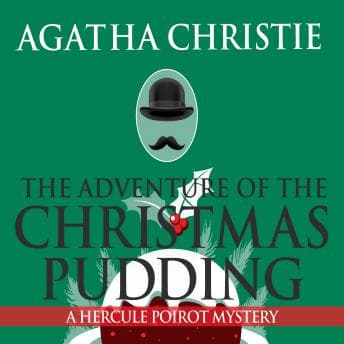
Here's what my students don't understand about short fiction: brevity isn't a limitation. It's a discipline. Christie published this story in The Sketch magazine in 1923, and you can feel that economy in every scene. There's no fat here. Poirot arrives at the Christmas celebration with a mission—recover a stolen ruby—and Christie wastes exactly zero time getting us into the intrigue.
The warning about the plum pudding? That's Christie at her most playful. She's winking at us through a hundred years of literary history, using the most English of holiday traditions as a vehicle for danger. If you loved Murder on the Orient Express for its claustrophobic setting, this is its cozy, festive cousin. Night Prey works the same way—tight setting, limited suspects, everything stripped down to essentials. Same sharp mind, smaller canvas.
Charles Armstrong narrates with what I'd call professional competence. He's not doing vocal gymnastics—no wild character voices or dramatic flourishes—but he keeps you engaged. His Poirot has just enough Continental precision without veering into caricature. The man understands that pause is punctuation, which matters enormously in mystery. Christie's reveals depend on timing, and Armstrong doesn't rush them.
What Christie's Really Doing Here
This reminds me of what Hemingway said about the iceberg theory—the dignity of movement of an iceberg is due to only one-eighth of it being above water. Christie's short stories work the same way. She gives you the surface: a charming country house, eccentric guests, holiday cheer. But underneath, she's constructing a puzzle box.
The Eastern prince angle is pure 1923—there's a colonial-era exoticism that feels dated now, but Christie uses it to create a fish-out-of-water dynamic. Poirot himself is an outsider in this very English setting, which lets him (and us) observe these traditions with fresh eyes. The Christmas party becomes a stage where everyone's performing their roles: the gracious hosts, the grateful guests, the unsuspecting victim.
My students would probably find this too slow. No car chases. No explosions. Just a Belgian detective eating Christmas dinner and noticing things other people miss. I love it.
The Short Story Problem (And Why It's Not Really a Problem)
Some listeners apparently felt this was "less fleshed out" than a full novel. Well—yes. That's how short stories work. You're not getting the sprawling character development of And Then There Were None. That's the trade-off with compact mysteries—Who the Hell is That? makes a similar choice, prioritizing plot mechanics over deep character work. What you're getting is a perfectly constructed puzzle that respects your time.
At 85 minutes, this is ideal for a single listening session. I finished it before Martinez even got to the budget projections. (Worth pausing the faculty meeting for, definitely.) It's the literary equivalent of a Christmas cookie—small, sweet, satisfying. You wouldn't complain that a cookie isn't a wedding cake.
The production is clean and straightforward. Single narrator, no sound effects, no musical interludes. Just Armstrong and Christie's prose. Sometimes that's all you need.
Who This Is For (And Who Should Skip It)
This is for Christie completists, obviously. But it's also for anyone who wants a taste of classic mystery without committing to a 12-hour production. If you're grading final exams in December (hypothetically speaking) and need something that'll keep your brain engaged without demanding too much attention, this fits perfectly. Skip it if you need action, deep character arcs, or anything resembling a modern thriller pace—you'll be bored before Poirot finishes his first cup of tea.
It's also genuinely festive without being saccharine. Christie loved English holiday traditions, and that affection comes through. The country house, the guests, the elaborate dinner—it's a time capsule of a particular kind of Christmas that probably never quite existed but feels real anyway.
The prose deserves to be savored. I listened at 1.0x because Christie chose those words, and Armstrong delivers them with appropriate care. Speed it up if you must, but you'll lose some of the atmosphere.
Class Dismissed
Denise asked me what I was smiling about during our lakefront walk last week. I was thinking about Poirot and the plum pudding. Some things just pair well with winter.