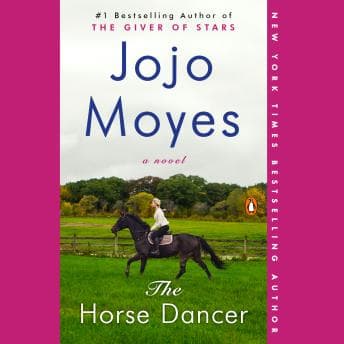

Fiona Hardingham is doing more work than Jojo Moyes on this one, and honestly? That's both the best and most frustrating thing about The Horse Dancer.
I finished this on a Sunday evening walk along the lakefront with Denise - she had her own podcast going, and I had about three hours left to burn through. The Chicago wind was doing its November thing, which felt right for a book set in gritty London where a fourteen-year-old girl is trying to keep a horse alive in what amounts to an urban stable. There's a cold, desperate energy to Sarah's story that pairs well with being slightly uncomfortable yourself.
The Girl, The Horse, and The Ghost of the Cadre Noir
Here's what Moyes does well: the premise is genuinely interesting. Sarah's grandfather, Henri Lachapelle - a former student of the Cadre Noir, which is essentially the Harvard of classical French horsemanship - is raising her in a cramped London council estate while training her and Boo in the old ways. Dressage in parking lots. Levade practice in city parks. There's something almost absurd about it, and Moyes leans into that tension between this ancient, aristocratic equestrian tradition and the reality of Sarah's neighborhood, where kids her age are getting pulled into much darker orbits.
But then Henri gets sick, and the book fractures into multiple storylines - Natasha the lawyer and her crumbling marriage, her ex-husband Mac who's suddenly back in her house, Sarah's increasingly desperate attempts to keep Boo fed and stabled without any adults noticing how badly things are falling apart. This is where I need to be honest: at sixteen hours, the Natasha-Mac storyline gets the kind of real estate that a Tolstoy subplot might deserve, but this isn't Tolstoy. Their will-they-won't-they-again dynamic is fine, but I found myself checking the chapter progress more than once during their domestic negotiations.
Let's talk about what Moyes is really saying here, though. The book's beating heart is about what we sacrifice - what we ask children to sacrifice - for legacy and tradition. Henri's dream for Sarah is beautiful and completely unreasonable. He wants her to escape through art, through discipline, through a horse. But the cost of that dream, when the adult structures collapse around her, is staggering. The scenes where Sarah is secretly sleeping in Boo's stable, skipping school, lying to everyone - those hit differently when you teach teenagers. I've had students carrying weights like that. They don't tell you. They just get quieter. That same slow suffocation under the weight of adult expectations - the way it warps a young person from the inside out - is something Joseph Conrad understood too, though he dressed it up in empire rather than dressage; my notes on Heart of Darkness kept coming back to me during Sarah's worst moments.
Hardingham Carries What the Plot Can't
Fiona Hardingham. This woman. She earned that AudioFile Earphones Award and then some on this recording. Her Sarah has this tight, guarded quality - a girl who's learned not to ask for help, and you can hear it in the clipped way Hardingham delivers her lines. Then she shifts to Henri, and suddenly there's this weathered French formality, a man speaking English with the careful precision of someone who's been doing it for decades but whose emotional life still lives in another language. The contrast between Henri's measured authority and the moments where his illness strips that away - Hardingham doesn't oversell it. She just lets his voice get a little thinner, a little less certain.
Natasha and Mac are handled well too - Natasha's slightly brittle professionalism versus Mac's warmer, more evasive tone. But it's the Sarah sections where the narration genuinely elevates mediocre plotting into something you care about. I was compelled to keep going through some middle sections that, on the page, I probably would've skimmed. And I don't say that as a compliment to the story structure.
The narrator understands that pause is punctuation. There are moments - particularly when Sarah makes decisions that you know are going to go wrong - where Hardingham holds just a beat longer than expected, and your stomach drops.
Where the Ride Gets Long
Sixteen hours is a lot for this story. If you loved Moyes' Me Before You, this is a different animal entirely - less focused, more sprawling, with a middle act that could've lost two or three hours without sacrificing anything essential. The Natasha chapters sometimes feel like a separate, less interesting novel that keeps interrupting the one you actually want to hear. And there are plot mechanics in the final act that strain credibility - Sarah's cross-Channel journey with Boo reads like it belongs in a different, more fantastical book than the gritty social realism of the first half.
My students would hate this. I love it. Well - I love about 70% of it. The other 30% I endured because Hardingham made the enduring feel worthwhile.
Who Gets in the Saddle
If you're a Moyes completist or someone who loves stories about the quiet, stubborn bond between a young person and an animal, this is worth your time. If you're coming off Me Before You expecting that same tight emotional gut-punch, recalibrate. This is a slower, wider book with a narrator who's doing Olympic-level work on a course that sometimes doesn't deserve her.
Skip if: you're impatient with domestic drama subplots or need tight pacing. Listen if: you trust a great narrator to carry you through the valleys. Worth pausing the faculty meeting for - but only the Sarah chapters. During the Natasha-Mac scenes, go ahead and pretend to pay attention to the budget presentation.