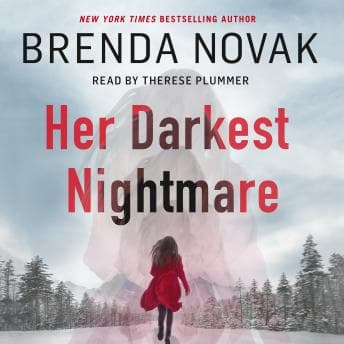

"The life she has so carefully rebuilt will never be the same."
That line from the description kept rattling around in my head while I was shelving returns at the library yesterday afternoon, which is probably why I decided to keep listening through my entire evening instead of switching to the backlist episode I was supposed to be editing for the podcast. Thirteen hours. On a weeknight. My eyes are paying for it today, but honestly? I needed to know how this one landed.
Here's the thing about Her Darkest Nightmare — it's not quite the book I expected, and I'm still sorting out whether that's a compliment or a complaint.
A Psychiatrist in Alaska Is Already a Horror Setup
Brenda Novak makes a smart move putting Evelyn Talbot in the most isolated, claustrophobic setting possible. A maximum-security facility for psychopaths in a tiny Alaskan town that gets cut off during winter? Shirley Jackson walked so this premise could run. The bones of this are pure psychological horror — a woman who survived being tortured by her teenage boyfriend, now spending her career face-to-face with men just like him, and then bodies start appearing.
That premise had me completely locked in. The early chapters where Evelyn is conducting sessions with inmates, trying to crack open their minds while keeping her own trauma from leaking through — that's where Novak is at her strongest. The power dynamics between doctor and patient, the way a psychopath can study you while you think you're studying them. This understands that horror isn't about gore — it's about dread. Big Little Lies operates on that same principle — the real threat is never the one you're watching. About the slow realization that the monster knows exactly where you are.
But then the book splits its attention. And this is where I have to be honest.
The Romance That Keeps Interrupting the Murder
So Sergeant Amarok is the rugged Alaskan lawman who doesn't trust the facility but is very, very attracted to Evelyn. Fine. I can work with that — the friction between them creates genuine tension early on when he's pushing to shut down Hanover House while she's defending her life's work. That dynamic crackles.
The problem is when the romantic storyline starts taking up real estate that the thriller plot needs. There are stretches in the middle — around hours five through seven, if I'm remembering right — where the pacing goes soft. The murder investigation loses momentum because we're spending time on will-they-won't-they beats that feel like they belong in a different book. I'm not anti-romance in my thrillers (I contain multitudes), but the tonal whiplash between "a woman was mutilated" and "his hand brushed her arm and she felt heat" gave me genuine friction burns. The tonal juggling act is something The President Is Missing also struggles with, honestly — thriller machinery grinding against softer character moments in ways that occasionally break the spell.
Some parts also required me to suspend my disbelief a little harder than I like. The way certain investigative decisions play out, the convenience of certain revelations — a couple of plot turns felt more like narrative shortcuts than earned twists. Entertaining shortcuts, sure. But I noticed them, and once I noticed, I couldn't un-notice.
Thérèse Plummer Sells What the Script Sometimes Doesn't
Here's where the audiobook format actually saves this book in places where the text might have lost me. Thérèse Plummer's delivery during the suspense sequences is genuinely tense — she modulates her pacing when things get dangerous in a way that kept my pulse up even during the sections where the plotting wobbled. Her Evelyn is controlled but brittle underneath, which is exactly right for a trauma survivor who's built her entire identity around clinical detachment.
Her Amarok is solid too, though I'll note that a couple of the male character voices blend together early on. By the midpoint she's differentiated them enough that it stops being an issue, but in those first few hours I occasionally had to reorient on who was speaking. Minor gripe.
The emotional scenes — and there are some heavy ones involving Evelyn's PTSD flashbacks — are where Plummer really earns her paycheck. The narrator commits. That's rare. She doesn't oversell the trauma but she doesn't flatten it either. There's a rawness to her reads of Evelyn's internal monologue during those moments that elevated the material.
No sound effects, no music, just a single narrator doing the work. Standard production, clean audio. Nothing fancy, nothing broken.
Who's Going to Love This (And Who Should Bail)
If you're here for pure horror or straight thriller, temper your expectations. This is romantic suspense with a horror-adjacent premise and some genuinely dark content (violence, sexual content, language — content warnings earned and deserved). If you love Brenda Novak's brand of intensity, or if you're the kind of listener who wants both the serial killer investigation AND the slow-burn love story, this is your sweet spot.
If you're like me and you wanted the book to stay in the dark corners of Hanover House with the inmates and the Alaskan winter pressing in — you'll get some of that, and those parts are strong, but you'll also spend time in romantic territory that may test your patience.
I listened in the dark. Mistake? Maybe. Worth it? Absolutely. Not because this is the scariest thing I've ever consumed — it's not — but because when Novak leans into the psychological dread, she knows exactly what she's doing. The Jasper thread, the question of whether he's found Evelyn again, the paranoia of being watched by someone who knows you better than you know yourself — that's the real engine here, and it runs hot.
My podcast listeners are going to have opinions about this one. Shirley (my cat) was unimpressed. I was... intrigued enough to queue up book two.