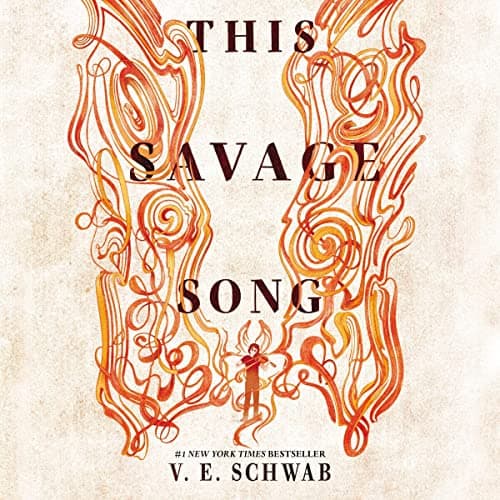

"Monsters, monsters, big and small, they're gonna come and eat you all." That nursery rhyme opens Victoria Schwab's This Savage Song, and Therese Plummer delivers it with this eerie, singsong cadence that immediately told me I was in for something darker than your standard YA fantasy. I started this one on a Monday commute and had it finished by Friday — not because ten hours is short, but because I kept finding excuses to keep listening.
Bottom Line: A romance-free urban fantasy built on atmosphere and two genuinely compelling leads, powered by a Therese Plummer performance that earned its AudioFile Earphones Award. Commit to both books in the duology — you'll want Our Dark Duet queued up before you hit the final chapters. Listen if you want character depth over ensemble breadth and don't mind a world that trades lore density for pressure-cooker tension. Skip if thin secondary characters or duology cliffhangers are dealbreakers for you.
Here's the premise that hooked me: in the city of Verity, human violence doesn't just cause suffering — it literally spawns monsters. Every act of cruelty births a creature. Schwab gives us three classes: Corsai, born from non-lethal violence, lurking in shadows and whispering; Malchai, vampiric things born from murder; and Sunai, the rarest, born from the worst atrocities, capable of stealing souls through music. Our protagonist August Flynn is a Sunai. He plays violin. When he plays, the guilty around him confess their sins and surrender their souls. There's a scene where August loses control of his hunger and Plummer shifts from his usual quiet restraint into something genuinely unnerving — his voice drops, the rhythm of her delivery changes, and you feel the monster surface through the human mask. It's the kind of moment that justifies choosing the audiobook over the page.
The city is split in two. On the north side, Callum Harker runs a protection racket — pay up or the monsters eat you. On the south side, Henry Flynn leads an actual resistance, fighting the creatures with a militia. Kate Harker and August Flynn are their respective heirs, and Schwab does something I didn't expect: she refuses to give them a romance. Kate is sharp, reckless, burning to prove she's as ruthless as her father. August is gentle, conflicted, desperate to be something other than what he is. They don't fall for each other. They build a wary, reluctant partnership that earns every inch of trust. In a genre where the default setting is instant attraction, this restraint surprised me and made both characters land harder.
Plummer's performance is the engine that keeps this moving. She voices August with a careful, almost fragile quality — you hear the effort of someone constantly holding himself in check. Kate gets steel and barely-concealed fear, the bravado cracking at the edges when things go sideways. What impressed me most is how Plummer handles the pacing shifts. When Kate and August are on the run after a failed assassination attempt, the narration accelerates without losing clarity. When August wrestles with his nature in quieter stretches, she lets the silence do work. She earned an AudioFile Earphones Award for this performance, and having listened to the whole thing, that tracks.
The worldbuilding stays lean, which I came to appreciate. Schwab doesn't build a magic system with seventeen rules and a glossary. She gives you the three monster types, the divided city, and the fragile truce between the Harkers and the Flynns, then lets tension do the rest. Verity feels like a pressure cooker. Every chapter pushes toward an inevitable break. The story runs closer to a two-person character study than an ensemble epic — and that's both its strength and its limitation.
Because here's the trade-off: the secondary characters suffer. Both fathers should be fascinating — a crime lord and a resistance leader running opposite sides of a monster-infested city — but they function more as plot architecture than people. Schwab handles ensemble depth much more generously in Vengeful, where the secondary cast gets real weight — though that book trades this one's lean atmosphere for something considerably more sprawling. The supporting cast around Kate and August exists to move them forward rather than to breathe on their own. If you're coming from Six of Crows, where Bardugo gives you six fully drawn protagonists, the smaller scope here might feel constraining. Schwab goes deep on two characters instead of wide on many, and whether that works for you depends on what you're after.
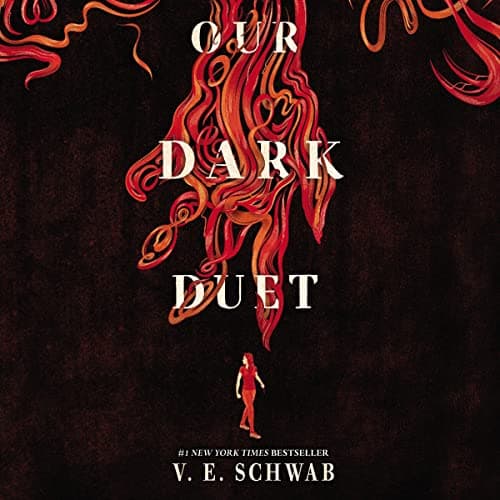
The other thing you should know going in: this is the first half of a duology, and it reads like one. The ending builds to a confrontation that resolves the immediate crisis but leaves the larger conflict wide open. Some listeners found this frustrating, and I get it. Have Our Dark Duet ready to go before you finish this one. The cliffhanger isn't egregious, but it's definitely there. I queued up Our Dark Duet immediately after finishing this one, and Plummer's continuity across both performances makes the whole duology feel like one long, very worthwhile commute.
What kept me coming back each morning was the atmosphere. This book feels genuinely dark without being gratuitous. The monsters work as literal threats and as reflections of human cruelty — every creature exists because someone did something terrible. When August picks up his violin, there's real dread in what follows, and Plummer's delivery during those moments carries genuine weight. The audio production is clean, the pacing rewards attentive listening, and the central relationship between Kate and August is strong enough to carry the story even when the world around them feels a touch sparse.
If you want a romance-free urban fantasy that trusts its characters to be interesting on their own terms, and you're willing to commit to both books, this is a strong ten hours.