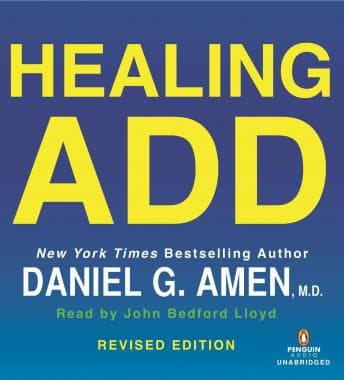

Fourteen and a half hours. For a book about ADD. The irony is not lost on me.
Look, I'll be honest - I picked this up because Kevin casually mentioned he thought he might have ADD after reading some Reddit thread at midnight, and I figured one of us should actually read something evidence-based before he started self-diagnosing via TikTok. Three commutes in, I was texting him screenshots of the 7 types like "babe, you're definitely Type 3, Overfocused ADD" and he was like "that's just being a software engineer." Fair point.
The "Your Brain Has 7 Failure Modes" Framework
TL;DR: Worth your commute if you or someone you care about deals with attention issues.
Dr. Amen's big thesis is that ADD isn't one thing - it's at least seven distinct types, each with different brain activity patterns visible on SPECT scans. Classic ADD, Inattentive ADD, Overfocused, Temporal Lobe, Limbic, Ring of Fire, and Anxious. Each gets its own chapter with symptoms, brain scan findings, and targeted treatment recommendations. This is basically a diagnostic decision tree but for your brain.
The strongest sections are where Amen walks through actual patient cases for each type. He'll describe someone who can't stop picking fights with their spouse - and then shows how their SPECT scan reveals overactivity in the anterior cingulate gyrus, which maps to the Overfocused type. Then he connects it to specific interventions: serotonin-boosting supplements for that type vs. dopamine-focused ones for Classic ADD. The specificity is genuinely useful. I found myself mentally sorting people I know into categories. (Sorry, coworkers. You've all been brain-typed without consent.)
Where it drags - and at 14+ hours, it DOES drag - is the repetition. Each type chapter follows roughly the same structure: here are the symptoms, here's what the scan looks like, here's a case study, here are the supplements, here's the medication. By type 5 you know the rhythm so well you could write the chapter yourself. This is a 9-hour book trapped in a 14-hour body. Classic business book bloat, except it's a medical book, so I felt guilty listening at 1.75x. I compromised at 1.5x and still caught everything.
SPECT Scans and the Credibility Question
I should flag something because the listener reviews mostly skip it: Amen's SPECT scan approach is controversial in mainstream psychiatry. The American Psychiatric Association hasn't endorsed SPECT imaging as a standard diagnostic tool for ADD. Amen's clinic charges significant money for these scans, and he has a financial interest in promoting them. Does that invalidate everything in the book? No. A lot of the practical advice - exercise recommendations, sleep hygiene, dietary changes, the breakdown of which supplements target which neurotransmitter systems - is solid and backed by broader research. But the book presents the SPECT scan framework as more universally accepted than it actually is. If you're an engineer like me, you want to know the confidence interval on your data, and he doesn't always give you that. That same frustration with sloppy reasoning is what made Art of Thinking Clearly such a satisfying commute for me — Dobelli is ruthless about naming exactly where human cognition goes wrong, no hand-waving about the evidence.
The supplement and medication chapters are genuinely the highest-ROI sections. He's specific: SAMe for Limbic ADD, L-tyrosine for Classic ADD, 5-HTP for Overfocused. Dosages, timing, interactions. Whether or not you buy the 7-type framework wholesale, having a structured approach to "which intervention for which symptom cluster" is way more useful than the generic "just take Adderall" approach.
John Bedford Lloyd Does the Job (Quietly)
John Bedford Lloyd narrates this the way you want a medical nonfiction book narrated: clean, clear, no drama. He's not trying to make brain scan results sound exciting, and I respect that. His pacing is steady enough that I never had to rewind after zoning out at a red light on the Caltrain platform - and for a 14-hour medical text, that's a real achievement. He's no Ray Porter (need I say more about Ray Porter? No? Good), but he's exactly the right voice for this material. Professional, trustworthy, the vocal equivalent of a well-organized Google Doc.
No sound effects. No music. No production gimmicks. Just a guy reading clearly. For this genre, that's perfect.
Who Gets the Prescription
Perfect for: train, gym, housework. Skip for: bedtime (you'll want to take notes on the supplement protocols, and that's hard when you're horizontal).
If you suspect you or someone close to you has ADD and you want a framework beyond "inattentive vs. hyperactive," this delivers real value. If you're a parent trying to understand a kid who's struggling, the parenting chapters are practical and compassionate. If you're a skeptic who needs peer-reviewed consensus before acting - you'll be frustrated by the SPECT scan evangelism, but you can still extract useful supplement and lifestyle info.
Kevin, for the record, does not have ADD. He just doesn't want to do the dishes. But now I have 14 hours of neuropsychiatry knowledge I didn't have before, so the ROI on this audiobook is... complicated.