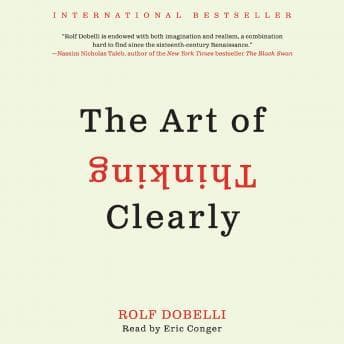

This book made me deeply uncomfortable. Not because it's bad—because it's a mirror.
I started listening during a late-night cooking session, making dal that would've fed four people but was destined for my fridge in single-serve containers. Somewhere between the sunk cost fallacy chapter and the confirmation bias breakdown, I realized I was stirring the pot way too aggressively. Dobelli had gotten under my skin.
A Catalog of Human Error (That Includes You)
The Art of Thinking Clearly is structured as 99 short chapters, each dissecting a specific cognitive bias. This format—bite-sized, standalone essays—works brilliantly for audio. You can pause between chapters without losing narrative thread, because there isn't one. It's modular thinking about thinking.
What makes this book compelling is Dobelli's refusal to position himself as immune. He's not lecturing from some rationality mountaintop. He's cataloging the same mental shortcuts he catches himself making. The protagonist here—and yes, I'm treating the reader as protagonist, my therapist would have thoughts about this—exhibits classic avoidance patterns. We all do. That's the point.
The examples range from auction fever to the swimmer's body illusion (we assume swimmers look fit because of swimming, when actually fit-looking people gravitate toward swimming). Some land harder than others. The free drink chapter stuck with me—why accepting something "free" creates psychological debt that costs more than just buying the damn drink yourself. I found myself asking: why do I really keep accepting review copies of books I'll never read?
Eric Conger's Clarity Problem
Here's where I need to be honest about a limitation. Conger's narration is technically impeccable. His phrasing is clean, his enunciation precise. Every concept lands with clarity.
But—and this is significant for nearly eight hours of listening—his tonal range is narrow. Each chapter sounds essentially like the last. No vocal differentiation between the chapter on social proof and the chapter on the availability heuristic. They blur together.
For a book that's already structured as discrete units, this sameness becomes problematic. You need the narrator to signal transitions, to reset your attention. Conger doesn't. He maintains the same measured, slightly detached delivery throughout. It's like listening to a very articulate GPS system explain human irrationality.
I bumped the speed to 1.25x around hour three. It helped. The faster pace created artificial urgency that his delivery lacked.
The Limits of Listicles
Psychologically, this doesn't track as a complete picture of human cognition. Dobelli cherry-picks biases that support his thesis (that we're fundamentally irrational) while glossing over the adaptive value of heuristics. Quick mental shortcuts evolved because they work most of the time. Our ancestors didn't survive by carefully weighing every decision against base rates.
This is a fascinating case study in... well, confirmation bias. Dobelli finds what he's looking for. The book would be stronger if he wrestled with the counter-evidence more seriously.
That said, as a practical toolkit? It's useful. I caught myself invoking the "sunk cost" framing twice last week—once when deciding whether to finish a terrible Netflix series (I didn't), once when evaluating a research project that wasn't going anywhere (still evaluating, but now with better language for the problem).
Who Gets Value Here
This works for you if: you want a reference guide to cognitive biases, you're new to behavioral economics, or you need ammunition for arguments about why humans make terrible decisions. The modular structure makes it perfect for commutes or gym sessions where you might miss chunks.
Skip it if: you've already read Kahneman's Thinking, Fast and Slow. Dobelli covers similar territory with less depth. Or if you need a narrator who varies their energy—Conger's consistency will wear on you. For a different approach to behavioral patterns—one focused on parenting cycles rather than cognitive biases—Raising Good Humans applies similar diagnostic thinking to family dynamics.
The Diagnostic Checklist
The Art of Thinking Clearly is the cognitive equivalent of a medical reference guide. It won't cure anything. But it names the diseases, and sometimes that's enough to start treatment.
I finished the audiobook at 1 AM, dal long since eaten, apartment quiet. Dobelli's final chapters circle back to what he calls "the circle of competence"—knowing what you actually know versus what you think you know. It's humbling.
My research focuses on how stories shape identity. This book argues that the stories we tell ourselves are usually wrong. We're unreliable narrators of our own lives.
He's not wrong. And that's the problem.