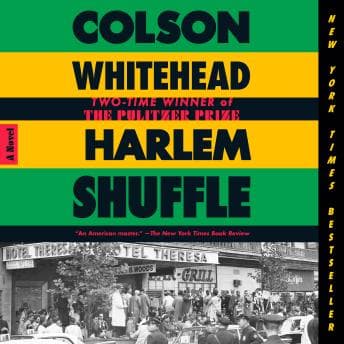

"Ray Carney was only slightly bent when it came to being crooked..."
I paused the audiobook right there. Maybe thirty seconds in. Because that's the kind of opening line you want to sit with. Colson Whitehead just handed you the entire novel's thesis in one sentence, and Dion Graham delivered it with this knowing warmth that made me think - okay, we're in good hands here.
And we are. Very good hands.
The Moral Architecture of a Furniture Salesman
Here's what I love about Whitehead's approach: he's written a crime novel that's really a character study that's really a social history that's really - and I mean this - a meditation on the American Dream and who gets to participate in it. My students would groan at that description. But they'd be wrong to skip this one.
Ray Carney sells furniture on 125th Street. Respectable. Family man. But he also fences stolen goods on the side because - and this is the quiet genius of the book - the line between legitimate business and criminal enterprise in 1960s Harlem isn't a line at all. It's a gradient. Whitehead never lets you forget that the same system that created Striver's Row also created the Hotel Theresa heist. The same forces that push Ray toward respectability push him toward crime.
The novel unfolds in three parts, spanning from 1959 to 1964, and each section deepens your understanding of Ray's world. It's not a thriller in the traditional sense. It's slower than that, more interested in the texture of daily life - the furniture showroom, the family dinners, the careful negotiations with both cops and criminals. But when the tension ratchets up, it ratchets.
Why Dion Graham Works
Look, I've listened to a lot of audiobooks set in historical New York. Some narrators treat the period like a costume - all exaggerated accents and theatrical flourishes. Graham does something different. It's the opposite of what I heard in Seven H.P. Lovecraft Stories, where the narrator leaned hard into theatrical delivery. He sounds like he actually lived there. Like he's telling you about people he knew.
His Ray Carney is measured, careful, always calculating. His Freddie - Ray's ne'er-do-well cousin - is loose and charming and a little dangerous. The gangsters sound like gangsters without becoming caricatures. The cops sound tired and corrupt and human. Graham maintains distinct voices for what feels like dozens of characters, and I never lost track of who was speaking.
He also understands Whitehead's humor. Because this book is funny - genuinely, unexpectedly funny. The descriptions of Ray's in-laws looking down on him. The absurdity of certain criminal enterprises. The way Whitehead skewers pretension while also taking his characters seriously. Graham gets the timing exactly right.
One thing I should mention: there are moments when Graham's voice drops low - really low - and if you're listening in a noisy environment (I was grading papers with the window open, traffic going by), you might miss a line or two. I rewound maybe three or four times across ten hours. Not a dealbreaker, but worth knowing if you're a commuter.
What Whitehead Is Really Saying
This is where I put on my English teacher hat. (Yes, I know. Bear with me.)
Harlem Shuffle is about the fiction of the straight path. Ray wants to believe there's a clean separation between his furniture business and his fencing operation. Between his respectable self and his criminal self. But Whitehead keeps showing us that the whole system is bent. The banks that won't give Black businessmen loans. The cops who shake down legitimate stores. The landlords, the politicians, the power brokers - everyone's got their hand in something.
So when Ray makes morally questionable choices, Whitehead isn't asking you to judge him. He's asking you to see the architecture that shaped those choices. It's social criticism disguised as a heist novel, which is basically my favorite genre.
The 1960s Harlem setting isn't just backdrop. It's argument. Whitehead researched this world obsessively - you can feel it in every detail, from the specific furniture brands Ray sells to the layout of the Hotel Theresa to the rhythm of street corner conversations. Graham's narration makes all of it vivid without ever feeling like a history lesson.
Would I Assign This to My Students?
Honestly? Yes. It's more accessible than Whitehead's Pulitzer winners while being just as smart. The crime novel structure gives reluctant readers something to hold onto. And the questions it raises about complicity, respectability, and survival are the kind of questions that lead to actual discussions, not just the performative nodding I usually get fifth period.
Plus, the audiobook is genuinely entertaining. Ten and a half hours went by faster than most five-hour listens I've done recently. I finished it on a Sunday walk along the lakefront, and Denise had to ask me twice why I was smiling.
Who's This For (And Who Should Skip It)
If you loved The Underground Railroad but want something lighter in tone (not in substance - just in how it goes down), this is your book. If you're a crime fiction fan who wants more literary depth, this is your book. If you just want to spend ten hours in a vividly realized world with a narrator who knows exactly what he's doing, this is your book. Skip it if you need constant action - this one earns its tension through accumulation, not acceleration.
Class Dismissed
The volume dips are minor. The rewards are major. Whitehead and Graham make a formidable team.