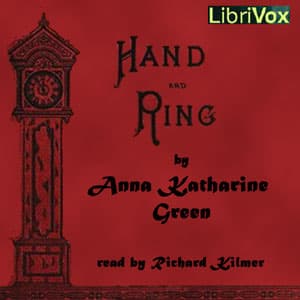

Anna Katharine Green wrote detective fiction before most people even knew what detective fiction was. Like, we're talking 1883. Before Agatha Christie was born. Before Arthur Conan Doyle published his first Sherlock Holmes. And honestly? Hand and Ring holds up better than it has any right to.
I started this one during a stretch of nights where the unit was eerily quiet - the kind of quiet you don't talk about because you're superstitious and you know what happens when someone says the Q word. I had my charting done, my patients were stable, and I popped in my earbuds. Sixteen hours and forty-six minutes is a commitment, and I want to be honest about that upfront.
A Murder Down the Street from the Courthouse? Sure, Why Not
The setup is classic and a little cheeky: Widow Clemmens gets killed in her own parlor while the town's lawyers and judges are literally chatting outside the courthouse a block away. Two suspects emerge fast, both equally plausible, and then there's this woman - Imogene Dare - hovering at the edges of everything like she knows more than she's letting on. Green doesn't rush the reveal. She makes you sit with the ambiguity, which I respect even when it tested my patience around hour eight.
Here's the thing about Green's legal accuracy - and this is where my ears perked up. I spend my professional life in a world where procedural accuracy matters. Get a medication dose wrong in a thriller and I will yell at my dashboard. Get courtroom procedure wrong in a mystery and... well, I'll notice. The procedural sloppiness in Indulgence in Death is exactly the kind of thing that keeps me honest about what real attention to process looks like versus what most genre fiction settles for. Green was trained by a lawyer father, and it shows. The courtroom scenes in the second half aren't just window dressing. They're the backbone. The cross-examinations have actual logic to them, the objections make sense, the way evidence gets introduced follows a real progression. This is not how most mysteries work. Trust me.
The Middle Will Test Your Loyalty
Okay, I have to be straight with you. The middle section drags. I've seen listeners say they skipped most of it, and I understand why. There are stretches where Green is building her case brick by brick - setting up the courtroom payoff - but it feels like she's laying every single brick individually while describing the mortar. Around hours six through ten, I was toggling between the audiobook and checking labs on my phone, and I won't pretend otherwise.
But here's why I didn't bail: the last fifty pages. When Inspector Gryce finally pulls all the threads together, it lands. The kind of landing where you go back and think, oh, THAT'S why she spent so long on that detail in chapter fourteen. Green was playing a longer game than I gave her credit for during the slog. It doesn't fully excuse the pacing, but it reframes it.
Richard Kilmer Does the Heavy Lifting
Richard Kilmer narrates this with steady, patient energy - which is exactly what a sixteen-hour Victorian mystery needs. He doesn't try to do wildly different voices for every character, but his pacing is deliberate in a way that keeps the courtroom scenes clear. You always know who's speaking and what's at stake. For a free LibriVox recording, the quality is solid. No weird audio cuts, no background noise that pulled me out. He reads like someone who actually understood the legal maneuvering, not just someone pronouncing words off a page.
I will say - and this is a personal preference thing - at nearly seventeen hours with a single narrator and Victorian prose, I bumped the speed to 1.25x around hour four and never looked back. The pacing improvement was significant without losing comprehension.
Who This Is For (and Who Should Run)
If you love courtroom drama - real courtroom drama, not the TV kind where someone confesses on the stand because the lawyer yelled loud enough - this is your book. If you're a mystery history nerd who wants to understand where the genre came from, Green is essential reading. If you want something that rewards patience with a genuinely satisfying resolution, the payoff is real.
But if you need constant action, if Victorian prose makes your eyes glaze, or if you can't commit to a slow burn that takes its sweet time through the middle act? Skip it. Life is short and your TBR isn't getting any shorter.
My mom would love this, actually. She devours courtroom dramas and she'd appreciate that Green was doing this work in the 1880s as a woman writing legally precise detective fiction. Mom's got taste. She still thinks I should've been a doctor, but she's got taste.
Night Shift Prescription
Perfect for that post-shift decompression if you've got a long commute and don't mind spreading a book across a couple weeks. Not great for staying alert during a quiet shift - the middle section will put you to sleep, and not in the good way. Carlos asked why I was still sitting in the driveway when I got home one morning. I told him Inspector Gryce was about to crack the case. He just handed me coffee and walked away. Smart man.