
"We were six days on the trail before the cattle began to travel like a herd."
That line hit me somewhere around hour two, walking the lakefront with Denise on a Saturday morning so cold Lake Michigan looked like hammered steel. She asked why I was smiling. I told her a book about cows just taught me something about patience I'd been failing to learn for twenty years of teaching.
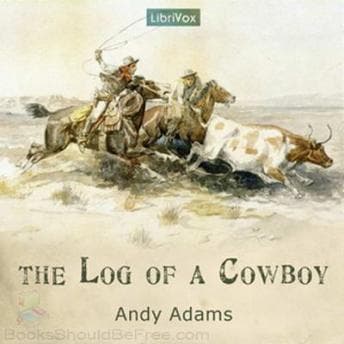
Andy Adams wrote The Log of a Cowboy in 1903 because he was sick of the dime-novel garbage being published about cowboys—all gunfights and rescuing maidens and dramatic last stands. His response was to write a novel about what cattle driving actually was: monotonous, dangerous, backbreaking, and occasionally transcendent. And here's the thing. It works. It works the way Hemingway's fishing passages in The Sun Also Rises work—not because anything dramatic happens, but because the specificity of labor becomes its own kind of poetry.
The Dust Is the Story
Let me be honest about what this book is and isn't. It's a five-month cattle drive from Brownsville, Texas, to Montana in 1882. Three thousand head. That's the plot. There's no love interest waiting in Dodge City. There's no villain twirling his mustache at the pass. There are river crossings where you feel the current pulling at your horse's legs. There are stampedes described with the kind of clinical terror that only comes from someone who actually survived one—Adams doesn't dramatize the chaos, he catalogs it, and somehow that's worse. The campfire scenes are full of tall tales that sound exactly like the stories my Uncle Jerome tells at Thanksgiving: sixty percent true, forty percent performance, one hundred percent committed.
What surprised me most was how the book handles boredom. Adams doesn't skip over the empty days. He lets you sit in them. And after a while, you start noticing what the cowboys notice—the way grass changes as you move north, how you read weather by watching the cattle's behavior, the politics of who rides point versus drag. It's world-building, but the world already existed. Adams just remembered it with impossible clarity.
If you loved Lonesome Dove, this is its spiritual ancestor—except McMurtry gave you characters to fall in love with, and Adams gives you a job to do. The comparison is inevitable, and I think Adams actually wins on authenticity, though McMurtry wins on everything else that makes a novel a novel. Log of a Cowboy reads more like memoir wearing fiction's clothes.
Richard Kilmer Knows When to Get Out of the Way
The narrator understands that pause is punctuation. Kilmer's reading is steady, unshowy, and exactly right for this material. He doesn't try to turn Adams's prose into theater. He reads it the way you'd imagine a man telling this story by a fire—measured, with a hint of dry humor that surfaces in the right moments and disappears before it becomes a shtick.
His voice has a plainspoken quality that suits the text. When Adams describes the practical logistics of getting three thousand cattle across a swollen river—the precise order of the herd, the positioning of riders, the calculated risk—Kilmer delivers it with the same even authority you'd hear from a man who knows exactly what he's talking about and doesn't need to convince you. I can't point to a single moment where the narration called attention to itself, and for this book, that's the highest compliment.
At ten hours, it's a commitment, but it never felt padded. The prose deserves to be savored. I listened at 1.0x and didn't once feel the urge to speed up—partly because the rhythm of Adams's sentences has a cadence that rewards patience, and partly because rushing through descriptions of trail life defeats the entire purpose of the book.
Who This Ride Is For (And Who Should Stay in Town)
This is for readers who love process. If you're the kind of person who watches videos about how things are made, who reads The Worst Journey in the World or Two Years Before the Mast for pleasure, who finds beauty in competence described plainly—this is your book. My students would hate this. I love it. Though I'll admit, the last time I recommended a slow, process-driven read to anyone outside this podcast, it did not go well—I wrote up my thoughts on Chicken Sisters, which is about as far from cattle drives as you can get, and even that had some readers telling me it moved too slowly.
But if you need plot momentum, character arcs, or anything resembling a traditional narrative structure, you're going to struggle. This isn't a novel in the modern sense. It's a record. A gorgeous, meticulous record of a world that was already vanishing when Adams sat down to write about it.
The Kind of Book That Teaches You to Pay Attention
I keep thinking about Adams writing this out of frustration—watching his lived experience get turned into cheap entertainment and deciding to set the record straight. There's something deeply familiar about that impulse. Every English teacher knows it. Every time a kid tells me The Great Gatsby is "just about a rich guy who throws parties," I feel a small version of what Adams must have felt reading those dime novels.
The Log of a Cowboy isn't exciting. It's something better. It's true. And in audio, with Kilmer's unhurried voice and ten hours of open sky, it becomes the kind of listening experience that changes how you see a genre. Worth pausing the faculty meeting for.